African Vehicle Import Tax Rules by Country

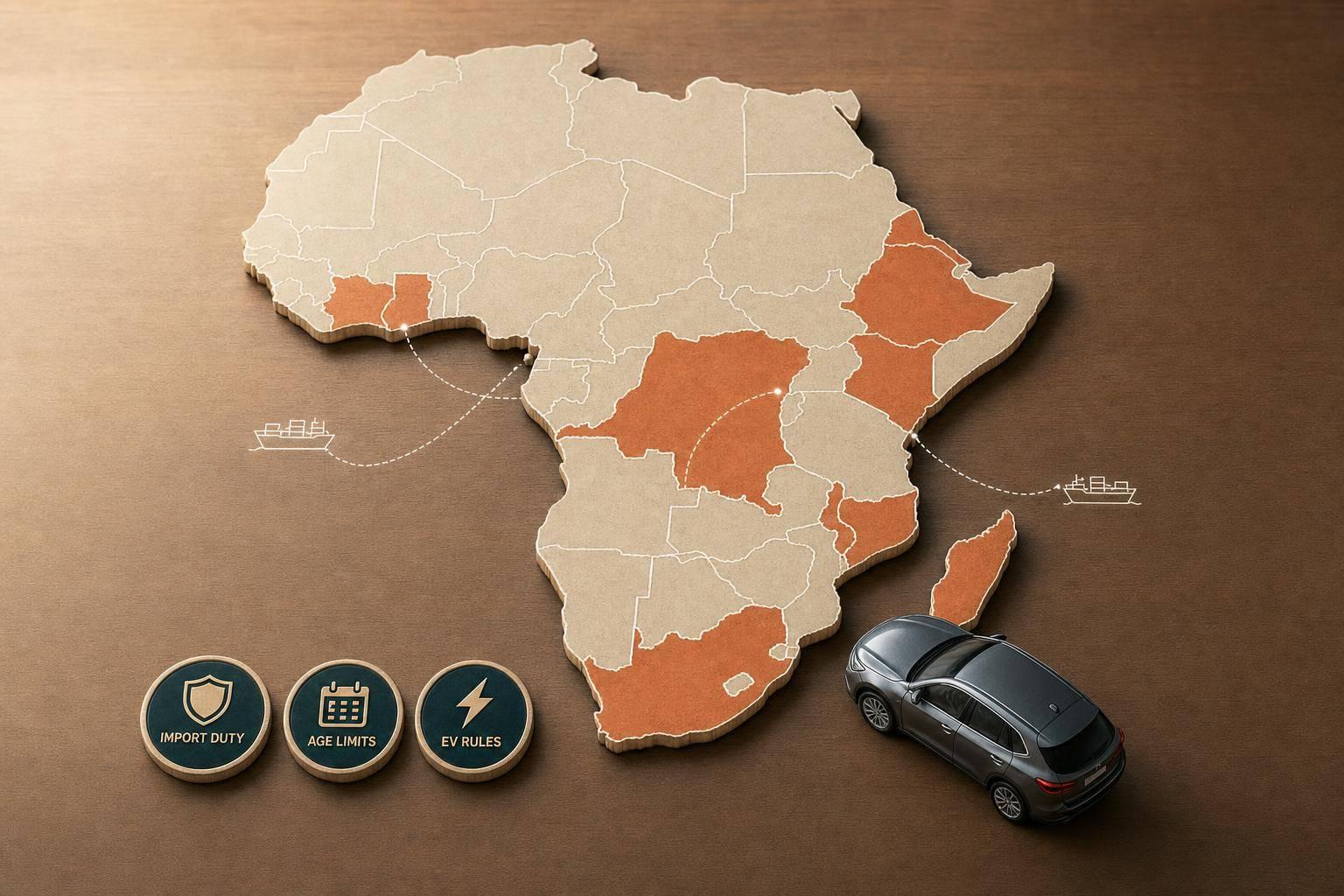
African Vehicle Import Tax Rules by Country
The same car can face a very different import bill across Africa. In this 7-country comparison, I found three things that shape cost most: CIF/customs value, vehicle age, and EV or hybrid rules.
If you import into Ghana, Uganda, Rwanda, South Africa, Nigeria, Tanzania, or Egypt, here’s the short version:
- Ghana stacks many levies on top of duty
- Uganda leans hard on value, condition, mileage, and age-related charges
- Rwanda mixes customs value with emissions checks and lower rates for EVs/hybrids
- South Africa uses duty plus extra charges for some higher-value vehicles
- Nigeria leans on vehicle class, engine details, and fuel type
- Tanzania starts with CIF value and then adds duty, VAT, and excise
- Egypt is driven mainly by engine size, with duty as high as 135%, plus 14% VAT and a development fee
A few points stand out fast:
- Manufacturing year matters more than registration year in many cases
- Engine size is a big deal in Egypt and still matters in Nigeria and Tanzania
- Used vehicles often face more pressure than newer ones
- Rwanda stands out for EV and hybrid treatment
- Even a small data error in a VIN record can change tax class, eligibility, or both
Africa Vehicle Import Tax Comparison: 7 Countries at a Glance
Quick Comparison
Country Main tax driver Main added charges Age check EV/hybrid angle Ghana Customs value + layered levies VAT, NHIL, GETFund, AU, ECOWAS, EXIM Yes Limited in this overview Uganda Value, condition, mileage, age VAT, other levies tied to class/use Yes EVs may skip exhaust-emissions testing Rwanda Value + emissions compliance VAT and other charges Yes Lower-rate treatment noted South Africa Duty bands + vehicle type/value VAT, ad valorem excise on some vehicles Yes Fuel type affects treatment Nigeria Vehicle class + engine/fuel details VAT, NAC levy, other fees Yes Fuel type can affect treatment Tanzania CIF value + specs VAT, excise duty, other levies Yes Fuel type and CO2 still matter Egypt Engine displacement 14% VAT + 3%–8.5% development fee + table tax Yes Used EVs allowed if within age limit
If I were pricing a shipment before export, I’d check these fields first: manufacturing year, engine size, fuel type, CO2 g/km, and MSRP/CIF basis. Those five details do most of the work in this comparison.
sbb-itb-9525efd
1. Ghana
Ghana mixes value-based taxes with checks on vehicle age and emissions. It taxes imports by vehicle class, and customs may use MSRP, the invoice price, or an adjusted market value to set the vehicle’s value [2][3]. On top of that, importers may need to pay import duty, VAT, NHIL, GETFund, AU, ECOWAS, and EXIM levies.
Age and Emissions Rules
The tax bill is only part of the process. Used imports also have to clear compliance checks. Customs checks the vehicle’s age by confirming the manufacturing year through VIN decoding [1][4]. Emissions class matters too. A vehicle rated Euro 4, 5, or 6 may face different eligibility outcomes depending on the rules in force.
2. Uganda
Uganda leans more on vehicle valuation than flat levies. So the amount you pay usually depends on what the car is worth and what shape it’s in. Condition, mileage, and roadworthiness all play a part in the final import cost.
Import Duty Structure
Uganda starts with the vehicle’s MSRP and then adjusts that value based on condition, mileage, and regional market differences [2]. That means two cars with the same original sticker price may not be taxed the same way.
Other vehicle specs can also affect the tax or registration class, including:
- horsepower
- engine displacement
- cylinder count
- fuel type
- drivetrain [2]
Age and Compliance
The manufacturing year and the vehicle’s roadworthiness record can affect both valuation and import eligibility [2]. On top of that, emission standards such as Euro 4, Euro 5, and Euro 6, along with average CO2 emissions measured in g/km, are used to check compliance [1].
There’s also a hard stop for certain vehicle types. Junk, salvage, or dismantled vehicles can’t be titled or registered [5]. EVs, on the other hand, usually skip exhaust-emissions testing because they don’t produce tailpipe emissions [1].
3. Rwanda
Rwanda taxes vehicle imports based on a mix of vehicle specs, customs value, and emissions compliance. In plain English, it uses a value-plus-compliance model. Customs looks at what the vehicle is, what it costs, and whether it meets the country’s emissions rules. Those details shape both the duty calculation and the compliance review.
Import Duty Structure and Levies
For customs valuation, Rwanda may use the MSRP, the invoice price, and delivery charges [6][2]. VAT and other levies are then applied to that customs value.
Age and Environmental Restrictions
Rwanda checks a vehicle’s age using its manufacturing year [1]. It also reviews emissions rules, including Euro 4, Euro 5, and Euro 6, along with average CO2 emissions in g/km, to decide whether an imported vehicle meets compliance requirements [1].
4. South Africa
South Africa doesn’t rely on customs duty alone. It adds extra levies for some vehicle types, with higher-value vehicles getting closer scrutiny. That shifts the system away from a simple value-based charge and toward a mix of duty, class-based levies, and compliance checks.
Import Duty Structure
Luxury cars and large luxury crossovers/SUVs can face extra levies tied to market value [2]. Fuel type also plays a part in how imports are assessed, whether the vehicle is electric, plug-in hybrid, hybrid, gasoline, or diesel [7].
In plain terms, vehicle class, age, and fuel type all shape both the tax bill and whether the vehicle can be imported at all.
Age and Environmental Restrictions
Compared with the previous countries, South Africa puts more weight on vehicle class and levies linked to market value. It also uses the VIN to confirm the manufacturing year when applying age-based import controls [1].
On the emissions side, South Africa checks Euro 4, Euro 5, and Euro 6 compliance, along with average CO2 emissions measured in g/km [1].
5. Nigeria
Nigeria charges import duty, VAT, and other levies on imported vehicles. The amount you pay depends a lot on the vehicle class, such as light, medium, or heavy [7]. In plain English, Nigeria uses a class-based system, so vehicle type and fuel type do much of the heavy lifting when officials decide the import cost.
Import Duty Structure
Import duty starts with the vehicle class, then moves into technical details like engine displacement and the fuel delivery system [8][2]. Cylinder configuration can also affect classification for duty purposes. That means two vehicles that look similar at a glance may not be treated the same once the specs are checked.
VAT and Additional Levies
Nigeria applies VAT on top of other levies. These charges can include taxable horsepower, which is used for registration and import fees [2]. So the final amount isn't just about customs duty alone.
Age and Environmental Restrictions
Nigeria also enforces age-based import limits, and authorities pay close attention to the manufacturing year [1]. This is one reason VIN or plate decoding matters so much. It helps confirm details like vehicle class, engine setup, and fuel type, all of which can affect duty treatment.
EV and Hybrid Treatment
Fuel type can change the way an imported vehicle is handled. Nigeria separates Electric, Plug-in Hybrid, Hybrid, Gasoline, and Diesel vehicles under its import rules [7].
That distinction matters because fuel type can affect duty treatment and whether a vehicle qualifies for an exemption. Checking the exact fuel type through VIN decoding before shipment can help you pin down the right classification and avoid problems at import [7][1].
6. Tanzania
Tanzania begins vehicle import tax calculations with the CIF value [1].
Import Duty Structure
Import duty is worked out using vehicle-specific details like the manufacturing year, engine displacement (cc), fuel type, and CO2 emissions [1][2]. Those details directly affect the assessment, which is why VIN decoding matters before shipment. It helps confirm the manufacturing year and can prevent problems at clearance. The same inputs can also affect VAT and excise duty.
VAT and Additional Levies
Import duty isn’t the only cost in play. VAT and excise duty may also apply, and taxable horsepower can push the total tax bill higher [2].
Environmental Compliance
Tanzanian authorities also look at emission standard ratings such as Euro 4, Euro 5, and Euro 6, along with average CO2 emissions (g/km), when judging a vehicle’s environmental performance [1]. Those same data points matter for electrified vehicles too.
EV and Hybrid Treatment
For EVs and hybrids, assessment still depends on factors like fuel type, CO2 emissions, and taxable horsepower [1][2].
7. Egypt
Egypt is one of the clearest examples of a displacement-first import tax system. For passenger cars, the main factors are engine size and fuel type.
Import Duty Structure
Egypt starts with engine-displacement brackets, then adds other taxes and levies on top.
Category Engine Size Customs Duty Table Tax VAT Development Fee Category 1 Up to 1,600cc 40% 1% 14% 3% Category 2 1,600cc – 2,000cc 135% 15% 14% 5% Category 3 Over 2,000cc 135% 30% 14% 8.5%
A small change in engine size can have a huge effect on total import cost. Once a car moves into a higher bracket, the customs duty and other charges jump fast.
VAT and Additional Levies
VAT is 14% for all three categories. On top of that, the development fee runs from 3% to 8.5%.
That means larger-engine vehicles get hit from more than one angle. It’s not just the customs duty that goes up. The added fees stack on, which can make imports in the upper brackets far more expensive.
Age and Environmental Restrictions
Tax is only part of the picture. Egypt also restricts used ICE passenger cars. They can’t be imported unless they are first-owner, same-model-year imports.
That rule matters because a car might clear the tax side but still fail on import eligibility.
EV and Hybrid Treatment
Used electric vehicles can be imported if they are no more than three years old. For EVs and hybrids, classification depends on fuel_type and electrification_level [1][9].
In plain terms, paperwork and vehicle data matter a lot here. If those fields are wrong before shipment, the vehicle can end up in the wrong class, and that can change both eligibility and cost.
How the 7 Countries Compare
Once you line up the country profiles, the big split is pretty simple: each country taxes vehicles based on different traits. And that can swing the landed cost of the exact same car by a lot.
Some countries lean hard on vehicle age. Others care more about engine size, customs value, or a stack of layered charges. So a car that looks affordable on paper can get expensive fast once it hits port.
Country Main Cost Driver Key Levies EV/Hybrid Treatment Ghana ECOWAS layered levies Import Duty, VAT, NHIL, ECOWAS Levy None noted Uganda Vehicle age Environmental Levy, Infrastructure Levy, VAT None noted Rwanda Green incentives Reduced rates for EVs/Hybrids, VAT Yes South Africa Duty bands Ad Valorem Excise Duty, Customs Duty, VAT None noted Nigeria Category-specific rules Import Duty, NAC Levy, VAT None noted Tanzania Engine size and age Excise Duty, VAT, Railway Development Levy None noted Egypt Engine displacement bands Customs Duty, Development Fee, VAT None noted
That difference matters in practice. A used mid-size sedan can fall into very different tax brackets depending on whether the country puts the most weight on age, engine displacement, or emissions.
A few patterns stand out:
- A used mid-size sedan gets hit hardest in Uganda, Ghana, and Egypt
- Rwanda is lighter on EVs and hybrids
- A new mid-size sedan in South Africa tends to face a middle-range tax load tied to duty bands and customs value
Scenario Country Main Cost Pressure Primary Reason Used mid-size sedan Uganda Heavy Age-based environmental and infrastructure levies Used mid-size sedan Ghana Heavy Layered levies Used mid-size sedan Egypt Heavy Engine-displacement bands, VAT, and development fee EV or hybrid passenger car Rwanda Lower Green incentive rates New mid-size sedan South Africa Medium Duty bands and VAT based on vehicle category and customs value
This is where pre-shipment data helps. CarsXE can decode VINs and return fuel_type, engine_size, avg_co2_emission_g_km, and manufacturer_suggested_retail_price, which helps importers estimate landed cost before shipment [1][3].
Pros and Cons by Country
The comparison above shows how these markets tax vehicles by age, engine size, vehicle value, or a mix of factors. Here, the goal is simpler: turn those rules into practical trade-offs you can use.
Some countries are easier to price upfront because the tax base stays fairly predictable. Others can swing more based on the vehicle itself, which makes early cost estimates a bit trickier.
Country Pro Con Ghana Layered levy structure is well-documented, which makes total duty easier to estimate before shipment Multiple stacked levies, including VAT, NHIL, GETFund, and ECOWAS, mean even small valuation errors can snowball fast Uganda Condition and mileage adjustments can help lower-value vehicles attract lower duty Age-based environmental and infrastructure levies can add a lot of cost to older imports Rwanda Reduced rates for EVs and hybrids make it one of the lower-cost markets for electrified vehicles Customs valuation draws on MSRP, invoice price, and delivery charges, so results can vary from one shipment to another South Africa Duty bands are linked to vehicle category and customs value, giving importers a fairly clear pricing setup Luxury and high-value vehicles face extra ad valorem excise duty on top of standard customs charges Nigeria Class-based duty structure makes cost estimation fairly direct once the vehicle category is confirmed Engine displacement, cylinder configuration, and taxable horsepower all shape final duty, which adds classification work Tanzania CIF-based calculation gives importers a consistent starting point for duty estimates Excise duty, VAT, and railway development levy all stack on top of import duty, and taxable horsepower can drive totals up Egypt Engine-displacement brackets are clearly defined, so rates are easier to predict once engine size is known Used ICE passenger cars face strict eligibility rules, and larger-engine vehicles get hit with stacked fees across multiple categories
In plain English, Ghana, South Africa, and Tanzania are often easier to model at the start because their pricing logic is more structured around customs value or set levy layers. By contrast, Uganda, Nigeria, and Rwanda can call for more vehicle-level detail, whether that's age, mileage, engine setup, or how customs arrives at value.
That difference matters. If you're pricing inventory, planning landed cost, or comparing markets side by side, a country with a simple framework can save time. But a market with more moving parts can still work in your favor if the vehicle fits the rules well.
Conclusion
Across these seven countries, import cost usually comes down to three main levers: stacked levies, age penalties, and EV or hybrid incentives. Ghana and Uganda show how age-based penalties can push costs up fast, while South Africa, Nigeria, Tanzania, and Egypt lean more on engine size, fuel type, and other vehicle specs. That means early pricing is fairly simple in some markets and much harder to pin down in others.
Before you buy or ship a vehicle, verify the manufacturing year, engine size, fuel type, and emission standard. Even a one-year gap can move a car into a higher penalty bracket, and CO2 ratings in g/km can affect eligibility or emissions-based charges [1][3]. CarsXE's VIN decoding tools can help surface those details.
Tax rules and customs values change often, so it’s smart to confirm the latest requirements before importing.
FAQs
Which country is usually cheapest for EV imports?
The available information doesn’t identify which African country is the cheapest for EV imports.
If you want country-specific vehicle data for markets like Nigeria, South Africa, and Tunisia, CarsXE offers vehicle specs and market value insights that can help you compare import costs.
Why does the manufacturing year matter so much?
The manufacturing year matters because it has a direct impact on a vehicle’s market value. As a car gets older, depreciation tends to lower its price, while buyer demand and past pricing trends also shape what the vehicle is worth.
It’s also a standard detail used alongside the make and model to identify vehicle-specific information. On top of that, it helps keep records consistent and supports regulatory compliance across different jurisdictions.
What vehicle details should I verify before shipping?
Before shipping, verify the main vehicle details for accuracy and compliance. That includes the VIN, make, model, registration year, and trim level.
You should also confirm the engine size, fuel type, transmission, and body style. On top of that, check for safety recalls and review the vehicle history.
These checks help keep records standardized and make international logistics run more smoothly.
Related Blog Posts
- Top Tools for Africa VIN Decoding
- Electric Vehicle Tax Incentives in Thailand: 2026 Update
- Cross-border EV Trends in Emerging Markets
- Vehicle Import Rules: Emissions Compliance by Region