Future of Synthetic Data in Vehicle OCR

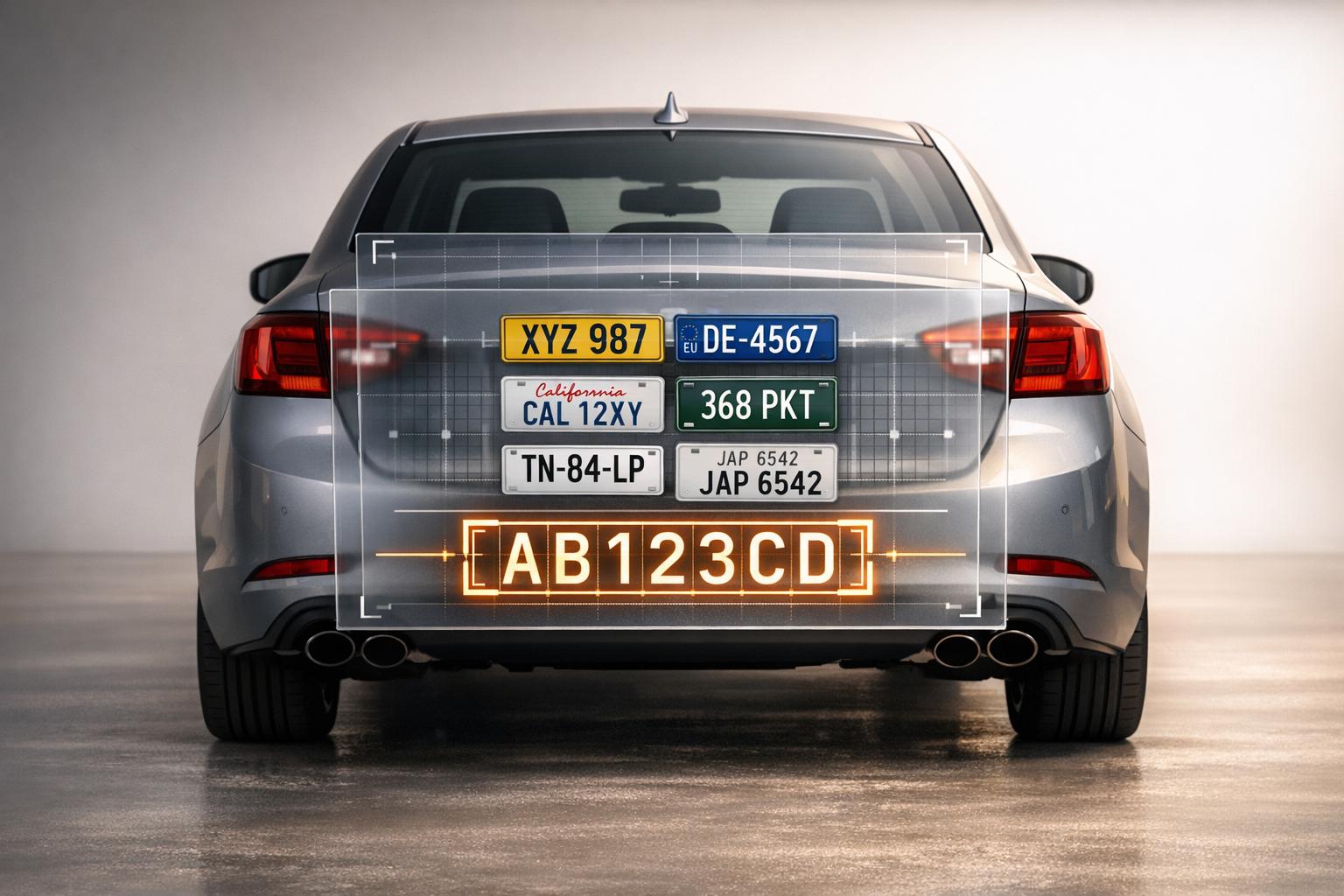
Future of Synthetic Data in Vehicle OCR
Synthetic data, created by computers to mimic real-world data, is transforming how Optical Character Recognition (OCR) systems for vehicles are trained. Instead of relying on costly and privacy-limited real-world data, synthetic data allows developers to generate massive, customizable datasets at a fraction of the cost. Here's why it matters:
- Cost Savings: Producing synthetic data is far cheaper than collecting and labeling real-world data, which can cost $0.86 per segment for labeling alone.
- Improved Accuracy: Studies show adding synthetic data to training sets can improve OCR accuracy by up to 3%.
- Scalability: Synthetic datasets can include rare scenarios like damaged plates or unusual lighting, ensuring OCR systems handle diverse situations.
- Privacy Compliance: Synthetic data avoids legal issues since it doesn’t involve real personal information.
Key techniques include template-based generation, GANs (Generative Adversarial Networks), and domain randomization, which simulate real-world variations like lighting and weather. Companies like CarsXE already use synthetic data to power OCR systems across 50+ countries, highlighting its practical value.
Synthetic data is reshaping vehicle OCR by cutting costs, boosting performance, and solving privacy challenges. It’s no longer experimental - it’s an essential tool for global OCR solutions.
Methods for Creating Synthetic Data for Vehicle OCR
When it comes to training OCR systems for vehicles, synthetic data offers a practical solution to tackle challenges like limited access to real-world datasets, privacy concerns, or the need for high-quality images. Here’s a closer look at some techniques used to generate synthetic data for vehicle OCR training.
Template-Based Data Generation
This method relies on creating data programmatically using predefined templates. By simulating various license plate designs, fonts, character arrangements, and backgrounds, it equips OCR models to handle a wide range of real-world scenarios. The process often involves applying transformations such as shifting, rotation, zooming, shearing, or mirroring to amplify diversity.
For instance, even simple pixel shifts have been shown to significantly improve OCR performance. In vehicle OCR, template-based techniques can produce a wide array of license plate variations, including different state designs, international formats, and rare character combinations that might not commonly appear in real-world datasets. Given its scalability and low cost, this approach is ideal for generating diverse datasets without the need for extensive data collection efforts.
Using GANs to Create Synthetic Data
Generative Adversarial Networks (GANs) take a different approach by learning from existing data patterns to create entirely new, realistic images. Unlike templates, GANs can replicate complex real-world details like lighting, camera angles, and environmental factors.
In November 2020, researchers Vinay Kukreja, Deepak Kumar, and their team demonstrated the power of GANs by generating high-resolution images from low-resolution vehicle license plates. Paired with a CNN for classification, their system achieved an impressive 99.39% recognition accuracy. As the researchers noted:
"GAN helps to create high-resolution images from a single low-resolution image".
GANs are particularly effective for creating rare or challenging scenarios - such as damaged plates, unusual weather conditions, or specific camera perspectives - that are often missing from real-world datasets. This makes them invaluable for training OCR systems to handle edge cases.
Domain Randomization and Noise Addition
This technique focuses on introducing controlled variations and noise into synthetic datasets to improve the robustness of OCR models. By altering lighting, adding blur or distortion, simulating weather effects, or introducing background distractions, domain randomization ensures that models can generalize better to real-world conditions.
For example, a study applying domain randomization to Ukrainian license plates showed a marked improvement in recognition accuracy. By incorporating such controlled variations, this approach helps OCR systems adapt to the unpredictable nature of real-world environments, reducing the risk of overfitting to specific scenarios.
sbb-itb-9525efd
Benefits of Synthetic Data for Vehicle OCR
Benefits of Synthetic Data for Vehicle OCR: Cost, Accuracy, and Speed Comparison
Synthetic data brings a range of advantages to vehicle OCR systems, addressing cost, performance, and development challenges head-on.
Lower Costs and Easy Scaling
Creating synthetic data is far more cost-effective compared to traditional methods like crowdsourcing, manual photography, or field surveys. Conventional approaches demand significant resources - physical measurements, extensive manual labeling, and months of effort - all of which add up quickly. Synthetic data generation, on the other hand, produces labels simultaneously with the images, cutting out the need for expensive human annotation altogether.
The scalability of synthetic data is another game-changer. Once a generation pipeline is in place, producing a million labeled images costs virtually the same as generating just ten. This approach enables developers to generate an almost unlimited amount of training data, which would be unfeasible to achieve through real-world data collection.
Additionally, synthetic data avoids the legal hurdles of privacy regulations like GDPR, which restrict access to real license plate datasets. Since synthetic plates are entirely fabricated, they contain no personal data, eliminating the need for compliance with privacy laws or handling sensitive information.
Better Model Performance and Accuracy
Synthetic data goes beyond cost savings - it actively enhances OCR model performance. By creating rare and challenging edge cases, such as damaged plates or unusual lighting conditions, synthetic data equips models to handle scenarios that are hard to find in real-world datasets.
The results speak for themselves. Research conducted in August 2024 by Shuhao Guan and Derek Greene at University College Dublin found that synthetic data using glyph similarity techniques reduced Character Error Rates (CER) by 12.41% to 48.18% across multiple languages. Furthermore, studies have shown that combining synthetic data with real-world datasets can boost accuracy by up to 3%.
These improvements are possible because synthetic data can be tailored to address specific weaknesses. For example, around 87.9% of OCR mapping errors arise from confusing visually similar characters, such as '0' and 'O'. Synthetic data can systematically generate examples that tackle these issues, something that real-world data often fails to capture consistently. This targeted approach not only improves accuracy but also speeds up the overall development process.
Faster Development and Deployment
Synthetic data accelerates development timelines significantly. Instead of spending months collecting and labeling thousands of images, developers can generate complete datasets in just days - or even hours. The labels are pixel-perfect because they are created directly from the image generation process.
This approach eliminates the inconsistencies and errors commonly associated with manual annotation, particularly when defining field boundaries. As the SymageDocs team highlights:
Because the data was generated rather than collected, the labels aren't estimates. The label is the source of truth the document was built from.
The privacy-friendly nature of synthetic data also simplifies development. Teams can work freely in non-production environments without needing to anonymize data or navigate complex regulatory requirements. This freedom allows for quicker iteration, broader testing, and faster deployment of OCR solutions - all without the delays tied to handling sensitive vehicle data.
Benefit Impact on Development Measured Result Cost Reduction Eliminates manual data collection and annotation Unlimited dataset expansion at minimal cost Accuracy Improvement Addresses specific error patterns and edge cases 12.41% to 48.18% CER reduction Speed to Market Pixel-perfect labeling during image creation 3% accuracy improvement over baseline Privacy Compliance No GDPR or privacy concerns Unrestricted development environment
Future Trends in Synthetic Data for Vehicle OCR
The development of vehicle OCR technology is moving toward hybrid data approaches, advanced generative models, and strategies for global deployment. These trends include combining real and synthetic data, improving GANs for international license plates, and practical applications like those implemented by CarsXE.
Combining Real and Synthetic Data
Future OCR models are increasingly using a mix of real and synthetic datasets to balance authenticity with scalability. Hybrid datasets have proven effective because they merge the realism of actual images with synthetic data's ability to cover edge cases. For example, a study from January 2025 showed that adding pseudolabeled synthetic data to real datasets boosted accuracy by 3%. This pseudolabeling process involves using models trained on real-world images to label synthetic data, creating a bridge between the two while retaining cost-efficiency and privacy benefits. These approaches are setting the stage for more advanced generative methods tailored to specific use cases.
Improved GANs for International License Plates
Generative Adversarial Networks (GANs) are evolving to tackle the complexities of international license plate formats. Advanced techniques, such as DeblurGANv2, are addressing challenges like low-light conditions, long-distance captures, and damaged plates. Building on earlier methods by Kukreja and Kumar, these GAN improvements are making OCR systems more adaptable to diverse scenarios.
Style transformation is becoming a key focus area. By aligning synthetic data with the visual characteristics of real-world images - factoring in sensor noise, lighting, and other variables - researchers like Il-Sik Chang and Gooman Park have demonstrated performance gains. Their work showed an increase in license plate detection performance from 0.614 mAP to 0.679 mAP, while image enhancement techniques like DeblurGANv2 improved detection rates from 0.872 to 0.915. Beyond GANs, diffusion models are emerging as a strong alternative for generating complex character distributions across languages and formats. These models are particularly useful for creating datasets that include both legacy and modern plate designs, which are often hard to source in equal quantities from real-world data. These advancements are already being applied in practical, global contexts.
How CarsXE Uses Synthetic Data for Vehicle OCR
CarsXE leverages synthetic data to enhance its license plate decoding and VIN recognition features across more than 50 countries. By using hybrid training methods that combine real-world vehicle data with synthetic edge cases, CarsXE ensures its OCR technology performs well across various lighting conditions, plate designs, and formats. The platform's Plate Image Recognition and VIN Optical Character Recognition APIs benefit from synthetic data's ability to simulate rare scenarios - like damaged plates, unusual fonts, or international formats - that are difficult and expensive to collect through traditional means. This approach allows CarsXE to maintain high accuracy rates while avoiding the privacy issues tied to storing real license plate images, demonstrating how synthetic data translates into practical, efficient, and globally scalable OCR solutions.
Conclusion
Synthetic data plays a key role in advancing vehicle OCR technology. It addresses major hurdles like privacy concerns, limited data availability, and high costs - issues that have historically hindered OCR progress. By generating realistic license plate images programmatically, companies can train their models without breaching GDPR regulations or handling sensitive personal data.
The impact on performance is clear. Studies reveal that adding synthetic data to training sets can improve recognition accuracy by up to 3%, achieving rates as high as 99.39%. These improvements directly translate into better business outcomes.
Beyond accuracy, synthetic data offers practical benefits for automotive businesses. It drastically reduces the time and expense associated with manual data annotation. Generating millions of labeled records costs no more than producing just ten. This scalability is especially crucial for global deployments, where gathering real-world data for dozens of license plate formats would be cost-prohibitive.
Emerging techniques like glyph similarity modeling and diffusion models are further enhancing the realism and utility of synthetic datasets, particularly for low-resource languages and unique regional formats. These advancements highlight synthetic data's growing importance in shaping the future of vehicle OCR. CarsXE's successful implementation across more than 50 countries demonstrates that synthetic data is no longer experimental - it’s a proven solution for building robust, scalable OCR systems capable of handling diverse real-world scenarios.
FAQs
How much real data do I still need if I use synthetic data for vehicle OCR?
Synthetic data offers a practical way to cut down on the need for large volumes of real-world data when training vehicle OCR models. Research indicates that blending synthetic data with even a small portion of real-world data can boost model accuracy. By using high-quality synthetic images and methods like domain randomization, it's possible to improve performance while reducing dependence on extensive real-world datasets. This approach not only streamlines the training process but also helps lower costs. However, the exact amount of real data required will vary based on the specific model and application.
How do you make synthetic license plate images match real camera conditions?
To make synthetic license plate images align with real camera conditions, the generation process needs to account for real-world elements like blur, noise, lighting variations, and perspective distortions. Tools like diffusion models and GANs are used to recreate these effects. Additionally, post-processing techniques - such as applying motion blur, introducing Gaussian noise, and tweaking brightness - help create images that closely mimic those taken by real cameras. This approach enhances their usefulness for training recognition systems.
What’s the best way to validate synthetic-trained OCR in the real world?
To ensure synthetic-trained OCR performs effectively in practical scenarios, it's crucial to pair rigorous benchmarking with real-world testing. Start with diverse datasets that mirror actual conditions, including challenging edge cases, which can be simulated using synthetic data. Combining synthetic and real-world data strengthens the model's performance and adaptability. Additionally, iterative testing - fine-tuning the model with real-world data after initial synthetic training - helps maintain accuracy and reliability in real-world applications.
Related Blog Posts
- How to Choose an OCR Engine for Vehicle Data
- Study: OCR Accuracy in Vehicle Data Processing
- AI Noise Reduction in License Plate OCR
- RNNs for Vehicle License Plate Recognition