Phishing in OBD Systems: Case Studies

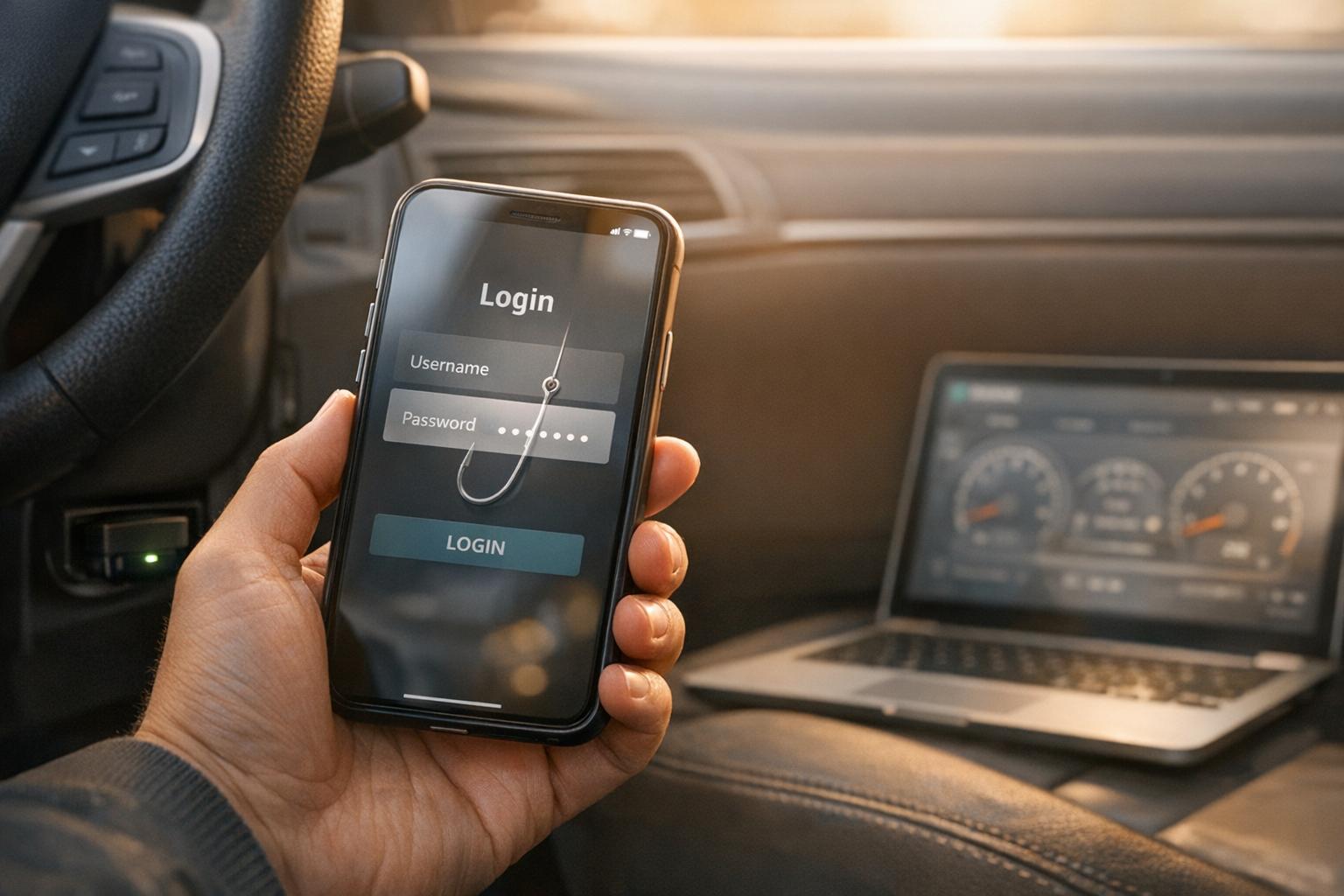
Phishing in OBD Systems: Case Studies
Phishing attacks on On-Board Diagnostics (OBD) systems are an emerging threat, targeting vehicles through social engineering tactics like fake apps, emails, and Wi-Fi networks. These attacks exploit weaknesses in OBD hardware, apps, and cloud platforms, potentially leading to data theft or even physical control of vehicles. Key findings include:
- Attack Methods: Fake apps, spoofed Wi-Fi networks, and phishing emails trick users into sharing credentials or installing malicious software.
- Vulnerabilities: Weak PINs, poor authentication, and unsecured firmware updates allow attackers to access critical vehicle systems.
- Real-World Examples: Cases like the Bosch Drivelog breach and Tesla "Phone Key" exploits demonstrate the risks of phishing in connected vehicles.
- Impact: Stolen data, compromised vehicle control, and fleet-wide disruptions are possible outcomes.
Key Solutions:
- Require physical authentication (e.g., key cards) for new device pairing.
- Use stronger PINs, encrypted firmware updates, and real-time alerts for suspicious activities.
- Implement strict filters to block unauthorized commands on the vehicle's CAN bus.
Phishing in OBD systems highlights the need for layered security measures to protect vehicles and their users.
Common Phishing Patterns Targeting OBD Users
Attack Surfaces in OBD Systems
OBD systems have three main components that attackers often exploit: the physical dongle, the mobile app, and the cloud dashboard. Each plays a role in accessing and managing vehicle data, but each also introduces its own vulnerabilities.
The dongle, which connects to the OBD-II port, is commonly the weakest point. Aftermarket OBD-II devices often pass data from their wireless interfaces - like Bluetooth or Wi-Fi - directly to the vehicle's CAN bus. Without proper filtering, this opens the door for hackers to send dangerous commands to critical systems like brakes or steering. To make matters worse, authentication is often poorly implemented. Many dongles rely on insecure Bluetooth pairing or short PINs that can be cracked through brute-force attacks.
Social Engineering Tactics Used Against OBD Users
Not all attacks require technical wizardry. Sometimes, the easiest way in is through social engineering - tricking users into taking actions that compromise their security. These tactics often exploit vehicle owners’ concerns about safety, savings, or maintenance.
One striking example took place in March 2024, when researchers Tommy Mysk and Talal Haj Bakry demonstrated a clever phishing scheme. They set up a rogue Wi-Fi network called "Tesla Guest" near a Tesla Supercharger station. Using a small hacking device, they broadcast this fake network to nearby drivers. Unsuspecting victims who connected were prompted to log in to what appeared to be a Tesla account page. The researchers captured not only passwords but also 2FA one-time passwords (OTPs) in real time.
"Adding a new Phone Key through the app does not require the car to be unlocked or the smartphone to be inside the vehicle, which makes for a significant security gap." - Tommy Mysk, Security Researcher
The table below illustrates how different OBD attack surfaces align with common social engineering tactics:
Attack Surface Social Engineering Tactic Psychological Trigger Public Wi-Fi Spoofing "Tesla Guest" or service center SSIDs Familiarity and trust Mobile Apps Fake firmware or "vehicle health" update alerts Urgency and authority Cloud Dashboards Phishing emails about account "security" or billing Fear and compliance OBD-II Dongle Impersonating insurance or maintenance providers Financial incentive (discounts)
These tactics are designed to gain access to accounts, vehicles, and sensitive data.
What Attackers Are After
The ultimate goals of these attacks typically fall into three categories: account access, vehicle control, and sensitive data.
Stealing account credentials is often just the beginning. Once inside a Tesla account - or any connected vehicle system - an attacker can register their own smartphone as a "Phone Key." This gives them Bluetooth-based access to unlock and even drive the vehicle, all without the owner realizing a new key has been added. Mysk and Haj Bakry’s research showed how this can happen from just a few meters away.
Beyond account access, attackers target GPS data, trip histories, VINs, and diagnostic information. These can be used for fraud, surveillance, or even resold. In the most extreme cases, hackers aim to gain direct CAN bus access, allowing them to inject commands that control how the vehicle operates - posing serious safety risks.
sbb-itb-9525efd
Case Study 1: Phishing via Malicious OBD Apps
Background and Attack Setup
In February 2017, the Argus Research Team uncovered a major vulnerability in the Bosch Drivelog Connector, a widely used OBD-II dongle that allowed drivers to monitor their vehicle's health through an Android app. The attack targeted the trust users placed in the system.
Attackers exploited this trust by impersonating the Drivelog app or sending phishing messages disguised with Bosch's branding. These messages tricked users into downloading a compromised app. Since users are accustomed to accepting diagnostic updates, they were more likely to fall for the deception. This initial breach set the stage for deeper manipulation of the vehicle's diagnostic system.
How the Attack Unfolded
Once the tampered app was installed, the attack unfolded in several steps. When the dongle connected via Bluetooth, it broadcast a certificate containing its MAC address, public key, and a SHA256 hash. This information enabled an offline brute-force attack on the dongle's 8-digit PIN. While 100 million combinations might sound like a lot, a modern laptop could crack it in just 30 minutes.
"The information leak allowed us to quickly brute-force the secret PIN offline and connect to the dongle via Bluetooth." - Argus Research Team
After the PIN was cracked, the attacker could authenticate to the dongle and inject commands directly into the vehicle's CAN bus, which controls critical functions. Although the dongle had filters to block standard diagnostic PIDs, attackers bypassed these by using proprietary OEM codes that the filters didn’t recognize. This allowed unrestricted access to critical vehicle systems, showing how phishing-induced app compromises could exploit weaknesses in built-in security defenses.
Impact and Lessons Learned
The Argus team tested their findings on a real vehicle.
"We successfully exploited the vulnerability in the Drivelog dongle to send a CAN bus message that shut down the car's engine while the car was in motion." - Argus Research Team
The vulnerabilities were disclosed to Bosch on February 20, 2017, and Bosch responded by introducing a two-step verification process for registering new users to a device. While this fix improved security, it came after researchers had already demonstrated the potential for catastrophic consequences, such as shutting down a moving vehicle.
This case highlights a critical takeaway: the app itself is a key attack surface. Attackers don’t need to compromise the dongle directly; they only need to trick users into installing a malicious app. From there, weaknesses in the dongle’s authentication system can be exploited. Developers working on OBD systems must prioritize secure app vetting processes and robust authentication mechanisms. Features like stronger Bluetooth pairing protocols, longer PINs, and better certificate design should be treated as essential security measures, not afterthoughts. This case demonstrates how phishing attacks can turn routine trust into a gateway for breaching vehicle systems.
Case Study 2: Phishing Targeting Cloud-Connected OBD Dashboards
Attack Scenario and Goals
Unlike the Bosch Drivelog case, which focused on app-layer vulnerabilities, cloud-connected OBD dashboards present a much broader attack surface. This is particularly alarming in fleet management, where a single breach can jeopardize multiple vehicles.
In March 2024, security researchers Talal Haj Bakry and Tommy Mysk highlighted this risk by spoofing a "Tesla Guest" network at a Supercharger station using a Flipper Zero device. Their target? Tesla Model 3 owners. When a driver unknowingly connected to the fake network, the attackers intercepted both account credentials and the one-time password (OTP), effectively bypassing Multi-Factor Authentication.
But credential theft was just the starting point. Once inside a Tesla account, the researchers added a new "Phone Key" to the vehicle without notifying the legitimate owner. This gave them full access to unlock and drive the car. The implications of such a breach are far-reaching, as outlined below.
Consequences of the Attack
In fleet settings, breaches of this nature can lead to serious tracking and control vulnerabilities. With admin-level access to a cloud OBD dashboard, attackers can monitor the real-time location of all connected vehicles. Worse, they can send harmful commands through the vehicle's CAN bus, potentially disrupting key functions like acceleration, braking, or engine operation.
Beyond direct vehicle manipulation, compromised dashboards pose significant operational risks. Fleet operators could face service shutdowns, supply chain interruptions, and logistical chaos. Since attackers often exploit legitimate tools rather than deploying obvious malware, these breaches can remain undetected for extended periods. This makes proactive security measures absolutely essential.
"The researchers argue that requiring a physical Tesla Card Key when adding a new Phone Key would improve security by adding an authentication layer for the new phone." - Bill Toulas, Tech Writer, BleepingComputer
How to Prevent This Type of Attack
Preventing such attacks starts with strengthening authentication and monitoring processes. Tesla's research underscores the importance of hardware-backed authentication. For instance, requiring a physical Tesla Card Key to authorize new devices would have completely blocked this attack. Software-only OTPs, while useful, are vulnerable to interception through Man-in-the-Middle (MiTM) tactics, making them insufficient.
Additional layers of protection include:
- Rigorous API access controls and constant dashboard monitoring.
- Alerts for suspicious activity, such as logins from unusual locations, off-hours access, or new device registrations, sent to both the mobile app and the vehicle's internal display.
- OBD-specific firewalls at the dongle interface to restrict CAN bus messages to a predefined set of diagnostic PIDs, minimizing risk even if credentials are compromised.
"Automotive cyber security requires multi-layered solutions. While it is clear that cryptography will play a large role in the future of automotive security, it cannot be relied upon to protect against all attacks." - Alisa Esage G, Cyber Security Solutions Architect
Case Study 3: Phishing for OBD Firmware Updates
How Attackers Exploited Firmware Updates
Firmware updates are essential for securing OBD dongles, but they can also create new vulnerabilities. Back in August 2015, researchers uncovered a critical flaw (CVE-2015-2908) in MDI C4 OBD-II dongles, like the Metromile Pulse. These devices, running firmware versions 2.x and 3.4.x, failed to validate firmware updates properly. According to NIST's National Vulnerability Database:
"do not validate firmware updates, which allows remote attackers to execute arbitrary code by specifying an update server."
This oversight earned the vulnerability a CVSS 2.0 base score of 9.0 (High). Attackers exploited this by redirecting devices to fake update servers. Combined with forced-update policies, users were essentially tricked into installing malicious firmware, leading to severe hardware-level risks.
What Happens When Firmware Is Compromised
Once malicious firmware takes over, the attacker gains full control of the device. A compromised dongle can override its own message filters, enabling unauthorized frames to be injected directly into the vehicle's CAN bus. This goes beyond mere data theft - it’s a direct threat to physical safety. Security researchers have even demonstrated the consequences:
"The vulnerabilities allowed us to stop the engine of a moving vehicle using the Drivelog platform." - Argus Research Team
The risks extend further. Attackers could disrupt critical vehicle functions like braking or acceleration, steal sensitive data, or even permanently disable the dongle.
Securing the Firmware Update Process
The MDI vulnerability highlights several critical measures to safeguard firmware updates:
- Cryptographically sign all firmware updates and verify signatures before installation.
- Encrypt updates during transmission and use mutual TLS for secure communication between the server and device.
- Store signing keys in a dedicated Hardware Security Module (HSM) for high-risk deployments.
- Add an out-of-band verification step, such as email or mobile push confirmation, before installing updates.
As the Argus Research Team emphasized:
"Automotive cyber security requires multi-layered solutions. While it is clear that cryptography will play a large role in the future of automotive security, it cannot be relied upon to protect against all attacks."
The lesson here is clear: no single solution can address every vulnerability, but combining robust cryptography with layered defense strategies significantly improves security.
Anatomy of a Phishing Attack
Patterns Across Cases: Phishing Tactics and OBD-Specific Risks
OBD Phishing Attack Surfaces, Tactics & Vulnerabilities Explained
Recurring Phishing Tactics in OBD Attacks
When examining the case studies, certain tactics used by attackers show up time and again. A standout method is brand impersonation - this includes mimicking an app store listing, creating fake cloud dashboard login pages, or setting up deceptive Wi-Fi networks like "Tesla Guest" at Supercharger stations. In each of these scenarios, attackers exploit the trust users place in familiar settings.
Another frequently observed strategy is real-time credential harvesting. Modern phishing setups don’t just collect login credentials - they also capture two-factor authentication (2FA) one-time passwords (OTPs) as they are entered. This allows attackers to bypass security protections before the OTP expires. For instance, in some cases, attackers used fake Wi-Fi networks to collect these credentials. They then registered new Phone Keys, enabling them to unlock and start vehicles without needing the physical key card.
These tactics underscore vulnerabilities that attackers exploit, which are rooted in technical flaws detailed below.
Technical Weaknesses in OBD Systems
The success of these phishing attacks isn’t just about social engineering. They also rely on specific technical weaknesses that make it possible to turn stolen credentials into actual vehicle access.
Vulnerability Type Technical Weakness Impact Authentication Leak PINs can be brute-forced offline using public pairing data Allows attackers to pair with OBD hardware using stolen pairing data Validation Gap No physical factor required to add a new Phone Key Enables vehicle theft through credential phishing alone Filter Bypass Dongles accept non-diagnostic OEM-specific CAN messages Phished access can escalate to control over vehicle functions Notification Failure No alerts when new keys or sessions are registered Leaves victims unaware of account or vehicle compromise
One example of these weaknesses is the authentication leak. When pairing data (like MAC addresses and public keys) is exposed, it creates an opportunity for offline brute-force attacks against weak PINs. Cybersecurity Solutions Architect Alisa Esage G explained it well:
"Even products designed with security in mind can have vulnerabilities... these two vulnerabilities are derived from errors in the design and are not implementation vulnerabilities."
A broader issue lies with CAN bus messages, which are broadcast without any authentication. This means that if an attacker accesses the OBD-II port, they can inject commands affecting critical vehicle functions like braking, steering, or engine performance.
These vulnerabilities highlight the need for targeted solutions to reduce risks.
Key Mitigation Strategies
Addressing these vulnerabilities requires a multi-layered defense strategy. As shown in the case studies, relying on a single control isn’t enough to prevent phishing-driven OBD attacks.
One straightforward improvement is mandatory physical authentication. For example, requiring an RFID key card or physical key to authorize the addition of new digital credentials can close the gap exploited in the Tesla attack.
"The researchers argue that requiring a physical Tesla Card Key when adding a new Phone Key would improve security by adding an authentication layer for the new phone." - Bill Toulas, Tech Writer, BleepingComputer
On the hardware side, OBD dongles should enforce strict message filtering, allowing only safe, standardized diagnostic messages (PIDs) through the CAN bus. These filters must also be tested rigorously to prevent bypass attempts. Authentication protocols should be redesigned to eliminate data leaks that enable offline brute-forcing. Additionally, real-time notifications - like push alerts or in-car warnings when a new key or session is added - can give users a critical chance to detect and respond to unauthorized access before it escalates.
Developers should combine strong cryptographic measures with anomaly detection on the CAN bus, conduct regular penetration testing, and ensure rapid over-the-air (OTA) updates to address security gaps.
Conclusion and Practical Recommendations
Key Lessons from the Case Studies
The examples explored in this article reveal a major weak point: attackers often exploit design flaws that bypass encryption entirely. A striking demonstration of this occurred in March 2024, when researchers Talal Haj Bakry and Tommy Mysk spoofed a "Tesla Guest" Wi‑Fi network. This allowed them to intercept credentials and two-factor authentication codes, enabling the registration of a new Phone Key on a Tesla Model 3 without triggering alerts or requiring a physical key card. Similarly, the 2017 Bosch Drivelog breach showed how a leaked Bluetooth authentication handshake enabled attackers to brute-force the dongle's PIN offline, exposing another avenue for exploitation.
These examples highlight recurring issues like authentication weaknesses, lack of adequate notifications, and poor message filtering. Often, social engineering becomes the gateway to these vulnerabilities, emphasizing the need for stronger safeguards. These insights guide the following recommendations to help prevent similar attacks.
Recommendations for Developers and Integrators
Developers and system integrators can take specific steps to strengthen security:
- Require a physical factor, such as an RFID card key, for pairing new devices.
- Implement strong CAN bus message filtering to block OEM-specific commands, reducing the risk of attackers manipulating critical systems like brakes or the engine.
"The most likely attack vector may be a compromised mobile device in the car (phone, tablet, laptop) used to gain and maintain access to the vehicle." - Dan J. Klinedinst, Software Engineering Institute
Additionally, all data from wireless interfaces should be sanitized before it reaches the CAN bus. Firmware updates should be encrypted during transit, validated on the receiving device, and accompanied by immediate alerts via the mobile app and the vehicle's head unit when security-sensitive changes occur, such as adding a new key or opening a session.
How Secure Vehicle Data Platforms Can Help
Beyond system-level defenses, secure vehicle data platforms offer another layer of protection by managing data access through controlled APIs. Platforms like CarsXE provide structured OBD code diagnostics via auditable RESTful API endpoints. This approach reduces the attack surface while simplifying logging, monitoring, and restricting diagnostic interactions.
"Automotive cyber security requires multi-layered solutions. While it is clear that cryptography will play a large role... it can not be relied upon to protect against all attacks." - Argus Research Team
For developers creating fleet management tools, insurance telematics systems, or diagnostic applications, integrating with a secure vehicle data platform is a practical way to lower exposure. These platforms come equipped with access controls and comprehensive API management, making it easier to maintain security while building advanced vehicle solutions.
FAQs
How can I tell if an OBD app or firmware update is a phishing scam?
Phishing scams can be sneaky, but there are clear warning signs to watch for when it comes to OBD apps or firmware updates. Be on the lookout for suspicious email addresses or URLs that don’t match the official source. Scammers often rely on poor grammar or urgent, alarming language to trick people into acting quickly.
To stay safe, always download updates directly from official manufacturer websites or trusted app stores. If you're asked to provide sensitive information through unofficial channels, take a step back and verify the source first. A little caution goes a long way in avoiding these scams.
Can stolen login credentials really let someone unlock or drive my car?
Yes, stolen login credentials can allow attackers to access and start your car. For instance, a Man-in-the-Middle phishing attack targeting Tesla vehicles showed how this technique could be exploited to gain access and steal a car. This highlights the importance of safeguarding your login details to avoid such risks.
What security features should I look for before using an OBD-II dongle?
Before plugging in an OBD-II dongle, check that it has reliable authentication features to block unauthorized access. Additionally, make sure any default debug services are turned off, as these can be a gateway for attackers. Paying attention to these details can safeguard your vehicle's systems against possible security risks.
Related Blog Posts
- How PKI Secures Vehicle Data APIs
- How TLS Protects Vehicle Data in Transit
- How to Integrate OBD Data with Cloud Platforms
- How Runtime Monitoring Secures Automotive APIs