Real-time Multi-language Plate Recognition: How It Works

Real-time Multi-language Plate Recognition: How It Works
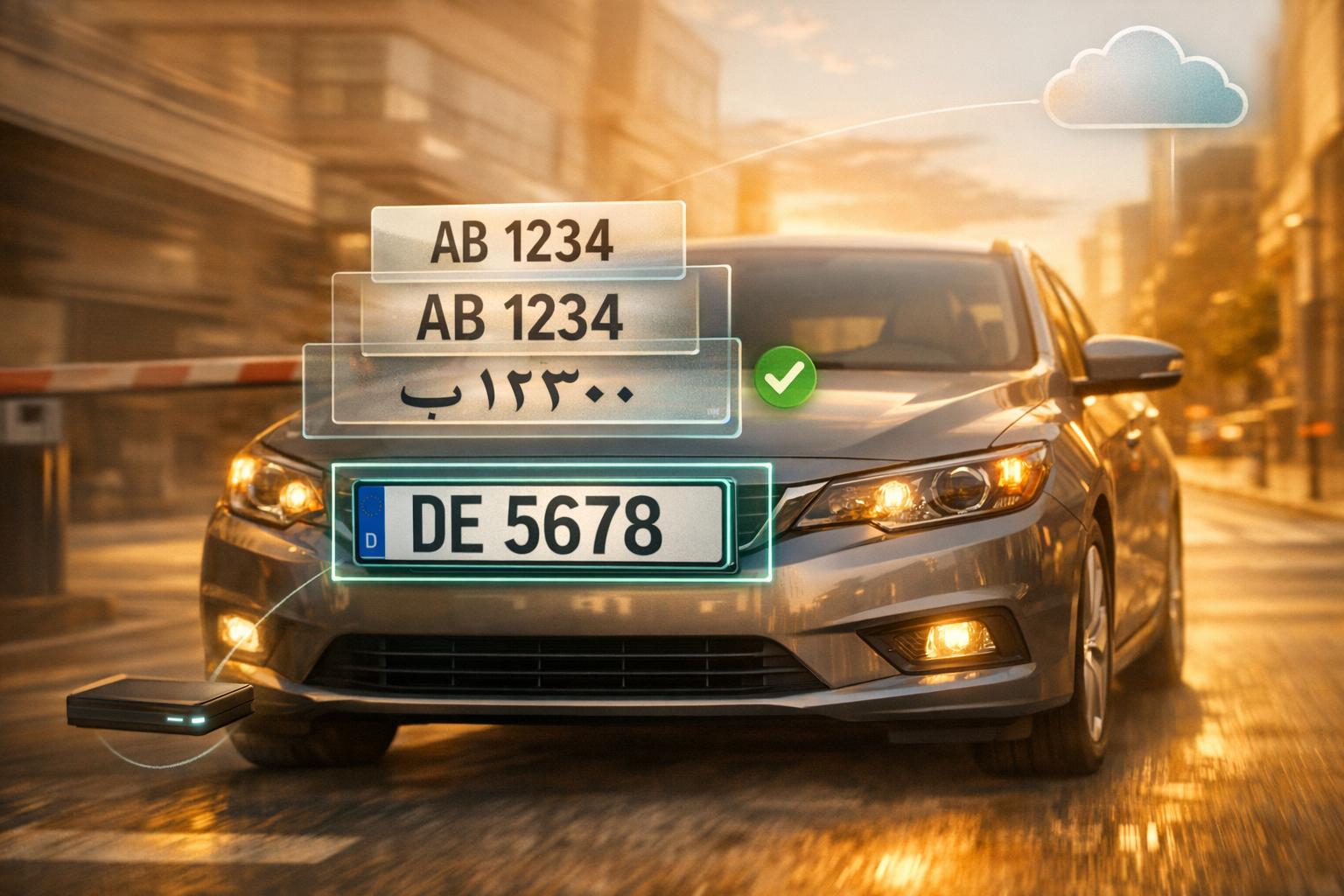
Real-time multi-language license plate recognition (LPR) uses machine learning and optical character recognition (OCR) to identify and extract text from vehicle plates in over 100 languages and scripts. With average recognition times of 226.9 milliseconds, this technology supports industries like law enforcement, parking, logistics, and fleet management by providing plate numbers, vehicle details, and region-specific insights.
Key challenges include:
- Handling diverse plate designs, mixed scripts, and varied formats.
- Overcoming latency, hardware constraints, and environmental conditions.
- Ensuring accurate OCR for multi-language and degraded images.
- Linking plate data to regional rules and databases.
Solutions involve optimized architectures, fine-tuned OCR models, preprocessing for low-quality images, and cloud or edge deployment strategies. Tools like CarsXE APIs simplify integration, offering fast and reliable plate recognition with access to detailed vehicle data.
Quick Takeaway: Advanced LPR systems are transforming vehicle tracking, security, and data access by combining speed, accuracy, and region-specific insights.
Core Challenges in Multi-language Plate Recognition
Latency and Performance Limits
License plate recognition systems operate under strict time constraints. To ensure no vehicles are missed in high-speed traffic, each frame needs to be processed within 100 milliseconds - a tight deadline that leaves little room for error[5].
The challenge is compounded by the hardware typically used for these systems. Roadside cameras often rely on edge devices like the NVIDIA Jetson Nano, which operate on less than 10W of power and have under 512MB of usable GPU memory[5]. As the Journal of Real-Time Image Processing points out:
"Traditional pipelines and multi-stage deep networks achieve high accuracy in laboratory settings but struggle with latency and robustness when deployed on resource-constrained cameras."[5]
Sequential processing models like RNNs and LSTMs further complicate matters by limiting parallelization, which slows down inference times[5][6]. These constraints highlight the need for efficient solutions, especially when dealing with the complexities of plate design diversity.
Varied Plate Designs and Formats
License plates come in a dizzying array of designs. Differences in colors, fonts, character counts, and layouts exist not just between countries but even within a single country, depending on vehicle type. For instance, commercial vehicles often use distinct color schemes compared to private cars. Legacy ALPR systems that depend on fixed design rules often fail to adapt to these variations[7].
Fonts pose a particular challenge. Region-specific or stylized typefaces can lead to character misclassification, even when the plate image is clear. Non-standard spacing and unusual character counts further reduce the confidence of OCR systems[7].
And as if that weren’t enough, the presence of multiple scripts on a single plate adds another layer of complexity.
Multi-script and Multi-language OCR
One of the toughest hurdles in multi-language plate recognition is handling plates that mix scripts, like Thai and Roman characters. Standard OCR engines such as EasyOCR or PaddleOCR often struggle with these mid-plate script switches, leading to errors like garbled text or skipped characters altogether[7][8].
Interestingly, a 2025 study demonstrated promising results by combining YOLOv10 with a custom Tesseract model for Thai-Roman plates. The system achieved 99.16% detection accuracy at 1.0 ms per image after being fine-tuned for Thai script[7].
Environmental and Deployment Conditions
Weather and lighting are constant adversaries for license plate recognition. Fog, rain, snow, glare, and low-light conditions can all undermine accuracy. Add to that motion blur from fast-moving vehicles, and the task becomes even harder. While deep learning models tend to perform better than traditional edge-detection methods in these scenarios, they demand greater computational resources to do so effectively.
Linking Plate Data Across Countries
Recognizing a license plate is just the beginning. Without regional context, a plate number can be ambiguous - identical alphanumeric strings might belong to vehicles in entirely different countries. To make the data actionable, systems must map the plate to its specific country and apply the correct validation rules[1].
This is no small feat. Plate formats vary widely: some countries include state or province codes, others use sequential numbering, and many have unique formats for government, military, or diplomatic vehicles. Without accurate data normalization and region-specific mapping, downstream tasks like retrieving vehicle history or specifications become unreliable. This underscores the need for robust post-processing systems to bridge recognition outputs with regional data rules.
sbb-itb-9525efd
How the Real-time Multi-language Recognition Pipeline Works
Real-Time Multi-Language License Plate Recognition Pipeline
Frame Processing and Vehicle Detection
The process kicks off by capturing video frames from cameras. A YOLO-based object detector, such as YOLOv8, v10, or v11, scans each frame to identify vehicles. Once a vehicle is detected, the system isolates that area into a smaller Region of Interest (ROI), removing unnecessary background elements like trees or buildings. This step helps reduce the computational workload for the subsequent stages.
Speed is critical here. For example, YOLOv8m processes frames with an average latency of 22 milliseconds, which translates to about 45 frames per second [12]. A study conducted in April 2026 by researchers at CIITEC-IPN in Mexico City tested YOLOv8m on 19,894 images from 10 intersections. The pipeline consistently maintained a throughput of 18 to 22 FPS while analyzing recorded traffic video [12].
After isolating the vehicles, the system zeroes in on the license plate.
License Plate Localization
Once the vehicle is cropped, a secondary model - often another YOLO variant or a specialized CNN - further narrows its focus to locate the license plate. This task can be tricky due to factors like tilt, occlusion, or unconventional mounting angles. To overcome these challenges, advanced systems employ attention mechanisms such as CBAM (Convolutional Block Attention Module) or SEAM (Separated and Enhancement Attention Module). These mechanisms help the model concentrate on small, detailed regions, even in cluttered or distorted images [9][13].
Thanks to these improvements, F1-scores have increased by 7.82%, and mAP has risen by 10.25% compared to baseline models. Additionally, false detection rates have dropped to as low as 5.6% [13].
OCR for Multi-language Plate Text
After pinpointing the license plate, the next step is extracting its text accurately. The cropped plate images go through preprocessing steps like noise reduction, grayscale conversion, and adaptive thresholding to enhance character clarity before OCR begins [12][9]. Instead of recognizing characters individually, the OCR engine reads the plate as a single sequence, making it more robust against issues like blur or distortion.
Different OCR engines are suited to different scenarios. PaddleOCR, for instance, uses a two-stage "text detection + text recognition" process, excelling with scripts like Latin and Bengali [12][8]. For plates featuring mixed scripts - such as Thai and Roman characters - a fine-tuned Tesseract model often outperforms more general-purpose systems [7]. Meanwhile, newer architectures like parallel decoder Transformers are replacing older RNN-based models. Systems like YOLOv5-PDLPR, for example, achieve 99.4% accuracy at 159.8 FPS on the CCPD dataset [6].
Post-processing and Country-specific Validation
The raw OCR output often requires refinement. A post-processing layer applies rule-based lexicons to correct common errors, such as confusing "0" with "O" or "1" with "I." The output is then validated against the expected format for the detected region [12][10]. This process uses ISO 3166-1 alpha-2 codes to apply country-specific syntax rules. For example, U.S. plates include a two-letter state code, while plates in Pakistan require both a state and district identifier for proper validation [2][16].
Once validated, the system enriches the data by matching the plate to regional databases. This step can provide additional details such as fuel type, engine size, transmission type, registration year, and vehicle category [2][3].
Integration with Vehicle Data Platforms
After validation, the processed plate data is linked to vehicle records. The validated plate string is sent via API to platforms like CarsXE, which cross-references it against registration databases to retrieve specs, history, and recall information in real time [12][11]. For instance, in April 2026, CarsXE's Plate Decoder API processed a California plate - 7XER187. Using state-specific rules for "CA", it returned a detailed profile for a 2017 Kia Forte LX, including its VIN (3KPFK4A78HE103497) and assembly location [2][15].
In cases where OCR confidence is low, the API includes a candidates array - a ranked list of alternative plate readings with associated probability scores. This feature allows downstream systems to implement fallback logic rather than failing outright [14][11].
Solutions to Key Technical Problems
Tackling the challenges of real-time multi-language license plate recognition demands precise technical approaches. Below are strategies tailored to critical issues like processing speed, script complexity, and degraded images.
Reducing Latency in Real-time Processing
One effective way to cut latency is by designing an optimized architecture. Systems that integrate a shared backbone - like ResNet-18 or MobileNet-V3 - for both detection and recognition, combined with anchor-free detection heads, eliminate the need for computationally heavy IoU matching and Non-Maximum Suppression per anchor[5]. Using INT8 precision with Torch-TensorRT allows kernel fusion, boosting throughput by over 300% compared to FP32. The shared backbone keeps the pipeline efficient.
In July 2025, researchers introduced the "Light-Edge" system, which employed a ResNet-18 + FPN backbone with a 1×1 channel-fusion block. This design reduced convolution operations by 28%, delivering 14 FPS while consuming just 4.8W - ideal for large-scale roadside implementations[5].
"Running the model directly on the edge device avoids communication link overload, security, and scalability issues associated with transferring data to the cloud." - Journal of Real-Time Image Processing [5]
This streamlined architecture significantly improves OCR performance for multi-script plates.
Improving Multi-script OCR Accuracy
Generic OCR solutions often falter when faced with stylized regional fonts or mixed scripts. A fine-tuned approach addresses these gaps. In early 2026, researchers combined YOLOv10 with a customized Tesseract OCR engine to handle Thai-Roman mixed-script plates. Tested on 50,000 images, the system achieved an impressive 99.16% accuracy at 30 FPS[7].
"Tesseract OCR, known for addressing diverse fonts and scripts, was fine-tuned in this study to accommodate Thai license plates' dual-script nature." - Scientific Reports [7]
Adding attention modules like SEAM improves sensitivity to small or occluded characters by recalibrating spatial and channel features. Additionally, swapping standard nearest-neighbor upsampling with content-aware methods like CARAFE enhances the model's ability to recover fine character details during feature downsampling[9].
Once OCR accuracy is addressed, the next hurdle is managing degraded image quality.
Handling Low-quality and Blurred Plates
Challenges like fog, rain, motion blur, and low light require robust preprocessing techniques. In January 2026, researchers introduced the CSCM-YOLOv8 + CSM-LPRNet system, which featured a CPA-Enhancer module. This module dynamically adjusted contrast and detail based on the type of degradation, achieving detection accuracy of 98.9% and character recognition accuracy of 98.56%, even under adverse conditions like fog, rain, and snow[9].
"The remarkable performance of this method in complex environments provides an efficient and reliable solution for license plate recognition in intelligent transportation systems." - Xiong et al. [9]
By addressing image quality issues during preprocessing, the system ensures reliable performance in real-world scenarios.
Supporting New Plate Formats and Regions
Adapting to new regions or plate formats often involves region-specific fine-tuning on localized datasets. Training models on data that mirrors the target region's scripts, fonts, and color schemes enables high accuracy without the need for a complete system overhaul. For example, YOLOv11 achieved a mAP of 98.24% on Bengali license plate datasets after targeted training[8].
Additionally, rule-based post-processing modules that incorporate country-specific syntax validation offer a modular way to support new formats while maintaining the core pipeline's stability.
System Design for Multi-country Deployments
Deploying a reliable multiregional system goes beyond just technical precision - it's about creating a framework that can handle diverse environments and requirements.
Cloud vs. Edge Deployment
Choosing between cloud and edge processing has a big impact on how the system functions.
Edge deployment processes data locally, ensuring real-time performance and reliability even in areas with poor internet connectivity. For instance, devices like the NVIDIA Jetson Nano can achieve latency under 100 milliseconds while operating on limited power [5].
On the other hand, cloud deployment provides access to richer datasets and broader geographic coverage without the need to manage physical hardware. For example, a cloud-based plate recognition API can deliver results in about 227 milliseconds, utilizing models trained across more than 100 countries [1].
In large-scale systems, a hybrid approach often works best. Here, edge gateways handle real-time detection, while the cloud takes care of tasks like model updates and long-term data storage [17]. Here's a quick comparison of the two approaches:
Feature Edge Deployment Cloud Deployment Latency Low (<100ms) [5] Higher (depends on network) [17] Bandwidth Low (local processing) [17] High (requires data upload) [17] Privacy High (data stays local) [5] Lower (data sent externally) [17] Model Complexity Limited (lightweight models) [5] High (supports full-scale models) [1] Scalability Hardware-dependent Straightforward via API [1]
Once the deployment model is chosen, the next step is to address the complexities of handling varied plate data across different regions.
Data Normalization and Regional Rules
Standardizing plate data is a key part of building a system that works globally. Regional differences mean the system needs to apply specific rules for each area, ensuring outputs are consistent and easy to use [1] [2]. For example, in countries like the US, Canada, and Australia, including a state or province code (e.g., CA for California or ON for Ontario) is essential for retrieving accurate registration details [2].
The type of data returned also varies by region. A US plate lookup might provide the vehicle's VIN, trim level, fuel type, and transmission. Meanwhile, in Brazil, the response might include axle count and gross vehicle weight [2]. Despite these differences, the system can normalize outputs to always include core details - such as make, model, and registration year - so downstream applications don't have to deal with every regional variation.
This standardization must also align with privacy laws and regulations, which can vary widely between countries.
Privacy and Compliance
In some regions, plate lookups can return sensitive personal information like owner names, national ID numbers, or even home addresses. This is common in countries like China, Chile, and Albania [2]. As a result, access control and data retention policies must be built into the system from the start.
For areas with strict data residency rules, edge processing is often the best option since raw data never leaves the local environment [18]. When cloud processing is used, encoding all recognized characters in a universal format like Unicode (UTF-32) ensures data integrity across different scripts and languages [18]. Additionally, incorporating metadata flags - such as marking plates as "unreadable" or "obstructed" - can help signal when human intervention is required, which is crucial for legal and law enforcement applications [18].
Conclusion and Key Takeaways
Main Learnings
Real-time multi-language plate recognition is no small feat. It involves overcoming challenges like reducing latency, ensuring OCR precision across various scripts, adapting to inconsistent plate designs, and managing different environmental factors - all within a streamlined processing pipeline. The workflow typically includes steps like frame capture, vehicle detection, plate localization, multi-script OCR, and country-specific validation. To create a reliable system, lightweight edge models, confidence filtering, localized data normalization, and privacy safeguards are essential.
The Future of Multi-language Plate Recognition
Technology in this field is progressing rapidly. Regional support continues to expand, and processing speeds are now approaching or even dipping below 100 milliseconds, making real-time performance achievable - even in edge deployments [19].
But it’s not just about OCR anymore. Systems are evolving into comprehensive vehicle intelligence platforms. They’re connecting recognized plates to broader data like accident history, title records, lien or theft status, and even market value [4]. AI integration is also becoming more common, with plate recognition APIs being embedded into autonomous workflows through user-friendly interfaces [20]. These developments open up practical applications, including those offered by CarsXE.
How CarsXE Can Help
The true value of plate recognition lies in linking plate data to actionable vehicle insights. CarsXE bridges this gap with two powerful tools: the Plate Image Recognition API, which converts an image into a plate string with confidence scores and bounding box details [11], and the Vehicle Plate Decoder API, which translates that string into detailed vehicle information like VIN, make, model, and fuel type [2].
These tools support image recognition across over 100 countries and provide in-depth vehicle data for more than 50 countries [14][3]. For developers working on international systems, CarsXE offers region-specific endpoints to minimize latency. Plus, the platform is SOC 2 Type II certified and GDPR-compliant [19]. Developers can explore these capabilities risk-free with a 7-day trial - no credit card required [3].
FAQs
What camera specs do I need for reliable plate reads?
To achieve dependable license plate recognition, focus on capturing images with adequate pixel density. Aim for at least 60 pixels per foot (196 pixels per meter), though 120 pixels per foot (400 pixels per meter) is preferred for sharper detail. Keep the camera's horizontal and vertical look angles below 30° for optimal results. Use a fast shutter speed to minimize motion blur, and incorporate external lighting to enhance contrast in low-light environments.
How do you handle plates with mixed scripts on the same plate?
The CarsXE Plate Image Recognition API handles mixed-script license plates by detecting potential character candidates and assigning each a confidence score. Instead of delivering just one result, it generates a ranked list of possible interpretations based on their likelihood. This method ensures more dependable data extraction, especially in cases where character recognition might be ambiguous, giving developers the ability to choose the most precise match using the confidence scores.
When should I run LPR on the edge vs in the cloud?
When you need real-time processing, want to work in areas with spotty internet, or are concerned about privacy, running license plate recognition on the edge is the way to go. This approach is perfect for low-power devices like roadside cameras.
On the other hand, cloud processing is the better option for scalable and high-accuracy solutions. It eliminates the need for on-site hardware and works well for tasks like intensive data analysis or connecting with extensive vehicle databases.
Related Blog Posts
- Multi-Language OCR for Vehicle Data: How It Works
- Study: OCR Accuracy in Vehicle Data Processing
- AI Noise Reduction in License Plate OCR
- RNNs for Vehicle License Plate Recognition