Regional Economies Shaping Car Brand Popularity

Regional Economies Shaping Car Brand Popularity
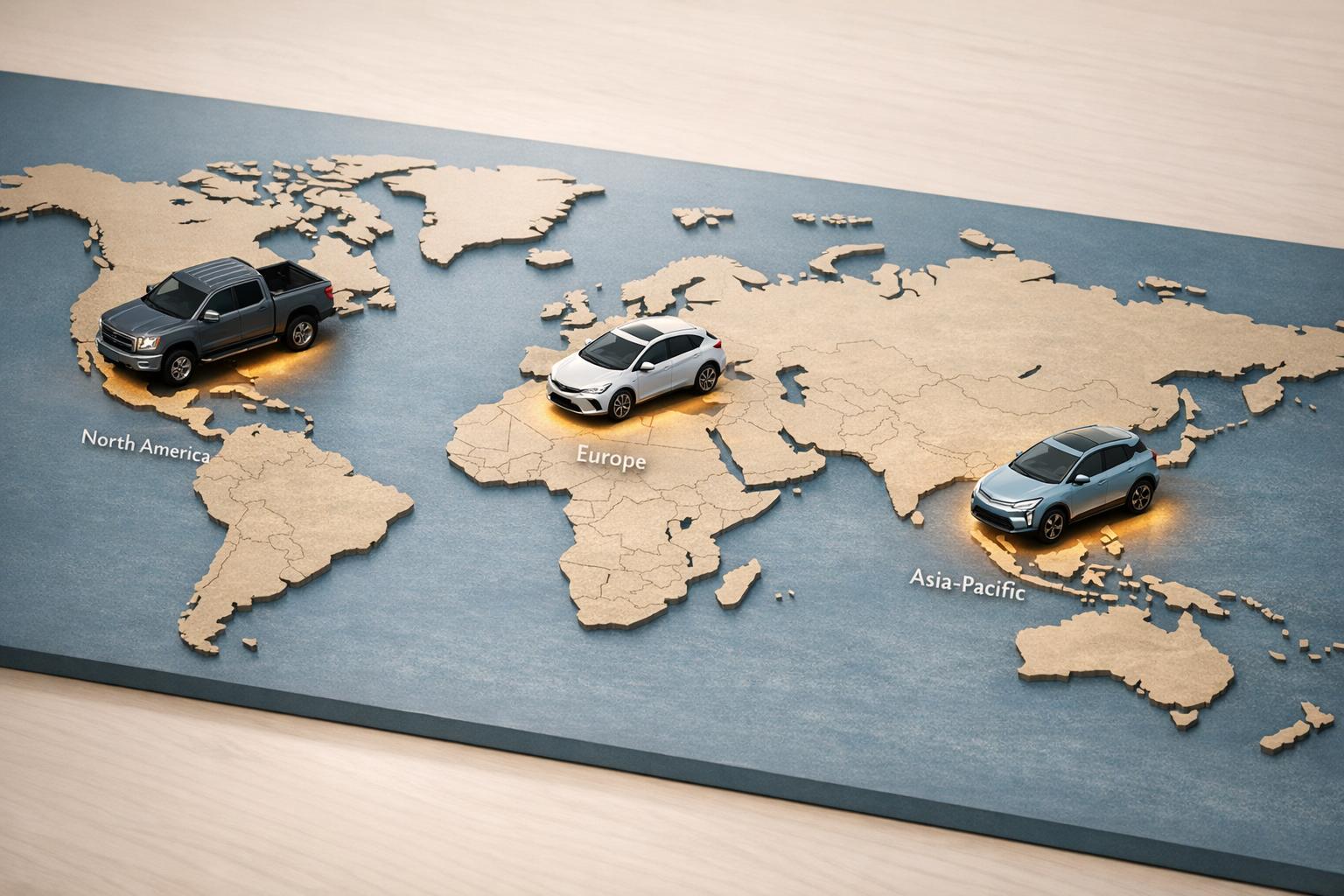
Regional economies heavily influence which car brands succeed in different markets. Here's the breakdown:
- North America: Pickup trucks dominate, making up 80% of new vehicle sales. Economic pressure has split the market, with high-income buyers opting for new vehicles and others leaning toward used ones. EV sales fell 28% in Q1 2026 due to the expiration of federal tax credits, while gasoline prices surged past $4 per gallon.
- Europe: Northern and Southern Europe show contrasting trends. Italy and Spain report strong car sales growth (+9.2% and +7.6% in Q1 2026), while France sees a 2.1% decline. Hybrid vehicles lead the market (38.6%), and BEVs are growing (19.4% share). Volkswagen remains the leader, but competition from brands like BYD and Tesla is increasing.
- Asia-Pacific: China leads with 45%-50% of the region's sales value, while India is the fastest-growing market. Chinese brands like BYD are expanding globally, overtaking Japanese brands in global sales. Electrification varies, with hybrids outpacing EVs in Southeast Asia due to limited charging infrastructure.
Economic factors like GDP growth, consumer spending, and government policies shape car preferences across regions. Manufacturers must tailor strategies to local conditions to remain competitive.
Global Car Market by Region: Key Stats & Trends 2026
Best-Selling Car Brands in the World (2000–2026) | Bar Chart Race
1. North America
The U.S. auto market in 2026 is navigating some tough terrain. New-vehicle sales are expected to hit around 15.8 million units for the year [4], while the average retail transaction price has climbed to $45,859, marking a 2.5% increase compared to the previous year [2].
Charlie Chesbrough of Cox Automotive summed it up well:
"Affordability remains the central challenge for the industry, and that is limiting the market's ability to expand beyond the mid-15-million range." [4]
The market is becoming increasingly divided. On one side, high-income buyers continue purchasing new vehicles, especially as interest rates begin to ease. On the other, inflation and rising costs are pushing lower-income consumers toward used or more budget-friendly options [4]. This divide is reflected in the numbers - new-vehicle registrations in Q1 2026 fell to 3.8 million units, down from 4 million the year before [8].
When it comes to preferences, light trucks and SUVs still dominate, making up about 80% of new vehicle sales in the U.S. [6]. In the compact utility segment, the Honda CR-V led with 99,151 new retail registrations in Q1 2026, narrowly beating the Toyota RAV4, which tallied 96,303 units [7]. Meanwhile, the Ford F-Series remains the top-selling full-size pickup overall, though GM’s combined sales of the Chevrolet Silverado and GMC Sierra outpaced Ford at the brand level [7].
Economic pressures are also shaping brand standings. In Q1 2026, Toyota led with 488,468 units sold, a modest 0.3% increase, while Ford followed with 433,705 units, reflecting a sharp 9% decline [9]. In terms of market share, GM leads at 17.4%, followed by Toyota at 16.5% and Ford at 12.6% [8]. Regionally, Ford maintains dominance in 22 states, particularly in the Midwest and South, while Toyota leads in 16 states concentrated in the West and Northeast. Chevrolet rounds out the top three, leading in 11 states [8].
One major challenge for the market has been the decline in EV sales, which dropped 28% in Q1 2026 after federal tax credits expired. At the same time, gasoline prices have surged to over $4 per gallon [1][5]. These shifts highlight the economic pressures shaping consumer behavior and emphasize the need for automakers to adapt quickly. The trends in North America serve as a key reference point when comparing how Europe and Asia-Pacific are responding to similar challenges.
2. Europe
The European auto market in 2026 is a story of contrasts. While the EU economy grew by 1.5% in 2025 and is expected to expand another 1.0%–1.2% in 2026 [3][10], the overall numbers hide significant differences between countries. Four nations - Germany, France, Italy, and Spain - make up about 50% of all EU car sales [13], but each is following its own economic trajectory.
The most noticeable divide is between northern and southern Europe. Italy and Spain are exceeding expectations, with Italy reporting a +9.2% increase in Q1 2026 car sales and Spain showing a +7.6% rise. In contrast, France experienced a -2.1% decline during the same period [14]. This disparity aligns closely with GDP trends: Spain's projected 2.2% GDP growth in 2026 is boosting consumer confidence, while stagnant conditions in France and Germany are making buyers more cautious [10][12].
Country Q1 2026 Sales Q1 2025 Sales % Change Germany 699,404 664,571 +5.2% United Kingdom 614,854 580,512 +5.9% Italy 484,577 443,792 +9.2% France 401,555 410,085 -2.1% Spain 300,529 279,409 +7.6%
This north-south divide reflects deeper economic contrasts that are also shaping automakers' strategies.
Volkswagen Group continues to lead the market with a 26.4% share in Q1 2026, though this is a slight drop of 0.4 percentage points compared to the previous year [16]. The reason? A surge in competition from international brands. For instance, BYD saw a 155.2% year-over-year increase in deliveries, reaching 21,158 units in March 2026, while Tesla delivered 36,868 vehicles, marking a 101.9% increase [16]. As Phil Curry from Autovista24 observed:
"With more brands entering the EU market, the increased competition is diluting the shares of more established carmakers." [16]
Consumer preferences are also shifting. Hybrid vehicles remain the top choice, accounting for 38.6% of the market in early 2026, while battery-electric vehicles (BEVs) climbed to a 19.4% share, up from 15.2% the previous year [15]. However, affordability remains a barrier, particularly in countries like Italy, Spain, and Poland, where lower purchasing power limits the adoption of fully electric vehicles. Marco Pasquetti of JD Power highlighted this challenge:
"Below-average purchasing power can significantly limit EV uptake." [11]
Budget-friendly models continue to dominate sales. The Renault Clio led European sales in Q1 2026, while the Dacia Sandero was the best-selling model across the EU in 2025 [13][14]. These choices underline the financial priorities of many European consumers.
The trends emerging in Europe provide an interesting contrast to developments in the Asia-Pacific market, which faces its own unique dynamics.
sbb-itb-9525efd
3. Asia-Pacific
The Asia-Pacific automotive market is expected to reach $2.8–$3.1 trillion by 2026 [18], but the region is anything but uniform. China dominates, contributing 45%–50% of regional sales value [18], while India emerges as the fastest-growing major market with a projected growth of 7%–9% CAGR [18]. On the other hand, mature markets like Japan are grappling with high borrowing costs, which are softening demand even during traditional sales peaks [17]. These varied economic conditions create a dynamic environment for brands across the region.
Chinese automakers are making waves globally. In 2025, China's domestic brand bloc, led by BYD, Geely, and SAIC, overtook the Japanese brand bloc in global sales for the first time, with 25.12 million units sold (27% global share) compared to Japan's 23.81 million units [21]. As Leon Liao from China as a System explained:
"2025 marked a truly symbolic inflection point: China's domestic-brand bloc... exceeded the Japanese brand bloc... becoming the world's largest brand bloc by volume." [21]
This trend is evident across individual markets. In Singapore, BYD secured a 21.2% market share in 2025, claiming the top spot for the first time [22]. Over in Indonesia, the BYD Atto 1 became the best-selling model in October 2025, dethroning the long-reigning Toyota Kijang Innova [20]. Meanwhile, in Thailand, a long-time stronghold for Japanese automakers, the combined market share of nine Japanese brands dropped to 69.8% in the first ten months of 2025, a significant decline from the historical highs of 80%–90% [20].
Economic conditions and infrastructure heavily influence consumer preferences across the region. Here's a snapshot of how these factors shape demand in key markets:
Country Key Economic Driver Leading/Rising Brands Popular Segments China NEV mandates & infrastructure BYD, Geely, Tesla NEVs, C-Segment India Rising disposable income Maruti Suzuki, Hyundai, Tata A/B Segment, Compact SUVs Indonesia Urbanization & local manufacturing Toyota, BYD, Wuling MPVs, LCGC, EVs Thailand Export hub status Toyota, Isuzu, BYD Pickups, Hybrids Vietnam Tax incentives VinFast, Toyota, Honda Hybrids, A-Segment Australia Rural access & lifestyle Toyota, Ford SUVs, Pickup trucks
Electrification is reshaping the region, but progress varies widely. Hybrids are outpacing pure EVs in much of Southeast Asia, where charging infrastructure remains a challenge. Vietnam, for instance, saw a 73% year-on-year surge in hybrid sales in early 2026, driven by tax incentives [19]. In Australia, battery-electric vehicles made up 8.3% of total sales in 2025, while plug-in hybrid sales more than doubled during the same period [23]. As noted by the ASEAN NCAP editorial team:
"Hybrid vehicles are rapidly becoming the 'automotive heroes' in Southeast Asia, outpacing pure electric vehicle (EV) sales amid global EV market volatility." [19]
The diversity across Asia-Pacific means no single strategy can work everywhere. A brand thriving in China's premium NEV market might struggle in Indonesia, where affordability and family-friendly MPVs dominate. Factors like GDP growth, infrastructure, and fuel import dependency play a key role in determining which brands and segments succeed.
Pros and Cons by Region
Regional economic conditions play a big role in shaping brand popularity, and what works in one market might not work in another. Here's a closer look at how different regions stack up:
Region Strengths Weaknesses North America (Heartland/South) High domestic loyalty, with Michigan leading at 75.3% loyalty rates[26]. Strong demand for utility vehicles keeps models like the F‑150 and Silverado performing well[24]. Sensitive to policy changes - EV sales dropped 28% year-over-year in Q1 2026 after a federal tax credit expired[1]. Import tariffs (about 15%) push up consumer prices[5]. North America (Coasts/Urban) Well-developed EV infrastructure, with California hitting nearly 50% electrified vehicle registrations in 2025[25]. Domestic brand loyalty is much lower in urban areas like California (28.3%)[26], leading to fragmented demand and affordability challenges. Europe Strong loyalty to local brands, with Germany's repurchase intent exceeding 47%[27]. High fuel prices (over $7 per gallon) drive demand for compact, fuel-efficient vehicles[28]. Import pricing is a major hurdle - for example, a Jeep Grand Cherokee costs $38,490 in the U.S. but jumps to $64,830 in France[28]. Asia‑Pacific (China) Rapid EV growth thanks to government-backed infrastructure projects. Brand loyalty is very low, hovering around 10%[27]. Asia‑Pacific (Emerging Markets) Expanding middle class in India, growing at a 7%–9% CAGR[18]. Brands like Maruti thrive here with affordability-focused models and strong distribution networks[25]. -
Each region has its own set of challenges and opportunities. For example, the heartland of North America benefits from loyalty-driven demand but remains vulnerable to policy shifts. Europe rewards brands with efficient and locally-rooted offerings, while Asia's markets - especially China and emerging economies - present high growth potential for brands that can meet diverse consumer needs.
These regional dynamics highlight how affordability and economic conditions uniquely influence car brand popularity.
Conclusion
From North America to Europe and Asia-Pacific, one thing is clear: regional economic factors like GDP growth, purchasing power, policy incentives, and infrastructure play a major role in shaping car brand preferences. To succeed, manufacturers need to adapt their inventory, pricing, and marketing strategies to fit local economic conditions. What works for heavy-duty trucks in Texas won’t resonate in Paris or Shanghai without major adjustments.
The regional trends highlighted earlier show just how important these tailored strategies are. While affordability challenges are a global concern, they show up in different ways - whether it’s the policy-driven push for EVs in North America, import cost hurdles in Europe, or infrastructure limitations in parts of Asia-Pacific.
For those keeping an eye on these evolving market dynamics, tools like CarsXE's real-time vehicle data API offer valuable insights. Covering market values, registration data, and vehicle specs across over 50 countries, this resource helps manufacturers fine-tune their strategies to meet local demands.
Car brands that align their strategies with regional economic realities stand the best chance of thriving in today’s increasingly segmented global market.
FAQs
Why are pickup trucks so popular in U.S. new-vehicle sales?
Pickup trucks make up roughly 20% of all new vehicle sales in the U.S., attracting a diverse range of buyers. This includes everyone from fleet operators to first-time owners and lifestyle enthusiasts. To meet this demand, manufacturers have broadened their lineups, introducing midsize, hybrid, and electric models, as well as luxury trims. These premium options, favored by wealthier buyers, play a big role in driving revenue - full-size pickups alone can bring in over $15 billion in just one month.
How do tax credits and fuel prices affect EV demand?
The expiration of the $7,500 federal EV tax credit on September 30, 2025, took away a major financial incentive, leading to an initial dip in electric vehicle (EV) sales. To counter this, automakers have introduced price reductions and other incentives to attract buyers. At the same time, rising gas prices - hovering above $4.00 per gallon - are making EVs more attractive because of their lower operating costs. This shift is slowly helping to balance out the absence of tax credits and increasing interest in both new and used EVs.
Why are hybrids growing faster than EVs in Southeast Asia?
Hybrid vehicles are gaining traction more quickly than electric vehicles (EVs) in Southeast Asia, largely because they tackle some of the biggest hurdles EVs face today. With lower upfront costs and no reliance on the region's still-evolving charging infrastructure, hybrids offer a more accessible alternative. They also ease concerns over "range anxiety" by utilizing existing fuel networks. For many in the region, hybrids represent a practical middle ground, combining better fuel efficiency with ease of use, especially in areas where infrastructure and economic stability remain uncertain.
Related Blog Posts
- How Regional Trends Impact Vehicle Depreciation Rates
- Cultural Trends in Cross-Border EV Adoption
- EV vs. Hybrid: Regional Adoption Trends
- Global Luxury Car Sales Trends by Trade Zones