Ultimate Guide to Vehicle Safety Ratings APIs

Ultimate Guide to Vehicle Safety Ratings APIs
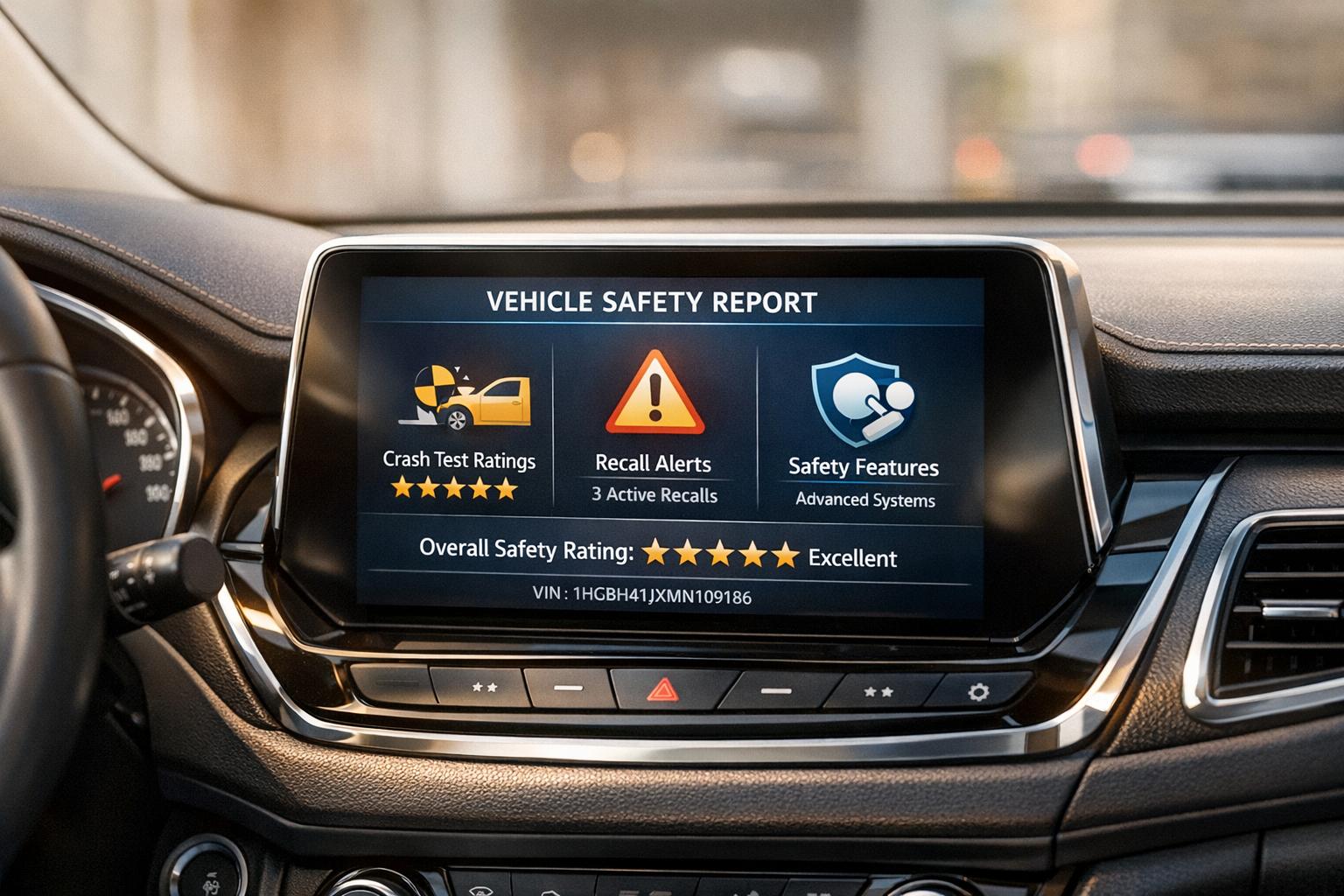
Vehicle safety ratings APIs allow quick access to crash test results, safety features, and recall data using identifiers like VIN or license plates. They simplify integrating safety information into platforms like insurance tools or automotive websites by providing data in JSON format. Key highlights include:
- NHTSA 5-Star Safety Ratings: Measures crashworthiness and crash avoidance; ratings range from 1 to 5 stars.
- IIHS Ratings: Uses qualitative scores (Good, Acceptable, Marginal, Poor) and evaluates features like headlights and child seat systems.
- CarsXE API: Offers VIN decoding, recall data, and safety specifications with high reliability (99.9% uptime, 120ms response time).
The NHTSA API is free, while CarsXE provides advanced features starting at a subscription with monthly quota + per-product overage tiers. Developers can combine these tools for detailed safety insights, ensuring accurate and timely data for users.
Is There An API For Vehicle Recall Lookup
By VIN And How Do I Use It? | CountyOffice News
sbb-itb-9525efd
What Are Vehicle Safety Ratings?
NHTSA vs IIHS Vehicle Safety Rating Systems Comparison
Vehicle safety ratings, accessible through specialized APIs, offer a standardized way to evaluate how well a vehicle protects occupants and prevents accidents. These ratings give consumers a straightforward method to compare models based on injury risk. They focus on two main areas: crashworthiness (how well a vehicle protects passengers during a collision) and crash avoidance and mitigation (technologies designed to prevent crashes or lessen their impact). While all vehicles sold in the U.S. must meet Federal Motor Vehicle Safety Standards (FMVSS), safety ratings go a step further, providing insights that help buyers differentiate between models.
The National Highway Traffic Safety Administration (NHTSA) introduced its 5-Star Safety Ratings system in 1993, setting a benchmark for government safety evaluations in the U.S.. Since 2006, federal law has required new car window labels to display this safety rating information. Additionally, automakers committed to making automatic emergency braking (AEB) a standard feature in all vehicles by 2022.
Let’s delve into the metrics that define these safety assessments.
Key Safety Rating Metrics
The metrics used to rate vehicle safety are designed to reflect real-world crash scenarios, making them essential for understanding how vehicles perform in accidents. For crashworthiness, NHTSA conducts specific tests:
- Frontal Crash Test: Simulates a head-on collision by crashing a vehicle into a fixed barrier at 35 mph.
- Side Barrier Test: Mimics an intersection collision with a 3,015-pound barrier striking a stationary vehicle at 38.5 mph.
A 5-star rating in these tests means there’s less than a 10% chance of serious injury, while a 1-star rating indicates a greater than 40% chance.
Modern evaluations also prioritize crash avoidance and mitigation technologies, such as Forward Collision Warning, Lane Departure Warning, and Automatic Emergency Braking, which help prevent accidents. Notably, NHTSA is the only organization that evaluates rollover resistance, using both the Static Stability Factor and dynamic maneuvers to measure a vehicle’s tipping tendency.
When comparing frontal crash ratings, it’s crucial to only compare vehicles within the same weight class (±250 lbs), as these tests simulate collisions between similarly sized vehicles. In contrast, side crash and rollover ratings can be compared across all vehicle classes. NHTSA also provides an Overall Vehicle Score, which combines frontal, side, and rollover results into a single rating. A warning symbol (⚠) on a rating highlights safety concerns like fuel leaks or structural failures that may not be reflected in the overall score.
Major Testing Organizations and Standards
In the U.S., two major organizations conduct vehicle safety testing, each with its own approach and rating system.
NHTSA (National Highway Traffic Safety Administration)
NHTSA’s 5-Star Safety Ratings program evaluates vehicles based on frontal, side, and rollover crash tests. A 5-star rating indicates a much lower-than-average risk of injury, while a 1-star rating signals a much higher risk.
IIHS (Insurance Institute for Highway Safety)
Unlike NHTSA’s star-based ratings, IIHS uses qualitative descriptors - Good, Acceptable, Marginal, and Poor. IIHS focuses heavily on overlap frontal tests (moderate and small), which simulate offset collisions that are more common in real-world crashes. The side impact test has recently been updated with a heavier, more realistic striking barrier to better reflect actual conditions.
In addition to crashworthiness, IIHS evaluates features like headlight performance, seat belt reminders, and the ease of using LATCH systems for child seats. IIHS also offers prestigious awards, such as TOP SAFETY PICK and TOP SAFETY PICK+, to vehicles that excel in crashworthiness and crash avoidance tests. These awards are updated yearly, with stricter criteria introduced regularly. For example, recent updates added rear passenger dummies to moderate overlap tests to assess backseat safety.
"IIHS-HLDI tests evaluate two aspects of safety: crashworthiness - how well a vehicle protects its occupants in a crash - and crash avoidance and mitigation - technology that can prevent a crash or lessen its severity." – IIHS
Here’s a comparison of NHTSA and IIHS testing criteria:
Feature NHTSA (NCAP) IIHS Rating Scale 1 to 5 Stars Good, Acceptable, Marginal, Poor Frontal Test Types Full-width rigid barrier Moderate overlap, Small overlap Side Test Types Barrier and Pole Updated Side Impact Test Rollover Testing Yes (Static & Dynamic) No Crash Avoidance Crash Avoidance Features Front Crash Prevention (Vehicle & Pedestrian) Additional Metrics Ease of Use (Car Seats) Headlights, Seat Belt Reminders, LATCH
Primary Data Sources for Safety Ratings APIs
When creating applications that showcase vehicle safety information, developers depend on a handful of trusted data sources. These organizations conduct detailed crash tests and share their findings through APIs and public databases. Knowing where this data originates and how it’s managed is key to building accurate and reliable applications. Let’s break down how each source delivers its data through specific API endpoints.
NHTSA Safety Ratings API
The National Highway Traffic Safety Administration (NHTSA) runs one of the most prominent public APIs for U.S. vehicle safety data. Through its New Car Assessment Program (NCAP), NHTSA has been publishing safety ratings since January 5, 2010, with records dating back to 1990. The API operates under a us-pd license, meaning it’s government data available for unrestricted public use.
The NHTSA API features two main endpoints for retrieving safety ratings:
/SafetyRatings/modelyear/{year}/make/{make}/model/{model}: This endpoint lists all available variants for a specific model year, make, and model combination. It’s particularly helpful for displaying details like trim levels or configurations./SafetyRatings/VehicleId/{id}: Once you have a unique vehicle identifier, this endpoint provides complete safety ratings for that specific variant.
The API catalog is updated daily, while the dataset itself is refreshed annually. In addition to crash ratings, NHTSA maintains a comprehensive recalls database with records going back to 1949. Automakers are legally obligated to report any safety defects or non-compliance issues to NHTSA within five business days. Recall data can be accessed via the endpoint:api.nhtsa.gov/recalls/recallsByVehicle?make={MAKE}&model={MODEL}&modelYear={MODEL_YR}.
It’s worth noting that while NHTSA certifies its Recalls and Complaints datasets, the NCAP ratings themselves are not certified.
Euro NCAP and IIHS Data Integration
While NHTSA is the primary source for U.S. vehicle safety data, other organizations like the Insurance Institute for Highway Safety (IIHS) and Euro NCAP provide additional insights. Each offers unique testing methods and rating systems.
The IIHS, funded by auto insurers, uses a qualitative rating scale: Good, Acceptable, Marginal, and Poor. Their API updates twice daily - at 12:15 AM and 10:15 AM - to ensure the latest data matches what’s available on their public site.
"The ratings data in the IIHS-HLDI API includes additional information on tested vehicles to ensure that consumers will not be misled about the performance of specific vehicles in safety evaluations."
– IIHS-HLDI
Accessing the IIHS-HLDI API requires registration and approval, with usage limits based on the details provided during sign-up. Unlike NHTSA’s open-access model, IIHS enforces strict rules about how ratings are displayed to prevent any misrepresentation. Their API also includes multimedia assets like crash test photos and videos, which can enhance user interfaces.
For vehicles sold in Europe, Euro NCAP provides safety ratings. While they don’t offer a public API like NHTSA, developers can integrate their data through web scraping or third-party aggregators.
Data Source Update Frequency Rating Scale Access Requirements NHTSA NCAP Daily (Catalog) / Annual (Dataset) 1 to 5 Stars Public / Open Data IIHS-HLDI Twice Daily (12:15 AM / 10:15 AM) Good, Acceptable, Marginal, Poor Registration & Approval NHTSA Recalls Daily N/A (Defect Data) Public / Open Data
These diverse sources provide the foundation for integrating safety data into platforms like CarsXE, ensuring users have access to reliable and up-to-date vehicle safety information.
Using CarsXE API for Safety Ratings Data
CarsXE goes beyond crash test results by offering a broader range of safety insights, making it a valuable tool for thorough risk assessments. It combines crash test data with detailed safety specifications, recall information, and VIN decoding for vehicles across more than 50 countries. This integrated approach simplifies the process of evaluating safety by providing accurate and centralized data.
CarsXE API Features for Safety Applications
At the heart of CarsXE's platform is the Vehicle Identification Number (VIN), which acts as a universal key to unlock a wealth of vehicle data. Through its Specifications API, CarsXE decodes VINs to reveal detailed safety features, such as airbags (driver, passenger, side, knee, head curtain), anti-lock braking systems (ABS), electronic stability control, and traction control. This detailed breakdown helps developers identify which safety features are standard and which are optional for specific vehicle models.
The Vehicle Recalls API adds another layer of safety information. By inputting a VIN, developers can access critical recall data, including NHTSA recall IDs, risk descriptions, and the current status of remedies. The API also flags urgent issues like "stop-sale" orders or "do not drive" advisories, providing users with actionable safety alerts in real time. When paired with NHTSA crash test ratings, this creates a complete picture of both historical safety performance and current concerns.
CarsXE allows users to retrieve comprehensive safety details using a single VIN or license plate number. The platform ensures high reliability, boasting a 99.9% uptime and an average response time of just 120ms, making it a dependable choice for production environments.
Developer Tools and Pricing
CarsXE isn’t just about features - it’s designed with developers in mind, offering tools and pricing plans that simplify the integration process. The pay-as-you-go pricing starts at a subscription with monthly quota + per-product overage tiers, with usage-based fees. For example, Specifications API calls drop from $0.20 to $0.10 per call as usage increases, while Recalls API calls start at $0.30 per call and decrease with volume. A free Sandbox tier (up to 100 free API calls) is also available, allowing developers to test the platform before committing to a subscription.
Developers can manage their API keys, track real-time usage, and test calls without writing code using a user-friendly dashboard. CarsXE also provides SDKs for popular programming languages like Node.js, Python, PHP, and Ruby, along with thorough documentation to streamline implementation.
For those building safety-focused applications, combining CarsXE's paid services with NHTSA's free API for crash test ratings can be a cost-effective strategy. This hybrid approach delivers detailed safety profiles while keeping costs aligned with actual usage.
Best Practices for API Integration
Error Handling and Data Validation
When working with safety ratings APIs, ensuring proper validation is crucial. Even a small oversight can result in displaying incorrect crash test scores to users. Start by verifying the success boolean field in every API response before processing any data. This simple check helps prevent your application from misinterpreting error messages as valid safety ratings.
Pay close attention to API request parameters. For instance, NHTSA's API is case-sensitive and strict about parameter names - using "modelyear" instead of "ModelYear" will result in a rejected request. Always confirm that the input object in the API's response matches your original request to ensure you're retrieving the correct vehicle data.
Not all vehicles undergo crash testing. Your application must handle "Not Rated" scenarios effectively. Instead of leaving blank spaces or showing zeros, clearly display "Not Rated" when IIHS or NHTSA returns an empty list or null response. This ensures users understand that the vehicle hasn’t been tested for specific crash conditions. For models with multiple test results, IIHS provides a "primary ratings" flag - use this to highlight the most relevant score, avoiding confusion caused by duplicate entries.
Once your validation processes are solid, the next step is optimizing for performance.
API Performance Optimization
NHTSA's servers handle a high volume of transactions - between 1,000 and 2,000 per minute during peak hours (6:00 AM – 6:00 PM EST). However, this capacity isn’t guaranteed. To avoid overwhelming the system or triggering automated rate limits that could block your IP address, consider scheduling batch processes during off-peak times, such as nights or weekends.
Caching can dramatically reduce latency and costs. Since NHTSA updates its safety ratings annually and IIHS refreshes data twice daily (at 12:15 AM and 10:15 AM), caching responses for several hours is a safe way to avoid serving outdated information. For initial data setup, download NHTSA's Safercar_data.csv file (approximately 9 MB) instead of making thousands of API calls.
Safety ratings often require multi-step lookups. For example, you might first query by year, make, and model to obtain a unique Vehicle ID, then use that ID to retrieve the actual ratings. Caching these intermediate Vehicle IDs can eliminate redundant API calls when users search for the same model repeatedly.
To further enhance accuracy, integrate this data with precise VIN decoding.
Combining Safety Ratings with VIN Data
Integrating VIN data ensures you’re associating the correct safety rating with the specific vehicle variant. For example, a 2024 Honda Accord with front-wheel drive might have different crash test results than the all-wheel-drive version. Only the VIN can confirm which variant you're evaluating. Use CarsXE's VIN decoding to identify the exact make, model, year, and drivetrain before querying NHTSA or IIHS for ratings.
For a more comprehensive safety profile, combine crash test scores with recall data. A vehicle might earn top marks in frontal crash tests but have an active "do not drive" recall for brake failure. CarsXE’s Recalls API provides NHTSA recall IDs and remedy statuses, while the Specifications API reveals details like installed airbags and stability control systems. This layered approach gives users actionable insights beyond just star ratings.
Legal compliance is also key when displaying comparisons. Frontal crash ratings, for instance, should only be compared between vehicles in the same class and within 250 pounds of each other. Meanwhile, side barrier, side pole, and rollover ratings are comparable across all vehicle classes.
Safety Feature Comparison Rule Test Speed Frontal Crash Same class (±250 lbs only) 35 mph into a fixed barrier Side Barrier All classes 38.5 mph moving barrier Side Pole All classes 20 mph sideways into a 25cm pole Rollover All classes Static Stability Factor
Conclusion
Vehicle safety ratings APIs play a crucial role in delivering consumer protection. By combining data from both the NHTSA and IIHS, you provide a comprehensive view of crashworthiness and crash avoidance features. While crash ratings are updated annually, recalls and manufacturer communications are refreshed daily, making real-time API access indispensable. CarsXE streamlines this process through its unified platform, giving users seamless access to essential safety information.
Accuracy and technical compliance are just as important as the data itself. With frequent updates and strict presentation requirements from both organizations, your application must ensure precise and timely delivery of information.
CarsXE makes it easy by consolidating VIN decoding, safety specifications, and recall data into one developer-friendly platform. Instead of juggling multiple API keys and authentication methods, you gain unified access to vehicle data spanning over 50 countries. CarsXE integrates crash test results, recall details, and VIN data into a single, all-encompassing safety profile. With SDKs available for eight major programming languages - Go, Java, .NET, Node.js, PHP, Python, Ruby, and Swift - and no-code options via Zapier and Make, the platform supports a wide range of development needs.
Pairing safety ratings with additional data unlocks actionable insights. For example, you can use VIN OCR to extract identification numbers from images, check for recalls instantly through the Recalls API, and then layer on market value and vehicle history to build a complete profile. This is especially relevant when considering that, in 2022 alone, 932 vehicle recalls impacted over 30.8 million vehicles in the U.S.. As the NHTSA emphasizes: "Whatever you're driving, or whatever vehicle equipment you're using, nothing is more important than safety".
Take advantage of this integration to create your own safety-focused applications. Start with a free Sandbox tier (up to 100 free API calls), and choose a pay-as-you-go plan starting at a subscription with monthly quota + per-product overage tiers - scalable to meet your needs.
FAQs
How do vehicle safety ratings APIs help protect consumers?
Vehicle safety ratings APIs give developers instant access to essential safety information, including crash-test results and recall data from reliable organizations like NHTSA and IIHS. With this data, apps and platforms can compare different vehicle models, spotlight potential safety issues, and help consumers make safer purchasing decisions.
By incorporating this information, developers can build tools that help users make smarter choices, boosting both safety awareness and confidence when selecting a vehicle.
How do NHTSA and IIHS safety ratings differ?
The NHTSA uses a straightforward 5-star system to rate overall vehicle safety. This system evaluates crash protection and rollover resistance through tests covering frontal impacts, side impacts, and rollovers.
On the other hand, the IIHS takes a more detailed approach, using letter grades - Good, Acceptable, Marginal, and Poor - to measure crashworthiness in areas like moderate-overlap front, small-overlap front, side impacts, and roof strength. They also assess crash-avoidance technologies.
While the NHTSA provides a single, easy-to-digest score, the IIHS gives more in-depth evaluations, allowing consumers to dive into specific safety features and make well-informed choices.
What steps should developers follow to integrate vehicle safety ratings APIs into their applications?
To get started with integrating vehicle safety ratings APIs, you'll first need to create an account on CarsXE and generate an API key. This key is essential for authenticating your requests. Depending on your setup, you’ll add the API key either to your HTTP headers or as a query parameter. Once that's done, you can use the Vehicle Recalls endpoint to retrieve data. Simply pass a VIN (Vehicle Identification Number), and you'll receive a JSON response containing recall details, risk ratings, and other related information.
Make sure your application is prepared to handle common errors like invalid API keys or exceeding rate limits. Implement retry logic and provide clear, user-friendly error messages to ensure a smooth user experience. Additionally, format the data specifically for U.S. users. For example, display dates in the MM/DD/YYYY format, use imperial units like miles and pounds, and show currency with two decimal places (e.g., $12,500.00).
Finally, thoroughly test your integration to ensure everything works as expected. Keep an eye on your API usage through the CarsXE dashboard to manage costs and maintain optimal app performance. By following these guidelines, you can efficiently incorporate accurate safety recall data into your application.
Related Blog Posts
- Top Recall Data APIs for Global Compliance
- How Real-Time VIN Decoding APIs Work
- Top 7 APIs for Accident History Reports
- Top 5 Freemium VIN Decoding APIs in 2025