How VIN Decoding Retrieves Vehicle Specs

How VIN Decoding Retrieves Vehicle Specs
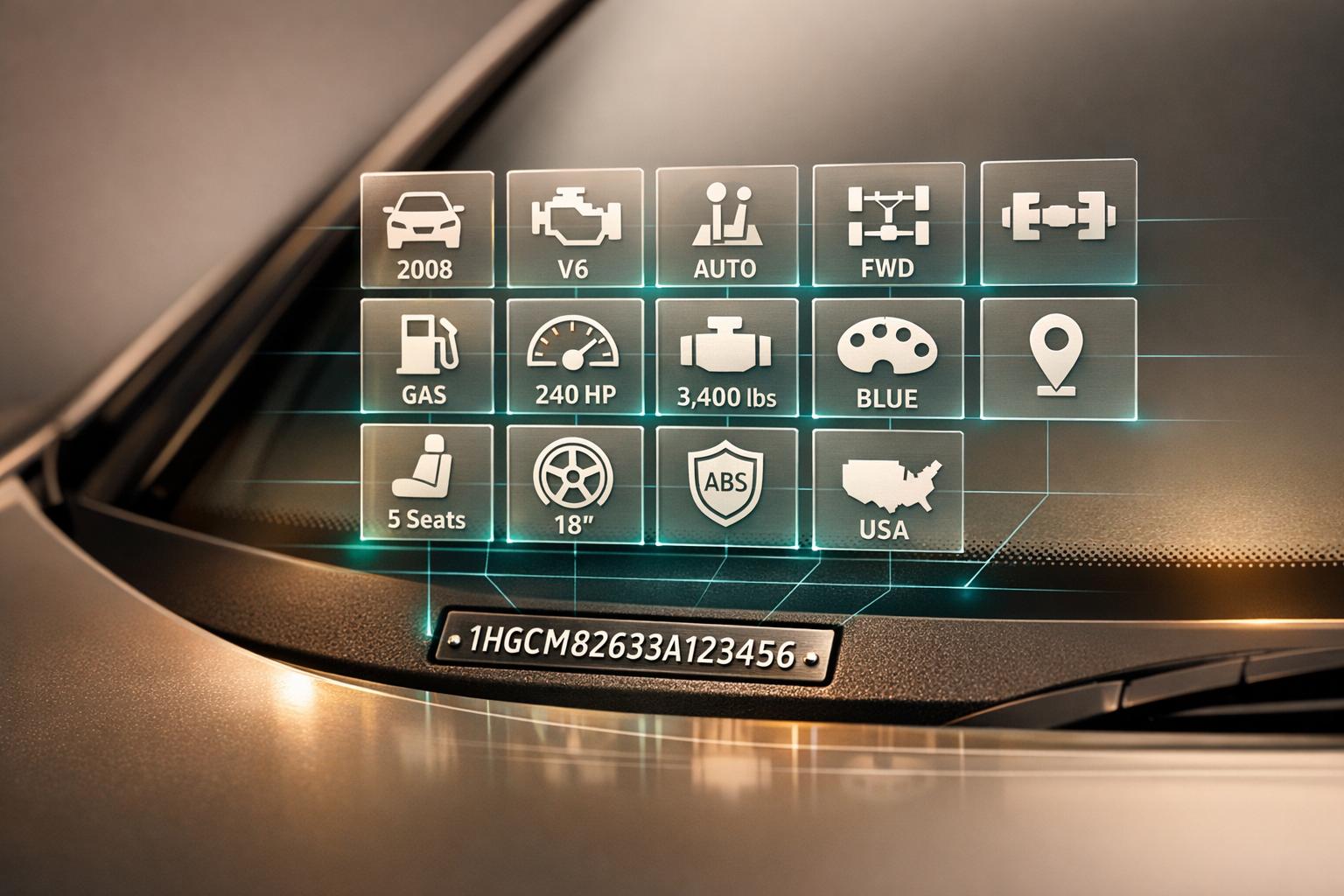
VIN decoding is the process of turning a vehicle's 17-character identification number into detailed information like make, model, engine type, and more. Introduced in 1981, this standardized system simplifies accessing over 250 specifications about a vehicle. Here's why it matters:
- Industries Using VIN Decoding: Insurance, dealerships, fleet management, and repair shops rely on it for accurate data.
- Modern APIs: Tools like CarsXE deliver vehicle data in milliseconds, covering over 50 countries with high accuracy.
- Manual vs. Automated Decoding: While manual decoding uses charts to interpret VIN sections, APIs provide instant, error-free results.
VIN decoding saves time, reduces errors, and enhances efficiency for businesses handling vehicle data.
Decoding and Understanding Vehicle Identification Numbers / VIN's
sbb-itb-9525efd
The 17-Character VIN Structure
VIN 17-Character Structure Breakdown and Decoding Guide
The VIN (Vehicle Identification Number) follows a strict 17-character format, which has been mandatory in the United States since 1981, as required by the National Highway Traffic Safety Administration (NHTSA). This format is standardized globally under ISO 3779 and ISO 3780, ensuring uniformity across manufacturers and countries.
To avoid confusion, the characters I, O, and Q are excluded from VINs because they can be mistaken for the numbers 1 and 0. Each of the 17 characters serves a specific purpose, encoding details such as the manufacturer, vehicle specifications, and production sequence.
The 3 Main VIN Sections
A VIN is divided into three sections, each with a unique role. These sections are critical for decoding vehicle information, whether done manually or through advanced API tools.
VIN Section Character Positions Information Represented WMI 1–3 Manufacturer, Country of Origin VDS 4–9 Model, Body Style, Engine, Check Digit (Position 9) VIS 10–17 Model Year (Position 10), Plant Code (Position 11), Production Sequence (Positions 12–17)
The World Manufacturer Identifier (WMI), found in the first three characters, identifies the vehicle's manufacturer and its country of origin. These codes are assigned by the Society of Automotive Engineers (SAE). For manufacturers producing fewer than 1,000 vehicles annually (or 2,000 in North America), the third character is a 9, indicating limited production.
The Vehicle Descriptor Section (VDS), which spans positions 4 through 9, provides details about the vehicle's model, body style, and engine type. Position 9 contains the check digit, calculated using a weighted algorithm to verify the VIN's authenticity. While this check digit helps catch transcription errors, it doesn’t guarantee the VIN is fraud-free, as there’s a 1-in-11 chance that two different VINs might share the same check digit.
The Vehicle Identifier Section (VIS), covering positions 10 through 17, provides a unique identifier for the vehicle. Position 10 represents the model year, based on a 30-year cycle of characters (1–9 and select letters). For example, vehicles manufactured in 2026 will use the letter T. Position 11 specifies the assembly plant, while positions 12 through 17 form the sequential production number assigned to the vehicle as it comes off the production line.
What Information Is Stored in a VIN
A VIN can reveal a wealth of information - modern decoding methods can extract over 250 attributes from these 17 characters. Some key details include:
- Engine specifications: Number of cylinders, displacement, and horsepower.
- Safety features: ABS, traction control, and airbag placement for driver and passenger.
- Physical dimensions: Wheelbase, height, width, and curb weight.
- Manufacturing details: Specific locations, such as Dingolfing, Germany, for certain BMW models.
VINs also encode data on emissions and compliance standards. Additionally, drivetrain information like fuel type, number of gears, and transmission type can be extracted. With modern APIs, this level of detail can be retrieved in just 120 milliseconds, drawing from vast databases containing over 275 million vehicle records from more than 50 countries.
Next, we’ll dive into decoding these components manually to uncover vehicle details.
How to Decode a VIN Manually
Decoding a VIN manually involves locating the VIN on your vehicle and using standardized charts to interpret each group of characters. While this process takes longer than automated methods, it offers a deeper understanding of how vehicle details are encoded within the 17-character VIN.
Where to Find the VIN on a Vehicle
You can usually find the VIN on the driver's side dashboard or door jamb, but it might also be stamped on the engine block or frame. For the dashboard, check the lower corner on the driver's side, visible through the windshield. Look for a small metal plate displaying the 17-character VIN. As Mopar explains:
The VIN can be found on the VIN plate located on the driver's side of the dashboard just below the windshield... [and] on the driver-side doorframe label.
If you're checking the door jamb, open the driver's door and inspect the label or post near the latch. The VIN is also recorded on official documents like the title, registration card, or insurance paperwork.
Make sure the VIN matches across all locations and documents. Count the characters - there should be exactly 17. If it's shorter, the vehicle was likely built before 1981, which is when the standardized format was introduced. Once you’ve located the VIN, you can begin decoding it with reference charts.
Reading VIN Charts and Tables
To decode the VIN, break it into its three main sections and refer to standardized charts. According to the National Highway Traffic Safety Administration:
Each motor vehicle must contain a vehicle identification number, also known as a VIN, which is a 17-character number that encodes specific information about the particular vehicle.
Here's an example using the VIN 1HGBH41JXMN109186: the first character indicates the vehicle's origin (e.g., "1" means the U.S.), and the tenth character specifies the model year. Use the table below to interpret each segment:
VIN Position Section Information Provided 1 WMI Country of Origin (e.g., 1=USA, J=Japan, W=Germany) 2–3 WMI Manufacturer and Vehicle Type 4–8 VDS Model, body type, engine, restraint system 9 VDS Check Digit (used for validation) 10 VIS Model Year (e.g., T=2026) 11 VIS Assembly Plant 12–17 VIS Sequential Production Number
While manual decoding gives you a clear picture of what each VIN position represents, automated tools using APIs can save time by instantly providing this information without the need for manual chart lookups.
VIN Decoding with APIs
How a VIN Decoding API Works
A VIN decoding API streamlines the process of retrieving vehicle information. Developers send a 17-character VIN - usually through an HTTP GET request to an endpoint like https://api.carsxe.com/specs. The request includes an API key for authentication, passed as a URL parameter. Once verified, the API accesses a vast database containing millions of vehicle records, including cars, motorcycles, and RVs. This data is sourced from manufacturers and regulatory organizations.
The API responds in JSON format, making it easy to integrate into websites, mobile apps, or other systems. It can provide over 250 attributes for vehicles in North America, such as engine size, transmission type, fuel capacity, curb weight, MSRP, and invoice price. For even more detailed information, developers can add the deepdata=1 parameter to their request. This unlocks additional details like airbag locations, tire pressure monitoring system (TPMS) types, and braking system specifics. Integration is quick - just two minutes - and a free Sandbox tier (up to 100 free API calls) is available. Compared to manual decoding, this automated approach is faster and seamlessly integrates into various applications.
Benefits of CarsXE VIN Decoding API
CarsXE's VIN decoding API offers real-time access to detailed vehicle data with impressive international coverage. The platform includes information from over 50 countries, with high accuracy rates - such as 98.46% coverage in North America. This makes it possible to decode VINs from nearly any manufacturer worldwide.
The structured JSON output reduces the chance of human error and simplifies integration into existing systems. As Andy Liakos, CEO of MotorTango, explains, CarsXE's reliable and fast vehicle data greatly improves customer satisfaction.
For developers looking to build more robust applications, CarsXE's VIN decoder pairs well with other tools like the Market Value API or the Vehicle History API. Together, these tools can create comprehensive platforms for vehicle information.
What Vehicle Specs You Can Get from VIN Decoding
Complete List of Vehicle Specifications
VIN decoding provides a wealth of information about a vehicle, covering a range of categories. At its core, it identifies details like the manufacturing year, make, model, trim level, and body style (e.g., sedan, SUV, or truck). When it comes to engine and performance, you can learn about the engine displacement, number of cylinders, fuel type, fuel tank capacity (in gallons), horsepower, transmission type, number of speeds, and drivetrain setup (RWD or AWD).
Physical dimensions are also available, including curb weight (in pounds), Gross Vehicle Weight Rating (GVWR), and measurements like length, width, height, and wheelbase - all provided in feet and inches. Safety and mechanical details include ABS, steering type, brake types (disc or drum), suspension configuration, and tire specifications.
Interior and exterior features include seating capacity, number of doors, cargo space (in cubic feet), and available color options. Financial data, such as MSRP, invoice price, and delivery charges, is also included, all listed in U.S. dollars. While the North American Vehicle Specifications API delivers over 250 attributes, the International VIN Decoder offers up to 40 attributes for vehicles globally.
For even more detailed manufacturer-specific data, such as plant location or safety restraint details, developers can use the deepdata=1 parameter to access expanded information. With API integration, accessing this extensive dataset is as easy as making an HTTP request.
How Businesses Use VIN-Decoded Data
VIN-decoded data plays a critical role in helping businesses make informed decisions across various industries.
Car dealerships rely on this data to create precise, detailed listings that enhance customer confidence. Auto finance companies use the same information, often paired with vehicle history reports, to evaluate loan risks more effectively.
Parking and valet services benefit from VIN data by optimizing space and identifying EVs or hybrids, ensuring these vehicles are directed to charging stations as needed. With a 99.9% uptime SLA, more than 1,000 businesses trust VIN-decoded data to power their operations.
Conclusion
VIN decoding eliminates the hassle of slow, manual lookups by instantly retrieving over 250 vehicle attributes, such as engine specs, dimensions, and equipment details.
By integrating automation through RESTful APIs and SDKs, businesses can move from idea to implementation in just minutes. With response times under 120ms and the ability to scale from 100 to over 10 million calls daily, the technology is built for efficiency. As Andy Liakos, CTO of MotorTango, highlights:
CarsXE offers MotorTango's customers accurate and reliable vehicle data across many makes and models. Their VIN decoder and specs API are second to none.
This kind of speed and precision drives real-world results. For example, a major parking app slashed onboarding time by 70% by tapping into automated VIN decoding, which accesses a global database of 275 million vehicles spanning over 50 countries.
CarsXE also simplifies pricing with a pay-per-call model and a free tier, removing the burden of complex contracts. With SOC 2 Type II certification and a 99.9% uptime SLA, the platform delivers the reliability and security required for mission-critical operations.
From dealerships creating detailed listings to finance companies evaluating loan risks, VIN-decoded data enables smarter, faster decisions across industries. It’s a powerful tool for developers and businesses to optimize every stage of the vehicle lifecycle.
FAQs
Can a VIN tell me the exact trim and options package?
Decoding a VIN can provide detailed information about a vehicle, including its trim level and options packages. However, the level of detail depends heavily on the decoding service you use. For instance, tools like CarsXE can pull data on trim and available equipment, but they may not always capture every detail about specific option packages.
Why does VIN decoding sometimes return missing or inconsistent specs?
Decoding a VIN can sometimes result in missing or inconsistent information. This often happens when the VIN is illegible, damaged, or contains invalid characters like I, O, or Q, which are not permitted in standard VINs. Such issues can lead to incomplete or inaccurate decoding.
How do I validate a VIN before sending it to a VIN decoding API?
To confirm a VIN's validity, start by checking that it’s a 17-character alphanumeric string. Keep in mind that the letters I, O, and Q are never used in VINs. Additionally, you can use a check digit algorithm to verify its accuracy. This involves the check digit (found in the 9th position) and uses a weighted modular arithmetic system to ensure the VIN is correct. By validating the length, allowed characters, and the check digit, you can catch potential errors before sending an API request.
Related Blog Posts
- How Real-Time VIN Decoding APIs Work
- How VIN Decoding Powers Compliance Verification
- VIN Decoding for Emission Compliance Tracking
- How VIN Decoding Changed Automotive Data Access