How Fuel Economy Labels Impact Vehicle Data APIs

How Fuel Economy Labels Impact Vehicle Data APIs
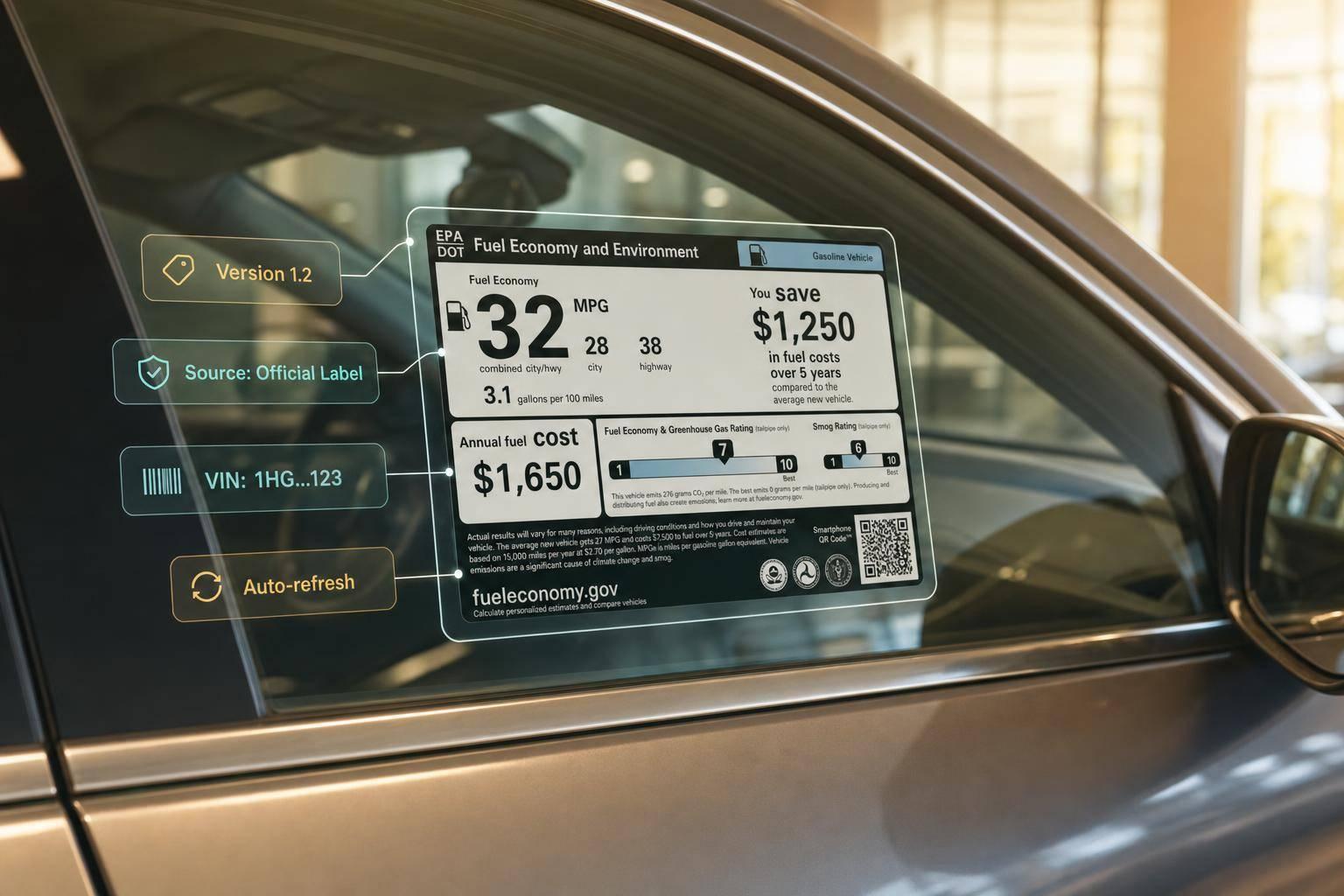
If your vehicle API treats fuel economy labels like plain spec data, it will drift. I’d build around the EPA label itself, store the official values as fixed records, version every change, and match each VIN to the exact EPA test record instead of guessing from the VIN alone.
Here’s the short version:
- The label is regulated data. City, highway, and combined MPG follow set rules, including the 55% city / 45% highway combined formula.
- The field set changes by powertrain. EVs and PHEVs add MPGe, electric range, total range, and 240V charge time.
- VIN decoding is only step one. A VIN often misses the exact engine, transmission, or drivetrain needed to find the right EPA record.
- Values can change after publication. In June 2026, EPA revised MPG estimates for some Nissan model years 2017–2025, which means stale imports can keep serving bad data.
- Storage design matters. I’d keep official label values separate from derived figures like annual fuel cost in USD, store original units and test metadata, and track both
created_onandmodified_on. - Daily refresh beats one-time import. Fuel economy data should be reloaded on a schedule and checked for updates instead of treated as fixed catalog content.
A few API rules stand out fast:
- Save official label values as first-class fields
- Keep adjusted label values apart from compliance or raw test values
- Resolve records by Year → Make → Model → Engine → Transmission → Drivetrain
- Log ambiguous VIN matches
- Version records so older label values stay available after revisions
Quick comparison
API issue What causes it What I’d do Wrong MPG shown VIN does not map to one EPA record Match to the EPA vehicle_id using trim and powertrain data Mixed or bad units Source systems use MPG, L/100 km, g/mi, or g/km Store source units and conversion metadata with each record Old label values EPA updates or retroactive revisions Run daily ingestion and track modified_on Confusing field meanings Label values mixed with derived values Separate official label fields from estimates like fuel cost Region collisions Federal and California records differ Store sales_area with each label record
So my takeaway is simple: the API should mirror the label, not improvise around it. That means fixed schema, source tracking, version history, and a match pipeline built for trim-level detail.
sbb-itb-9525efd
The Main Data Problems Fuel Economy Labels Create
Even after the label rules are sorted out, the harder part starts: mapping those rules to actual vehicle records.
Fragmented Sources and Inconsistent Field Definitions
Fuel economy data usually comes from multiple legacy sources. That sounds manageable until you look at the fields themselves.
A common headache is inconsistent engine and transmission descriptors. Manufacturers don't always name things the same way, so the exact same turbocharger can show up as "TURBO", "TRBO", or "TC*" across different records [6]. For an API that needs to normalize this data, those aren't minor spelling quirks. They can break field matching logic.
Regional unit differences add another layer of risk. U.S. APIs need to normalize MPG and g/mi against systems that use L/100 km, km/L, or g/km.
One rule matters a lot here: store adjusted label values separately from compliance values. If those get mixed together, the consumer-facing MPG data becomes wrong.
VIN Matching and Trim-Level Ambiguity
A VIN can point to the base vehicle, but it often does not identify the exact EPA-tested powertrain.
That gap matters because a single model year can include multiple EPA records split by engine, transmission, and drivetrain. Each of those records can carry different label values [7]. So if you want the right fuel economy match, you have to resolve the full chain: Year → Make → Model → Engine → Transmission → Drivetrain - all the way down to the specific EPA vehicle_id [7].
That’s why VIN decoding by itself falls short.
Stale Values, Annual Updates, and Unit Conversion Issues
Static imports go stale fast. Fuel economy data changes often, and the EPA can issue retroactive revisions for vehicles that have already been on the road for years.
In June 2026, the EPA revised MPG estimates for Nissan vehicles covering model years 2017 through 2025 [4]. If an API pulled those records once and never refreshed them, it would keep serving the wrong fuel economy values long after the source had changed.
"In order to make estimates comparable across model years, the MPG estimates for all 1984–2007 model year vehicles and some 2011–2016 model year vehicles have been revised." - FuelEconomy.gov [2]
To avoid drift, keep the original units, test-cycle, and conversion metadata tied to each record. That way, derived values can be refreshed later and traced back to the source data [8][1].
These failures affect how the API should store label data, not just how it should display it.
How to Model Label Data in an API
Start by modeling the label itself. Fuel economy APIs need explicit fields, not vague vehicle-spec fields. That clears up fragmentation, helps track where a value came from, and cuts down on trim-level mix-ups.
Use Explicit Fuel Economy and Emissions Fields
Each fuel economy field should include the unit in the name. Fields like city_mpg, highway_mpg, and combined_mpg are clear and direct. There’s no guessing. The same idea applies to emissions: co2_tailpipe_g_per_mile tells you exactly what the value means, while a broad field like emissions does not.
Store combined_mpg as a saved field, not one you calculate on the fly. For EVs, CNG, and hydrogen vehicles, use mpge when you need cross-fuel comparisons [1].
It also helps to run all regulated label values through one normalization layer before they hit the API. That gives you a clean, steady shape across both required and conditional fields.
Field Category Required Conditional Fuel Economy city_mpg, highway_mpg, combined_mpg city_mpge, highway_mpge, combined_mpge for EVs, CNG, and hydrogen vehicles Fuel Type fuel_type_1 fuel_type_2 for dual-fuel vehicles Consumption - gallons_per_100mi, kwh_per_100mi Emissions co2_tailpipe_g_per_mile - Ratings ghg_score (1–10) smog_score (1–10), epa_smartway_code Cost annual_fuel_cost_usd five_year_savings_usd
For dual-fuel vehicles, such as PHEVs or E85 flex-fuel models, split the schema into fuel_type_1 and fuel_type_2. If you try to squeeze two fuel modes into one field set, you end up with collisions that get messy fast [2].
Store Provenance, Region, and Test-Procedure Metadata
Every label value should include metadata that shows where it came from and when it changed. At a minimum, store sales_area, label_model_year, test_procedure, created_on, and modified_on [2][5].
Use sales_area to separate Federal All Altitude records from California records. That small detail matters because it prevents one regional record from colliding with another.
modified_on is the main signal for label updates. When a record changes, API consumers need a direct way to spot it so they can decide whether to re-fetch the data or review the change [2][4].
There’s one more field pattern worth keeping: store both the adjusted, label-ready values and the unadjusted, calculation-ready values. The EPA publishes fields like city08 alongside city08U, which lets downstream systems use the exact figure instead of the rounded one [6][2].
That metadata gives downstream systems what they need to detect revisions and compare records without mixing things up.
Separate Official Label Values from Real-Time Estimates
Official EPA label values stay fixed for a given model year and test cycle. Derived estimates do not. Annual fuel cost is a good example.
Keep official label values separate from derived estimates. If both sit in the same place as combined_mpg, consumers can’t tell what stays fixed and what may change later.
That split also makes VIN matching and refresh logic much easier.
With the schema fixed, the next step is resolving the right label record for each VIN.
Integration Strategy: VIN Decoding, Matching Logic, and Data Maintenance
VIN-to-Fuel Economy Label: API Resolution Pipeline
A clean schema handles storage. VIN matching handles delivery. Once you have clear label fields and source tracking in place, the next job is mapping each VIN to the right label record.
Build a VIN-to-Label Resolution Pipeline
A VIN doesn't always point to a single EPA record. In practice, the lookup usually moves through Year → Make → Model → Options. And the Options step is where things can get messy, because decoded attributes need to line up with EPA text exactly.
Use case-insensitive matching, and allow suffix variants like "2WD" and "4WD" when you compare decoded model names with EPA descriptions. For instance, a decoded value like "Grand Cherokee" should match both "Grand Cherokee 2WD" and "Grand Cherokee 4WD" as separate records [10].
That matters more than it may seem. A 2012 BMW 535i can return both a 6-speed manual and an 8-speed automatic setup, which means two different fuel economy records [9]. When that happens, the pipeline should do one of two things:
- use secondary data to break the tie
- send the case to manual review
Use Automated Ingestion and Quality Checks
Manual updates fall apart at EPA revision speed. EPA MPG revisions can hit multiple model years at the same time, and a manual workflow just won't catch that on a steady basis.
Strategy Pros Cons Manual Maintenance High accuracy for small, specific fleets Impossible to scale; misses frequent EPA revisions [3] Automated Ingestion Handles daily updates; supports thousands of models [10] Requires matching logic for options text [10] Direct VIN-to-Label Fastest response time Often fails - VINs frequently lack trim-level detail required by EPA [9] Multi-Step Matching Most reliable path to the exact fuel economy ID [2] Higher latency; requires multiple sequential API calls
Automated ingestion should run on a daily schedule. Pull updated CSV or XML files from fueleconomy.gov, then check modifiedOn timestamps to spot changes [2][10].
A few guardrails make a big difference here:
- Flag changed records instead of overwriting them without notice
- Log every ambiguous match where one VIN maps to more than one EPA vehicle ID
- Version past records so earlier label values stay available when revisions arrive
Where CarsXE Fits in the Workflow
The decode layer and the EPA match layer should stay separate. CarsXE can provide decoded fields like engine, transmission, drivetrain, and electrification, which then feed the EPA matching step [9].
That split keeps the workflow clean: CarsXE handles vehicle identity, and your matching logic handles the label record.
Conclusion: Build APIs Around the Label, Not Around Assumptions
Once schema, matching, and ingestion are set up, the takeaway is pretty simple: build around the label. Fuel economy consumer labels are the official source for MPG, MPGe, CO2 emissions, and smog ratings. So every API field, unit, and refresh rule should map back to that label. Put plainly, API values should mirror the regulated label, not guess at it.
The biggest risk is drift from the official label. To avoid that, pull updates straight from fueleconomy.gov.
That matters for any team showing vehicle data to users or regulators. If your product depends on vehicle specs people can compare side by side, label data needs to remain the source of truth.
A practical setup is versioned, label-aware, and auto-refreshed. Use versioned records with provenance, along with created_on and modified_on timestamp tracking. CarsXE's VIN decoding layer supports the matching workflow by surfacing vehicle attributes such as engine, transmission, drivetrain, and fuel type [8].
Build the API around the label, and the result is an API that stays accurate, compliant, and predictable.
FAQs
Why isn’t VIN decoding enough?
VIN decoding helps you identify a vehicle, but it only tells part of the story. It won’t show how that car is likely to perform on the road or what its emissions profile looks like in day-to-day use.
That’s where federal fuel economy labels come in. They add context that VIN data alone can’t give you, including MPGe, five-year fuel cost projections, smog-forming emissions ratings, and EPA combined fuel economy estimates. Those details make it much easier to compare vehicles in a way that reflects actual ownership, not just factory specs.
How often should fuel economy data be refreshed?
It’s best to refresh fuel economy data daily so your application stays in step with the latest government datasets.
The reason is simple: the EPA can update guidance and MPG ranges during a model year. A daily sync helps keep vehicle data APIs accurate and current for fuel efficiency and cost estimates.
What fields should a fuel economy API store?
A fuel economy API should store standardized fields that line up with official EPA label requirements, such as:
- City, highway, and combined MPG
- Tailpipe CO2 emissions in grams per mile
- Fuel type, engine displacement, cylinder count, transmission, and drivetrain
It should also include the metrics people actually look for when comparing cars: estimated annual fuel costs, the five-year cost difference versus an average vehicle, and 1 to 10 ratings for fuel economy and greenhouse gases.
Related Blog Posts
- How Real-Time VIN Decoding APIs Work
- Global Emission Standards: Compliance Guide
- Global Emission Standards: What Developers Should Know
- Top APIs for Emission Data Integration