How GDPR Shapes Cross-border VIN Decoding

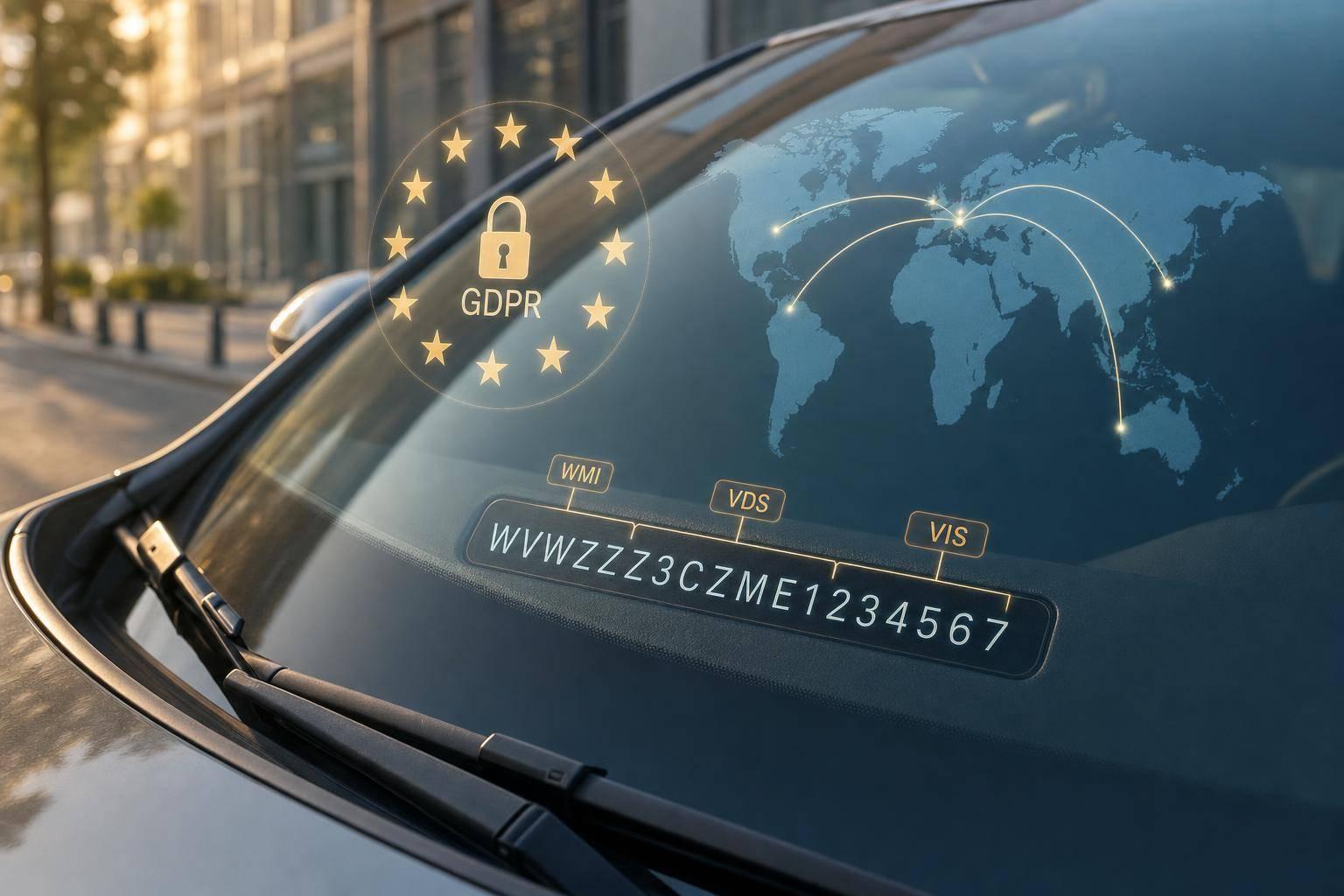
How GDPR Shapes Cross-border VIN Decoding
If a VIN can be tied to a person, GDPR steps in. That is the whole issue in one line.
From what I see in this piece, the rule is simple: a VIN alone is often not personal data, but a VIN plus account data, registry access, claims data, logs, or overseas access often is. The article also makes clear that cross-border VIN decoding is not just about where servers sit. If someone outside the EEA can view VIN-linked personal data, that can count as a transfer too.
Here’s the short version:
- I need to check context using a vehicle data platform, not just the VIN itself
- I need to map all fields around the VIN, including logs and IDs
- I need a lawful basis tied to the actual use case
- I need to review EEA-to-non-EEA access and transfers
- I need to limit payloads, lock down access, and delete data on schedule
- I need current contracts, records, and vendor terms
A few points stand out:
- The article leans on the EU court view that a VIN becomes personal data when someone has reasonable means to link it to a person
- It warns that smart vehicle data is often personal data in practice
- It treats remote support or developer access from abroad as a GDPR transfer issue
- It points to SCCs and a Transfer Impact Assessment when no adequacy decision applies
- It frames compliance as a repeat task tied to product, hosting, vendors, and market changes
If I had to reduce the full article to one takeaway, it would be this: VIN decoding under GDPR is a workflow problem, not just a data-field problem. What matters is who can connect the data, why they use it, where it goes, and who can access it.
That sets up the rest of the article in a clear way.
GDPR Compliance Workflow for Cross-Border VIN Decoding
Step 1: Map Your Data and Separate Vehicle Data from Personal Data
Once you know which workflows fall under GDPR, map every field they touch.
List the Fields You Collect, Generate, and Store
Start by tracing the full life cycle of one decode request. The obvious inputs are the 17-character VIN and, in many cases, a license plate number. But the less obvious fields are often where GDPR risk shows up.
API keys can link a request to an account. IP addresses, timestamps, geolocation data, user IDs, and session IDs are often logged or shown in dashboards and audit trails. If your workflow pulls in enrichment data like mileage history, accident records, inspection dates, or recall status, those fields belong on your map too.
Any one of those fields, when combined with a VIN, can turn the record into personal data. A VIN stored next to a customer name, account ID, or registration certificate is personal data.
Use a Field Classification Table to Sort Your Data
Once you have a full field inventory, classify each field. The point is simple: separate data that is just technical vehicle info from data that is personal or depends on context.
Data Category Example Fields GDPR Classification Purely Vehicle Data Make, model, year, fuel type, engine type, number of doors, transmission gears Non-personal (unless linked to a user account) Contextual Identifiers VIN, license plate, sequential production number Potentially personal; classify based on whether your organization can reasonably link them to a person Enrichment Data Mileage history, accident records, inspection dates, recall status Context-dependent; review case by case Metadata and Logs IP address, timestamp, geolocation, user ID, session ID Personal or context-dependent Stored Records Customer name, registration certificate, account metadata Personal data
Classify each field based on whether your organization can link it to a person. If technical vehicle data sits next to a user ID or IP address in the same log record, treat the whole record as personal data.
And there’s one more piece here: classification only helps if it also explains why each field is being processed.
Document the Purpose Behind Each Decoding Workflow
GDPR requires you to record why you process each field. That purpose shapes what you can keep and how long you can keep it.
Here are a few common workflow purposes and what they mean for retention:
- Repair verification - decode the VIN to confirm parts compatibility; retain only for the length of the service job [2].
- Fraud prevention - if you process vehicle history data to prevent mileage tampering or consumer fraud, longer retention may be allowed under legitimate interest [2].
- Import compliance - keep only the emissions fields you need, such as
avg_co2_emission_g_kmandemission_standard; remove owner-linked identifiers from the payload. - Corporate fleet operations - confirm whether the VIN can be linked to a natural person, since VINs for corporate vehicles may not count as personal data if they cannot [1][2].
Writing down the purpose also forces a useful check: do you need every field your API returns?
If the purpose is parts cataloging, fields like fuel_type and engine_cc make sense. Fields like sequential_number or owner-linked metadata do not. Remove unneeded fields from the response before storage so you limit data from the start.
Record the purpose now. You’ll use it to pick a lawful basis in Step 2.
sbb-itb-9525efd
Step 2: Choose a Lawful Basis and a Valid Transfer Mechanism
Use your field map and purpose notes to match each workflow to the right lawful basis and transfer route.
Pick the Right Lawful Basis for VIN-related Processing
Your lawful basis needs to fit the purpose you logged in Step 1. In plain terms, don’t pick a basis first and force the workflow into it. Start with the purpose, then match the basis.
Use Case Lawful Basis Key Requirement OEM repair data shared with independent operators Legal obligation (Art. 6(1)(c)) Cite EU Regulation 2018/858; document necessity and data limits Vehicle history checks for fraud prevention or buyer protection Legitimate interests (Art. 6(1)(f)) Complete a Legitimate Interest Assessment (LIA) Owner-requested VIN decode or history report Contract (Art. 6(1)(b)) Processing must be essential to deliver the service Government registry access or transport law compliance Public task or legal obligation National transport law; public interest justification
For OEM repair-data sharing, the CJEU said that Article 6(1)(c) can apply when EU law requires VIN-linked disclosure.[3]
"where independent operators may reasonably have at their disposal the means enabling them to link a VIN to an identified or identifiable natural person... that VIN constitutes personal data for them" - Court of Justice of the European Union [3]
Add the lawful basis to your ROPA and make sure your privacy notice matches the workflow. It helps to list the lawful basis right next to each workflow purpose so nothing gets fuzzy later.
After that, check whether the same workflow also triggers a cross-border transfer.
Check Whether Data Leaves the EEA or Is Accessed from Abroad
If any part of the workflow reaches outside the EEA, treat it as a transfer risk. Under GDPR, remote access by support staff, developers, or subprocessors in a non-EEA country can count as a transfer. The data doesn’t have to move off an EU server for that to happen.[4]
That point trips up a lot of teams. A dashboard hosted in the EU can still create transfer issues if someone in another country can log in and view VIN-linked data.
Before you allow overseas access, audit who can see what. Then check whether the recipient can connect the VIN to an owner or driver.
Use SCCs and Transfer Assessments for International Access
If the destination country doesn’t have an adequacy decision, use SCCs and document the transfer assessment.
SCCs don’t need prior approval from a data protection authority, but they do require a Transfer Impact Assessment (TIA).[4] A TIA checks whether local law cuts into the protections the SCCs are meant to provide. For VIN workflows, review whether local law allows government access to vehicle ownership data or can force the vendor to hand it over. Get that analysis on paper before production.
Canada, Japan, and Switzerland currently have adequacy decisions, so transfers there don’t require SCCs. Transfers to the U.S. and many other countries do. Review the European Commission’s adequacy list on a regular basis because status can change. Also confirm that every subprocessor your VIN API depends on is covered by either an adequacy decision or signed SCCs with a completed TIA on file.[4]
Step 3: Apply Privacy Controls to VIN Decoding APIs and Storage
Take the field map and lawful basis from Steps 1 and 2 and turn them into clear rules for your API, logs, and storage.
Limit Payloads, Added Fields, and Stored Records
Only collect the fields you need for the job at hand. If you're using CarsXE, set up your app to parse just the fields your workflow uses. For a parts-matching workflow, that might mean keeping make, model, year, and fuel_type. Unless there's a clear need, drop sequential_number and manufacturer_address.
Data Category Example Fields Vehicle Info and Technical Specs make, model, year, body, fuel_type, engine_manufacturer, transmission Unique Identifiers vin, sequential_number, check_digit Manufacturing Data plant_country, manufacturer_address
One more thing: don't auto-join API responses with customer profile records unless the workflow calls for it. That's where things can get messy fast. Vehicle data that may seem harmless on its own can become personal data once it's tied to identity records.
Apply Pseudonymization, Access Controls, and Retention Limits
Pseudonymize or tokenize VIN-linked records so vehicle data and identity data live in separate places. If one record gets exposed, that split helps limit what anyone can see.
Then lock access down with role-based rules. Each person or service should only reach the endpoints and fields it needs. No more, no less. Set retention rules by event type, and automate deletion so old records don't just sit there forever.
These controls connect straight into the records, notices, and vendor terms covered in Step 4.
Log Access and Define Incident Response Steps
Every VIN lookup that touches personal data should leave a clear trail.
"Access is managed consistently, without discrimination, and in an auditable manner (e.g., through APIs, portals, audit logs, and authorization models)." - Taylor Wessing [5]
Log the API request metadata, the user or service ID that triggered it, and the timestamp. For cross-border workflows, also log who accessed the record, when, and through which system. Those logs show how VIN-linked data moved across systems and borders. If a regulator asks who touched a record, this is where you look first.
On the incident response side, name one internal owner for VIN-related data breaches. Set the escalation path ahead of time, including who gets notified inside the company and how your team will handle any required notifications. Write these controls down so they're ready for the governance and vendor-review step.
Next, keep the responsible parties, records, and vendor terms aligned with these controls.
Step 4: Maintain Governance, Contracts, and Regular Review
Once your technical controls are in place, governance is what keeps them up to date. Your field map, transfer assessment, and vendor terms shouldn't sit still while APIs, hosting setups, and target markets change.
Assign Controller, Processor, and Service Provider Responsibilities
Use these roles to assign updates, approvals, and deletion duties.
Responsibility Data Controller (e.g., Car Dealer/Service) Data Processor (e.g., VIN API Vendor) Non-EEA Vendor Instructions Decides why and how VINs are decoded. Processes data only on documented controller instructions. Must follow documented instructions and transfer terms. Security Accountable for overall compliance and choosing secure processors. Implements technical and organizational measures (TOMs). Provides safeguards equivalent to EU standards. Transfer Terms Conducts Transfer Impact Assessments (TIAs). Assists controller with transfer documentation. Signs SCCs or operates under Binding Corporate Rules (BCRs). Subprocessor Oversight Grants prior written authorization for new subprocessors. Responsible for the conduct of its subprocessors. Discloses all downstream data recipients in third countries. Deletion Defines retention periods. Deletes or returns data at service end. Certifies deletion in accordance with the transfer agreement. Data Subject Support Primary point of contact for fulfilling rights (access, erasure). Assists the controller in responding to subject requests. Assists the controller with data subject requests.
If you're using CarsXE as your VIN decoding API, your organization is the controller. You decide the purpose and means of processing, and you own the relationship with the data subject. In that setup, CarsXE is the processor, carrying out VIN decoding based on your documented instructions.
Keep Records, Notices, and Vendor Terms Current
Your Record of Processing Activities (ROPA) under Article 30 should name each VIN decoding workflow, the fields involved, the legal basis behind it, and where the data is sent. If a vendor changes its hosting location or adds new subprocessors, update the DPA, SCCs, and TIA before production. [4]
Privacy notices need the same kind of upkeep. A shift in use case can change the legal analysis. For example, if a workflow moves from fraud prevention to marketing, your Legitimate Interest Assessment (LIA) needs an update too. [2]
Don't wait for a calendar review if one of these happens:
- A key transfer safeguard changes in a material way.
- A court ruling changes how VIN data is classified.
- You enter a market with different government-access rules.
- A workflow moves from static VIN decoding to live vehicle telemetry.
Conclusion: A GDPR Compliance Checklist for Cross-border VIN Decoding
Use this checklist when a workflow, vendor, or market changes.
- Classify your VINs. Check whether your team or vendor can connect a VIN to an owner through registration records or certificates. [2][3]
- Map every field and its purpose. Document what you collect, why you collect it, and where it goes in your ROPA.
- Confirm your lawful basis. Match the basis to the workflow purpose, and update the LIA if the use case changes. [2]
- Validate transfer mechanisms. For any VIN decoding API hosted outside the EEA, confirm SCCs are signed and a TIA is on file. [4]
- Minimize and secure API data. Apply access roles and filtering, and automate deletion when retention ends. [5]
- Review on a regular schedule. Reassess right away when any of the triggers above occurs.
"A VIN is personal data of the natural person listed in the registration certificate if the person with access to the number has reasonable means to identify the vehicle's owner or lawful user." - European Court of Justice (Case C-319/22) [2]
Compliance here isn't a one-time task. It's a maintenance habit tied to your product roadmap, your vendor contracts, and the shifting landscape of international data law.
FAQs
When does a VIN count as personal data under GDPR?
A VIN is not personal data by default because it points to a vehicle, not a person.
It becomes personal data when someone can reasonably connect it to a specific, identifiable person through records or other details about the vehicle’s owner or lawful user.
Does remote access from outside the EEA count as a data transfer?
Yes. Under the GDPR, remote access to personal data from outside the EEA counts as an international data transfer, even when the data never leaves its original system in a physical sense.
That means simply making personal data available from abroad for support, troubleshooting, or admin work can trigger the transfer rules. When that happens, organizations need a lawful transfer mechanism in place, such as an adequacy decision or Standard Contractual Clauses.
What documents do I need for cross-border VIN decoding compliance?
You usually don’t need special paper records. What you do need is a solid process for handling VIN-related data across borders, including checking whether a VIN can be tied to a vehicle owner.
Compliance also means using an adequacy decision or safeguards like standard contractual clauses, supporting erasure and correction rights, and protecting sensitive telemetry data with encryption and local in-vehicle processing where possible.
Related Blog Posts
- Ultimate Guide to Anonymizing Vehicle Data
- US vs. EU VIN Decoding Standards
- Q&A: Multinational Compliance for Vehicle Data APIs
- How VIN Decoding Helps with Import Compliance