US vs. EU VIN Decoding Standards

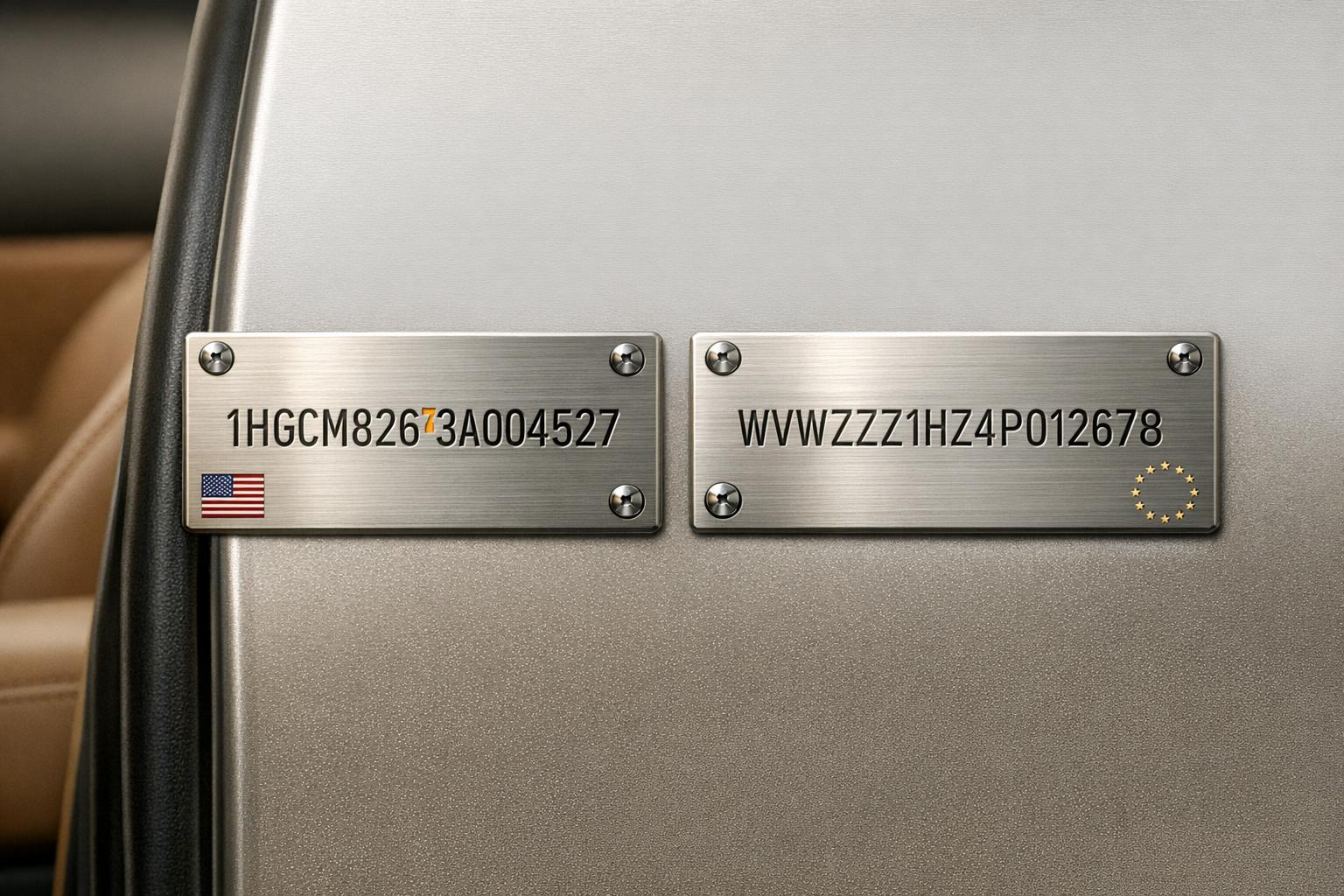
US vs. EU VIN Decoding Standards
Key takeaway: The United States and European Union both use the 17-character VIN system to identify vehicles, but their standards differ significantly. The US applies stricter rules, including a mandatory check digit for error detection, while the EU allows more flexibility, making VIN decoding between the regions challenging.
Quick Facts:
- US VINs: Stricter structure with a mandatory check digit (position 9), model year (position 10), and assembly plant code (position 11). Public databases (like NHTSA) make data easily accessible.
- EU VINs: Check digit optional, and positions 10 and 11 are often undefined. Data is fragmented across manufacturers and national systems, requiring proprietary tools for decoding.
- Impact: US VINs are easier to validate and decode, while EU VINs offer manufacturers more freedom but complicate cross-border applications.
Why It Matters:
- For Developers: US-focused systems may flag valid EU VINs as errors due to structural differences.
- For Businesses: Managing international fleets or cross-border vehicle data requires tools that account for these differences.
- For Consumers: Accessing vehicle history or recall information is simpler for US vehicles due to centralized data.
Quick Comparison:
Feature US VIN Standard EU VIN Standard Check Digit (Pos 9) Mandatory Optional Model Year (Pos 10) Mandatory Optional Assembly Plant (Pos 11) Mandatory Optional Data Accessibility Public (NHTSA Database) Fragmented across registries Decoding Accuracy ~99.5% (with check digit) ~85–90% (no universal check digit)
Understanding these differences is critical for accurate VIN decoding, especially in cross-border scenarios. Tools like CarsXE's VIN decoder address these challenges by tailoring decoding to regional standards and offering high accuracy rates for both US and EU vehicles.
US vs EU VIN Standards: Key Differences Comparison Chart
US VIN Standards (FMVSS 115 Part 565)
Main Features of US VIN Standards
The United States adheres to strict guidelines outlined in Federal Motor Vehicle Safety Standard (FMVSS) 115 Part 565, established in 1981. Under these rules, every Vehicle Identification Number (VIN) must be exactly 17 characters long, using only approved uppercase letters and numbers. Certain characters - I, O, and Q - are excluded to prevent confusion with similar-looking digits.
A key feature of the system is the 9th character, which serves as a check digit. This digit is calculated by applying a weight factor to each character, summing the results, and taking the remainder modulo 11. If the remainder equals 10, the check digit is represented as "X". This method effectively catches single-character mistakes and adjacent swaps.
Specific positions in the VIN encode critical details:
- Position 10 identifies the model year (e.g., "T" corresponds to 2026).
- Position 11 indicates the assembly plant.
- For passenger vehicles and light trucks weighing less than 10,000 pounds, the last five positions (13-17) must be numeric, representing the sequential production number.
Manufacturers producing fewer than 1,000 vehicles annually must include a "9" in the third position and use positions 12–14 for a unique identifier. Additionally, for vehicles under 4,536 kg (10,000 lbs), the VIN must be visible through the windshield, with characters at least 4 mm in height.
How the US Enforces VIN Regulations
The US takes VIN compliance seriously, with strict oversight managed by the National Highway Traffic Safety Administration (NHTSA). Before production begins, manufacturers must register with NHTSA under 49 CFR Part 566. This registration includes detailed documentation on how positions 4-8 (known as the Vehicle Descriptor Section) are used to encode attributes like engine type and safety systems.
"A person may not manufacture for sale, sell, offer for sale, introduce or deliver for introduction in interstate commerce, or import into the United States, any motor vehicle or motor vehicle equipment unless the vehicle or equipment complies with all applicable Federal motor vehicle safety standards."
NHTSA enforces these regulations for both domestic and imported vehicles. Foreign vehicles must either meet all FMVSS standards or qualify for specific exemptions. Under the FAST Act program launched in March 2022, low-volume manufacturers can produce up to 325 replica vehicles annually with certain safety exemptions. However, these vehicles must still comply with Part 565 VIN requirements. Manufacturers are required to affix permanent certification labels that identify any exemptions, and NHTSA reserves the right to revoke registrations if compliance lapses or safety defects are identified.
These robust enforcement practices underscore the US's dedication to maintaining the integrity of VIN systems, contrasting with the more lenient approaches seen in Europe.
sbb-itb-9525efd
EU VIN Standards (ISO 3779 and SAE J853)
Main Features of EU VIN Standards
The European Union adheres to the ISO 3779 standard and SAE J853 guidelines for structuring VINs. While EU vehicles also use the 17-character VIN format, the regulations governing these characters are less restrictive than those in the US.
"When it comes to rules, the EU has similar regulations for VINs, only not as strictly bound by them compared to the North American type." – Vincario
One notable difference is the optional use of the check digit in the EU. Many manufacturers use a default value for positions 10 and 11 rather than encoding specific information. For instance, Volkswagen only introduced the check digit for certain models, like the Audi A1, between 2009 and 2015.
In the Vehicle Descriptor Section (positions 4–9), EU manufacturers have more freedom to decide what information to encode. These positions can include either technical specifications or general identifiers, unlike the more rigid requirements in the US. For low-volume manufacturers producing fewer than 500 vehicles annually, the third character must be "9", and positions 12–14 are designated for additional identification.
This flexibility allows for greater customization but also impacts the efficiency of decoding and error detection.
Country Codes and WMI Differences
When it comes to World Manufacturer Identifier (WMI) codes, European vehicles use letters S through Z to represent the country of the manufacturer. For example:
- Germany: SN–ST and W
- France: VF–VR and VX–V2
- United Kingdom: SA–SM
- Spain: UA–UC and VS–VW
- Italy: ZA–ZU
In the EU, the WMI often reflects the manufacturer's headquarters rather than the actual assembly location. A good example is Adam Opel AG, which historically used German WMIs (e.g., W0L and W0V) for Opel and Vauxhall vehicles, even when production occurred in Spain, Poland, or the UK. This is because Opel's headquarters is based in Rüsselsheim, Germany. Similarly, after the 2021 Stellantis merger, the 2024 Lancia Ypsilon - an Italian brand - uses a French WMI, even though it is manufactured in Spain. This contrasts with US standards, where the first character of the VIN consistently indicates the country of manufacture.
How Flexibility Affects VIN Decoding
The EU's relaxed approach to VIN standards introduces challenges for decoding. Without a mandatory check digit, there is no universal method to detect errors, resulting in approximately a 1 in 11 chance that an incorrectly entered VIN could still appear valid.
"European VINs are not required to include year, factory, or vehicle attribute data." – Vincario
Decoding European VINs manually is nearly impossible without access to manufacturer-specific data or specialized tools. Because model year and plant codes are not consistently encoded, decoding often relies on proprietary manufacturer data rather than a standardized system. This inconsistency complicates cross-border applications, requiring comprehensive databases to manage the varied encoding practices of different manufacturers.
The lack of uniformity means that decoding methods can differ not only between manufacturers but even among models from the same brand. As a result, accurate decoding for cross-border purposes often demands advanced tools that can handle this diversity effectively.
Main Structural Differences Between US and EU Standards
Side-by-Side Comparison
For developers and regulators working with cross-border VIN data, understanding the differences between US and EU standards is crucial. Both regions adhere to the 17-character VIN format established by ISO 3779, but the US standard (FMVSS 115 Part 565) imposes stricter requirements for specific positions. By contrast, the EU standard offers more flexibility in how VINs are structured.
One major distinction lies in position 9. US VINs require a mathematically calculated check digit using the Modulo 11 algorithm, while European manufacturers often use this position as part of their vehicle descriptor (VDS) without enforcing a check digit.
Feature US Standard (FMVSS 115) EU Standard (ISO 3779) Total Characters 17 (Mandatory) 17 (Standardized) Position 9 Mandatory Check Digit (0-9 or X) Manufacturer-defined (VDS) Position 10 Mandatory Model Year Code Optional / Manufacturer-defined Position 11 Mandatory Assembly Plant Code Optional / Manufacturer-defined VDS (Pos 4-8) Strictly regulated vehicle attributes Flexible; attributes are optional Validation Possible offline via check digit Requires manufacturer database Data Accessibility Public (NHTSA VPIC Database) Fragmented across national registries
This table illustrates how US standards prioritize decoding accuracy, while the EU's flexible approach can introduce challenges. For example, the US check digit system catches nearly all single-digit errors and up to 98–99% of character transpositions, resulting in decoding accuracies exceeding 99.5%. In contrast, EU VINs often achieve 85–90% accuracy due to fragmented data.
How This Affects Cross-Border Applications
These structural differences significantly impact cross-border VIN decoding. Tools designed for US VINs frequently struggle with European VINs, as they expect a check digit at position 9 and a standardized year code at position 10. When these conditions aren't met, systems may flag the VIN as invalid.
In addition, US VINs include standardized plant codes, which improve recall accuracy compared to the less consistent identifiers used in EU VINs. For cross-border applications, developers must adapt their tools by applying the check digit algorithm only for North American WMIs and avoiding reliance on positions 10 and 11 for European vehicles, where filler characters like "0" or "Z" are often used.
The disparity in data access adds another layer of complexity. The US provides public access to VIN patterns through the NHTSA's VPIC database at no cost, making it one of the most accessible vehicle databases globally. Meanwhile, EU data is fragmented across national registries and often proprietary. To bridge this gap, international VIN decoders require robust databases capable of handling these differences - a challenge addressed by specialized APIs like CarsXE.
Cross-Border VIN Decoding Challenges and Solutions
Common Cross-Border Decoding Problems
Decoding VINs across borders can get tricky. One major hurdle is the difference in check digit and Vehicle Descriptor Section (VDS) encoding between regions. For example, a VIN that’s perfectly valid in Europe might be flagged as invalid by systems designed around North American standards.
The Vehicle Descriptor Section (positions 4–9) adds another layer of complexity. Since this section is specific to manufacturers, US-based APIs often struggle to pinpoint details like trim levels or equipment configurations for European cars. A Renault Clio, for instance, might be identified without specifying its exact trim level.
Model year discrepancies also create issues. These differences can lead to errors in vehicle registration or even incorrect valuations.
Additionally, regional data requirements vary significantly. European applications prioritize technical specs like CO₂ emissions (measured in grams per kilometer), emission standards (Euro 4, 5, or 6), and WLTP/NEDC fuel consumption figures. On the other hand, US systems focus on emission tiers (LEV, ULEV) and city/highway mileage ratings. As a result, a decoder optimized for one market may not provide complete data for the other.
These challenges highlight the need for tailored API solutions to ensure accurate cross-border decoding.
How APIs Handle Multi-Country VIN Decoding
Modern VIN decoding APIs have stepped up to tackle these regional differences. For example, CarsXE's International VIN Decoder adjusts automatically to regional variations. It provides region-specific data, such as emission standards, average CO₂ emissions (g/km), and the manufacturing plant location for European vehicles. Meanwhile, it delivers US-specific information for North American VINs. To avoid false rejections, the system validates check digits only for North American WMIs, aligning with the standards for each region.
Transatlantic API requests can add slight delays, typically ranging from 80–150 milliseconds. To counter this, regional endpoints like CarsXE's EU-specific API, hosted in Belgium, keep response times under 200 milliseconds - ideal for time-sensitive tasks like dealership point-of-sale systems.
Accuracy is another key factor. Specialized APIs like CarsXE report a 99.31% decoding accuracy for European VINs and 98.46% for North American ones. This high performance is achieved by leveraging extensive databases that include manufacturer-specific VDS tables and detailed trim-level information.
Benefits of Using International VIN Decoders
International VIN decoders simplify cross-border operations by eliminating the need for separate tools for different regions. With a single API key, businesses can access unified data for both US and European vehicles. This approach not only reduces development time but also cuts down on maintenance and integration costs.
These APIs also make it easier to comply with regional regulations. For example, businesses operating in European markets like France can rely on data providers accredited to access official Vehicle Registration System (SIV) information. CarsXE’s platform extends its reach to over 50 countries, ensuring comprehensive coverage.
Another major advantage is real-time updates. As manufacturers roll out new models or trim levels, API solutions continuously refresh their databases. CarsXE offers a pay-as-you-go pricing model, starting at a subscription with monthly quota + per-product overage rates (see https://api.carsxe.com/pricing), with a free Sandbox tier (up to 100 free API calls). This flexibility allows businesses to test the service and ensure it meets their fleet coverage requirements.
Conclusion
Key Takeaways
Understanding the differences between US and EU VIN standards is crucial for managing cross-border vehicle data effectively. US VIN standards adhere to the detailed FMVSS 115 Part 565 regulations, while the EU follows the less rigid ISO 3779 guidelines. These structural variations can lead to validation issues, such as errors in cross-border systems and challenges in manual decoding without access to manufacturer-specific tables. This lack of uniformity underscores the importance of professional decoding tools.
For businesses handling vehicles across multiple regions, tools like CarsXE's unified VIN decoding system offer a practical solution. With a single API key, users can access data for vehicles from both the US and Europe, achieving accuracy rates of 99.31% for Europe and 98.46% for North America. This simplifies processes, reduces development time, lowers maintenance costs, and ensures compliance with regional regulations across more than 50 countries.
As the industry continues to evolve, these foundational differences remain at the heart of VIN decoding challenges.
The Future of VIN Decoding
The cross-border complexities of VIN decoding are driving manufacturers and decoders to adapt to emerging vehicle technologies. The US National Highway Traffic Safety Administration has confirmed that the 17-character VIN format, in use for nearly three decades, is expected to remain viable for at least another 30 years. At the same time, manufacturers are adjusting VIN structures to accommodate new vehicle types, such as using VDS positions to indicate battery capacity for electric vehicles instead of engine displacement.
Another noticeable shift is the growing emphasis on integration and real-time data access. Modern decoders are earning accreditation to tap into official registration databases, improving reliability. As vehicle technologies advance and global commerce expands, the need for advanced, multi-region VIN decoding tools will continue to rise.
Decoding and Understanding Vehicle Identification Numbers / VIN's
FAQs
How can I validate an EU VIN if it has no check digit?
To verify a European VIN (Vehicle Identification Number) without a check digit, you'll need to rely on regional standards and specific manufacturer data. Unlike North American VINs, European VINs don’t include a check digit as part of their format. Validation typically involves breaking down the VIN’s structure, checking it against the manufacturer’s specifications, and cross-referencing it with the vehicle’s details to confirm its accuracy.
Why do some EU VINs not show the model year or plant code?
Some European VINs leave out the model year or plant code. This happens because VIN standards in the EU aren’t as strict as those in the US. While they do follow the ISO standard, EU manufacturers aren’t obligated to include specifics like the model year or factory code. Instead, the system prioritizes identifying the manufacturer, make, and type over providing detailed attributes, as the US system does.
What should developers change to avoid rejecting valid EU VINs?
Developers need to tweak their VIN decoding systems to accommodate the specific nuances of European standards. Unlike the more rigid U.S. system, European VINs can omit certain elements, such as the year digit or factory code, and may not always include the Vehicle Descriptor Section (VDS). By tailoring algorithms to handle these differences, developers can avoid incorrectly rejecting valid EU VINs and ensure their systems work seamlessly with European formats.
Related Blog Posts
- Impact of Regional Standards on VIN APIs
- Regional VIN Standards: What Developers Need to Know
- Steps to Calculate a VIN Check Digit
- How VIN Decoding Retrieves Vehicle Specs