NVIDIA Hardware for Plate Recognition Systems

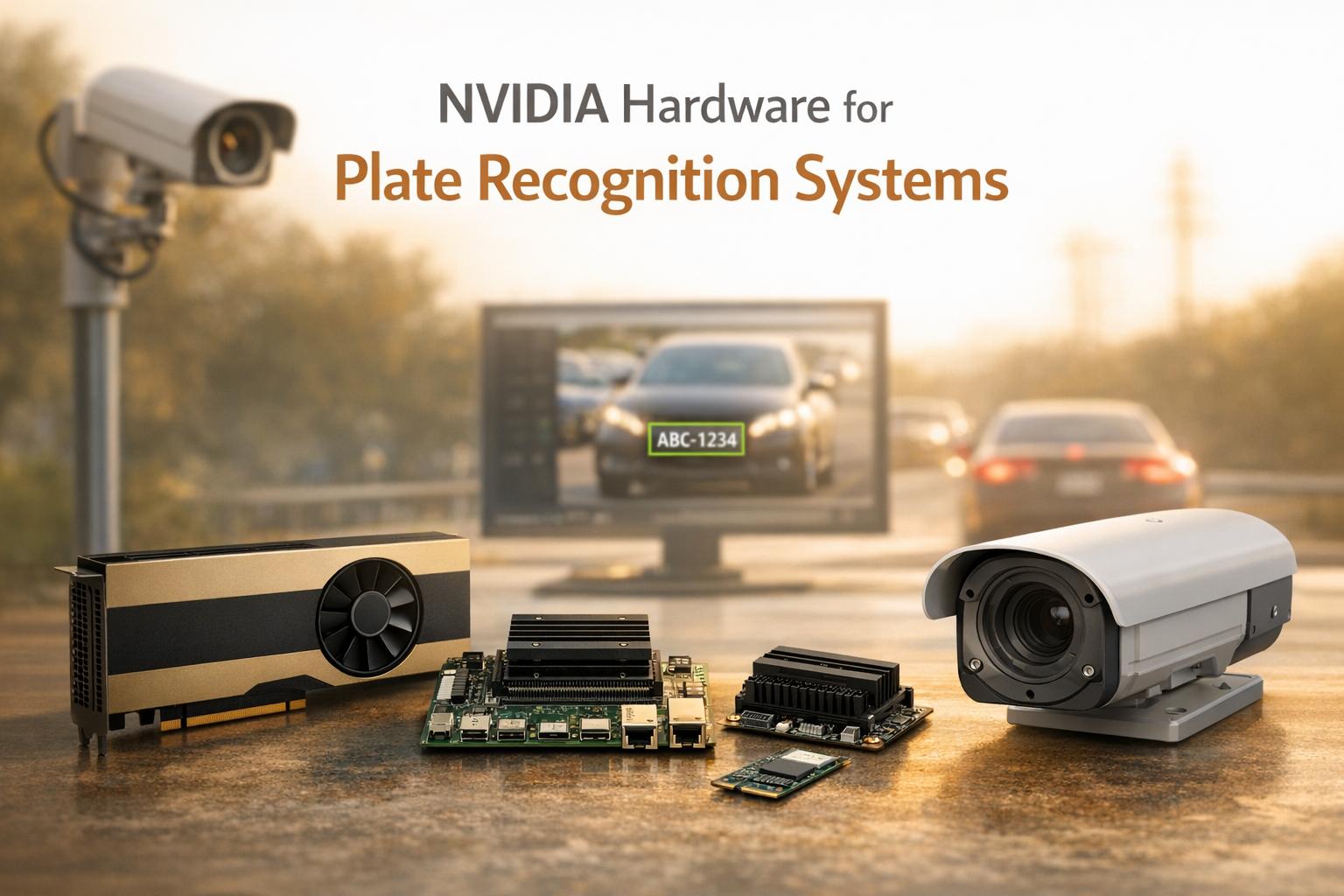
NVIDIA Hardware for Plate Recognition Systems
NVIDIA GPUs are the top choice for license plate recognition, offering unmatched speed, accuracy, and scalability. Their T4 GPU processes up to 2,748 frames per second (FPS), making it ideal for high-speed scenarios like highways. Compared to traditional CPUs, NVIDIA hardware is faster, more energy-efficient, and handles multiple video streams with ease. Here's what you need to know:
- Performance: NVIDIA T4 achieves 2,748 FPS for detection, while the Jetson Nano handles 9.2 FPS for smaller setups.
- Accuracy: NVIDIA models deliver near-perfect results, even in tough conditions like low light or motion blur.
- Cost: Options range from $99 for the Jetson Nano to $699 for the Jetson AGX Xavier, balancing affordability and power.
- Integration: Tools like DeepStream SDK and TAO Toolkit simplify deployment and optimize performance.
- Scalability: From small edge devices to large centralized systems, NVIDIA hardware handles it all.
For smaller budgets, Intel and ARM platforms provide alternatives but fall short in speed and scalability. NVIDIA remains the go-to for large-scale, high-performance systems.
1. NVIDIA Hardware
Performance
NVIDIA's AI models are designed to handle license plate recognition tasks with incredible speed and precision. Their LPDNet (License Plate Detection) and LPRNet (License Plate Recognition) models operate in a cascading pipeline - first spotting the vehicle, then isolating the license plate, and finally identifying the characters.
The hardware lineup offers a range of processing power. For instance, the Jetson Nano handles detection at 66 FPS, while the T4 GPU achieves a staggering 2,748 FPS at INT8 precision. Precision settings can make a big difference; the T4 GPU, for example, reaches 3,821 FPS for recognition tasks when set to FP16 precision. This high throughput means fewer hardware resources are needed, which directly cuts down operational expenses.
The TAO Toolkit is another game-changer, speeding up the training process with pre-trained models. Using this tool, developers achieved 82.28% mAP accuracy for license plate detection in just 120 epochs, compared to 53.11% when starting from scratch. For recognition tasks, pre-trained weights hit 90.90% validation accuracy in only 24 epochs, whereas models trained from scratch didn’t even converge after 100 epochs.
Cost and ROI
NVIDIA hardware stands out for its ability to lower costs while delivering excellent performance. A single GPU can handle multiple video streams simultaneously, reducing the need for additional devices and cutting both initial hardware investment and ongoing maintenance costs. This multi-stream capability makes it easier to cover larger areas with fewer resources.
Energy efficiency is another key benefit. For example, the Jetson TX2 consumes just 7.5 watts while processing license plates, making it a great choice for remote locations with limited power. In high-speed scenarios, like vehicles traveling over 60 mph, GPU acceleration ensures the accuracy needed for dependable recognition.
Ease of Integration
NVIDIA simplifies deployment with tools like the DeepStream SDK, which optimizes video decoding, image preprocessing, and inference across multiple streams. This ensures high channel density for real-time video analytics. TensorRT takes trained models and converts them into optimized engines tailored to specific hardware, enabling dynamic input shapes and high-throughput inference. Additionally, the tao-converter tool transforms encrypted .etlt models into TensorRT engines, ensuring they perform at their best on deployment hardware. Together, these tools make it easier to implement scalable, high-performance solutions in a variety of environments.
Scalability
NVIDIA's hardware is designed to adapt to a range of deployment needs, from small-scale setups to large installations. The Jetson family, for example, offers different performance levels to suit single-stream applications or multi-camera systems.
Optimization techniques further enhance scalability. INT8 quantization significantly boosts inference throughput, allowing each device to handle more cameras. The TAO Toolkit also supports model pruning, which reduces model size and speeds up inference without sacrificing much accuracy - an essential feature for scaling up to hundreds of cameras. Plus, pre-trained models available on the NVIDIA NGC catalog come with no licensing fees, making large-scale deployments more cost-effective.
VaxALPR for embedded devices using Jetson TX2 GPU
2. Alternative Hardware Platforms (Intel, ARM, and Others)
After evaluating NVIDIA hardware, it's worth exploring other platforms like Intel and ARM, each offering a mix of benefits and trade-offs in terms of speed, cost, and integration.
Performance
Intel's high-end CPUs, such as the Intel Xeon Platinum 8124M, deliver solid results for license plate recognition without needing GPU acceleration. This processor can handle 720p video at 148.7 FPS and 1080p at 112.3 FPS. However, these numbers fall short when compared to NVIDIA's T4 benchmarks.
ARM-based platforms are specifically designed for edge deployments. For instance, the Jetson Xavier NX processes 720p video at approximately 20.1 FPS, while the Jetson Nano achieves 16 FPS using FP16 precision. Non-NVIDIA solutions, like Meta's EgoBlur, operate on standard CPUs and generic GPUs, managing around 2 FPS for Full HD images. Tamas Foldi from HCLTech-Starschema highlighted the difference in performance, stating:
"NVIDIA LPDNet was able to detect LPs from low-res, low-quality feeds... LPDNet wins by orders of magnitude [in inference speed]".
These performance gaps directly impact both cost-effectiveness and the complexity of system integration.
Cost and ROI
Intel offers cost-efficient options for AI workloads. For example, the Intel Gaudi series provides strong AI performance. For retrofitting existing setups, the Intel Neural Compute Stick 2 is a budget-friendly, plug-and-play solution that adds AI capabilities without requiring a full system upgrade.
ARM-based accelerators shine in power efficiency. The Hailo-8 chip delivers 26 TOPS while consuming just 2.5 watts, translating to about 10 TOPS per watt. Similarly, Google Coral achieves 4 TOPS at 2 watts, making it a great fit for low-power IoT applications.
Ease of Integration
Intel simplifies integration with tools like the OpenVINO toolkit and the Neural Compute Stick 2, which connects via USB for quick deployment. Solutions like Meta's EgoBlur, using standard Python/Conda environments, also make initial setups on generic hardware straightforward.
However, these platforms often lack the cohesive software ecosystem that NVIDIA provides through tools like DeepStream and TAO Toolkit. While the openness of Intel and ARM platforms can simplify basic setups, it often requires more custom development for optimized multi-stream processing. This additional effort can affect scalability and deployment timelines.
Scalability
Beyond performance and cost, scalability plays a key role in selecting a hardware platform. Intel CPUs scale by distributing workloads across multiple cores rather than relying on massive parallelization. For centralized deployments, Intel Xeon processors can handle over 100 FPS for 720p streams, making them suitable for moderate-scale installations. Typically, systems add video streams until CPU utilization approaches 90-95%.
ARM-based platforms, on the other hand, focus on edge scalability. Numerous low-power devices process data locally, which works well for distributed setups like smart city applications. However, achieving the throughput of a single high-end NVIDIA GPU often requires deploying more hardware units. Emerging competitors, such as Intel's Gaudi 3 and Google TPUs, are also stepping into the enterprise space as alternatives to NVIDIA's architecture for large-scale workloads.
sbb-itb-9525efd
Advantages and Disadvantages
NVIDIA vs Intel vs ARM Hardware Performance Comparison for License Plate Recognition
Each hardware platform has its own set of strengths and limitations when it comes to license plate recognition systems. The table below breaks down how NVIDIA, Intel, and ARM-based solutions stack up across key factors like performance, cost, integration, and scalability.
Platform Performance Cost & ROI Integration Scalability NVIDIA GPUs (RTX 2080, T4, A100) Outstanding: 221 FPS at 1080p (RTX 2080); 2,748 FPS detection on T4 High initial cost but excellent FPS-per-dollar value; TAO Toolkit reduces training expenses Comprehensive ecosystem: DeepStream SDK and pre-trained models streamline deployment Highly scalable: A single T4 can handle 14 streams at 447.15 FPS; ideal for centralized, large-scale setups NVIDIA Jetson (Nano, NX, Xavier) Solid for edge: Nano achieves 9.2 FPS end-to-end; Xavier reaches 146.43 FPS across 5 streams Budget-friendly: Nano starts at $99, Xavier at $699; low power usage (7.5W–10W) cuts operational costs Moderate complexity: Requires TensorRT optimizations and careful sensor selection Best for edge deployments - multiple units needed to match centralized GPU performance Intel CPUs (Xeon Platinum) Decent: 203.8 FPS at 1080p (Xeon 8124M); lower performance compared to NVIDIA GPUs Cost-effective for existing systems; Neural Compute Stick 2 provides an affordable retrofit option Easy setup with OpenVINO toolkit and USB plug-and-play support Moderate scalability through multi-core CPU setups, suitable for mid-sized installations ARM Accelerators (Hailo-8, Google Coral) Limited: Hailo-8 offers 26 TOPS at 2.5W; Google Coral delivers 4 TOPS at 2W, ideal for single-stream tasks Lowest upfront cost and minimal power needs; achieves about 10 TOPS/W efficiency Basic integration via Python environments, though custom development is often required Best for distributed edge setups but lacks the performance of centralized GPU solutions
This comparison highlights the trade-offs, helping guide decisions based on deployment needs and scale. NVIDIA stands out in performance and software offerings, making it the go-to choice for high-throughput tasks. However, these systems require precise hardware-specific tuning to achieve their full potential.
For smaller, power-sensitive edge applications handling just one or two video streams, ARM accelerators like the Hailo-8 shine with their efficiency of 10 TOPS per watt. On the other hand, for large-scale deployments - such as monitoring urban environments with hundreds of video streams - NVIDIA GPUs like the T4 or A100 deliver unmatched centralized processing power. These distinctions are crucial when considering real-world deployment scenarios across different environments.
Conclusion
For single-camera setups, the Jetson Nano offers an affordable, energy-conscious option, operating at around 5–10W. If you're dealing with medium-scale operations, the Jetson Xavier NX/AGX steps up, delivering 80–146 FPS. For large-scale deployments, the NVIDIA T4 shines, handling 14 streams at over 447 FPS with ease.
While there are budget-friendly alternatives on the market, none rival NVIDIA's ability to process multiple high-resolution streams simultaneously.
But it’s not just about processing power. The real game-changer is turning raw data into actionable insights. For instance, after your NVIDIA system detects license plates using the TAO Toolkit (with detection accuracy of approximately 98.46% and recognition accuracy of 97.49%), the CarsXE vehicle data API takes over. It enriches this data by providing detailed vehicle information - covering the make, model, VIN, registration status, recalls, and even market value, sourced from a database spanning over 50 countries.
NVIDIA's hardware excels at real-time, computationally heavy video processing, whether at the edge or in a data center. Paired with CarsXE, you can seamlessly enhance the captured data through simple RESTful API calls. This powerful combination is ideal for applications like parking systems, toll networks, or security checkpoints, offering unmatched speed and depth of information.
The secret lies in choosing hardware that aligns with your stream count and leveraging INT8 precision optimization to boost performance. By integrating CarsXE’s API, you can transform license plate data into comprehensive vehicle profiles, creating a synergy between NVIDIA’s high-performance platforms and enriched data insights - a combination that sets a new benchmark for license plate recognition systems.
FAQs
How does NVIDIA hardware enhance license plate recognition in low-light conditions?
NVIDIA hardware plays a key role in enhancing license plate recognition, especially in low-light conditions. By utilizing advanced GPUs, it powers deep learning models like YOLOv5s, LPRNet, and LPDNet. These models excel at processing images with exceptional precision, improving clarity and ensuring dependable detection and optical character recognition (OCR), even when lighting is less than ideal.
With NVIDIA's optimized hardware, these systems can perform complex computations at impressive speeds, making them perfect for real-time applications like traffic monitoring and vehicle identification.
What are the cost advantages of using NVIDIA GPUs for large-scale license plate recognition systems?
NVIDIA GPUs are well-known for their performance and reliability in handling demanding tasks like license plate recognition. While exact cost comparisons aren't provided, their ability to process large amounts of data quickly and accurately can help businesses save money in the long run. By improving processing efficiency and requiring less hardware, they contribute to lower operational expenses over time.
What sets NVIDIA apart is its advanced GPU architecture, which enables real-time data processing and incorporates AI-driven optimizations. These features are especially valuable for large-scale systems, making NVIDIA GPUs an attractive option for businesses that need solutions built for scalability and high performance.
How does the NVIDIA TAO Toolkit simplify using NVIDIA hardware for license plate recognition?
The NVIDIA TAO Toolkit simplifies the process of building and deploying license plate recognition (LPR) systems on NVIDIA hardware. It comes with pre-trained, commercially licensed models such as LPDNet for detecting plates and LPRNet for recognizing characters. These models can be fine-tuned with your own datasets, eliminating the need to write custom code and significantly reducing development time and effort.
Using a straightforward YAML-based workflow, you can configure training parameters, leverage GPU Tensor Cores for model optimization, and export the models as TensorRT engines for real-time performance. Plus, the toolkit integrates effortlessly with NVIDIA’s ecosystem, including the DeepStream SDK and NGC containers, making it easy to deploy LPR systems on edge devices or in the cloud. This seamless approach helps you achieve efficient workflows and accelerates the development of LPR solutions.
Related Blog Posts
- Top 7 APIs for Multi-Country Plate Decoding
- AI Noise Reduction in License Plate OCR
- How Image Preprocessing Improves License Plate Recognition
- RNNs for Vehicle License Plate Recognition