Steps to Calculate a VIN Check Digit

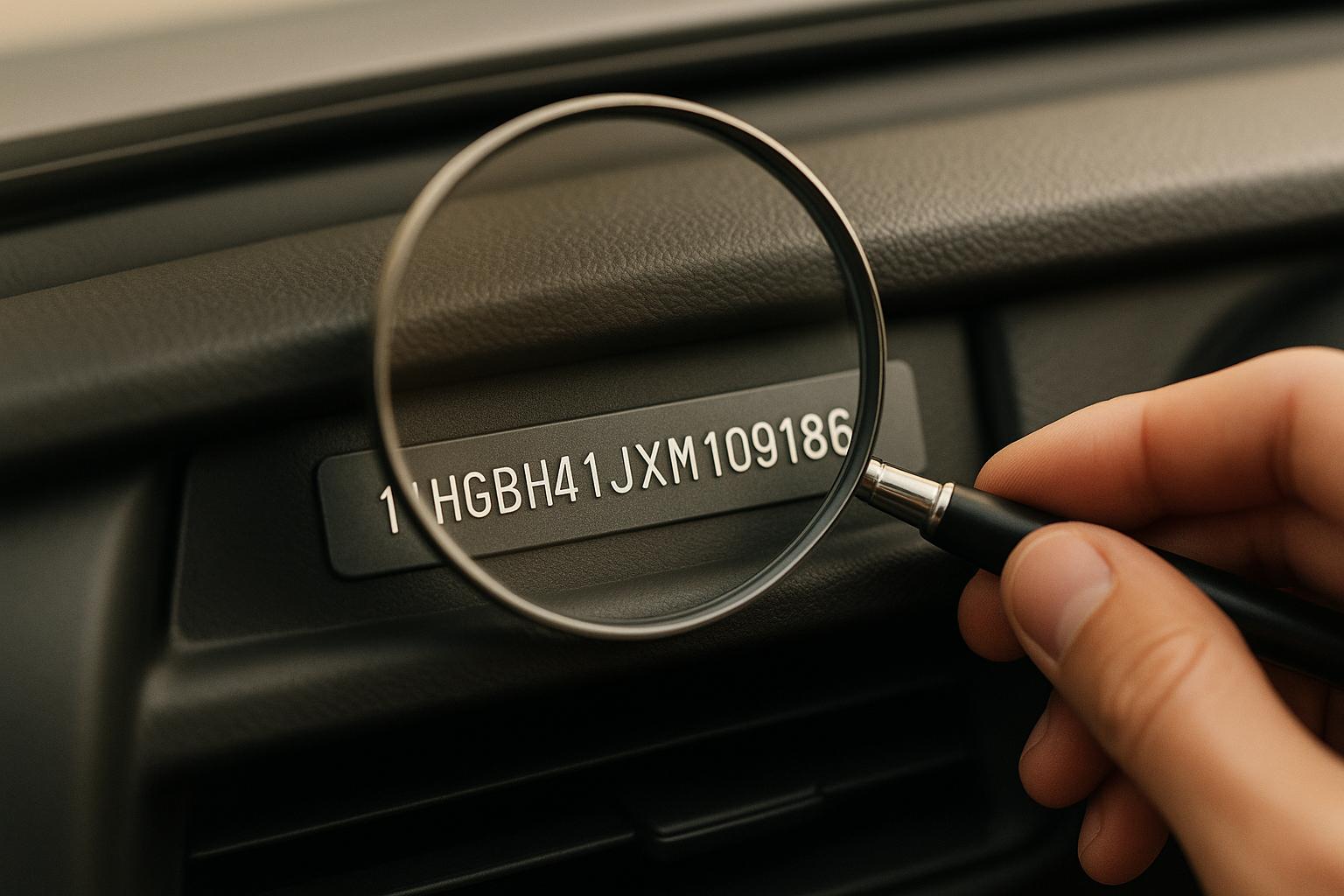
Steps to Calculate a VIN Check Digit
In the U.S., every vehicle has a unique 17-character VIN (Vehicle Identification Number), and its 9th character is the check digit. This digit is a safeguard to ensure the VIN's accuracy. Calculating the check digit involves converting letters to numbers, applying weight factors, and performing a modulus operation. Here's how:
- Convert Letters to Numbers: Use a standard transliteration table (e.g., A = 1, B = 2, etc.; I, O, Q are excluded).
- Apply Weight Factors: Each VIN position has a specific weight (e.g., 8 for position 1, 7 for position 2, etc.).
- Multiply and Add: Multiply each character's numeric value by its weight and sum the results.
- Divide by 11: Use modulus 11 to find the remainder. If it’s 10, the check digit is "X"; otherwise, it’s the remainder.
Example: For VIN 1M8GDM9A_KP042788, the check digit is X. This ensures the VIN is mathematically valid, reducing errors during vehicle registration or data entry.
For large datasets or automation, tools like CarsXE's API simplify this process.
The #Check Digit(9th Digit), of your Vehicle VIN. Is Ur Vehicle VIN Valid?
What You Need Before Starting
Before diving into the process of calculating the VIN check digit, you'll need to gather a few essential tools: a letter-to-number conversion table, a weight factor table, and a complete 17-character VIN (with the check digit temporarily set to zero).
Letter-to-Number Conversion Table
The transliteration table is the key to converting VIN letters into their numeric equivalents. For example, the letters A and J both translate to the number 1. To avoid confusion, the letters I, O, and Q are excluded from VINs because they can be mistaken for numbers like 1 and 0.
Here’s how the standard conversion works:
- A = 1, B = 2, C = 3, D = 4, E = 5, F = 6, G = 7, H = 8
- J = 1, K = 2, L = 3, M = 4, N = 5, P = 7, R = 9
- S = 2, T = 3, U = 4, V = 5, W = 6, X = 7, Y = 8, Z = 9
Some letters share values to streamline the process. For example, if you're working with the VIN segment "1M8GDM9A", the conversion would look like this:
1 = 1, M = 4, 8 = 8, G = 7, D = 4, M = 4, 9 = 9, A = 1.
This approach applies to every alphabetic character in the 17-character VIN. Once you've converted the letters, the next step involves applying the weight factors.
Weight Factor Table
Each position in the VIN is assigned a specific weight factor, which determines how much influence that position has during the calculation. These weights are multiplied by the corresponding numeric values from the conversion table.
The weight factors for positions 1 through 17 are as follows:
8, 7, 6, 5, 4, 3, 2, 10, 0, 9, 8, 7, 6, 5, 4, 3, 2.
Notice that the 9th position (the check digit) uses a weight of 0, as it doesn’t contribute to the calculation.
VIN Format Requirements
Before starting the calculation, make sure the VIN meets the required format. You need a complete 17-character VIN that adheres to the US standard. For the calculation, the ninth position (check digit) should be temporarily set to zero or left blank.
The 17-character format is mandatory for all road vehicles sold in the United States and Canada. Using a VIN that’s incomplete or doesn’t follow this format will lead to incorrect results because the process relies on the exact sequence of characters and their corresponding weight factors.
Each VIN must consist of digits and permitted letters (excluding I, O, and Q). If the VIN isn’t formatted correctly, calculations won’t work as intended.
For those looking to simplify the process, platforms like CarsXE offer APIs that can handle VIN validation and check digit calculations automatically.
How to Calculate the VIN Check Digit
To calculate the VIN check digit, you'll follow a structured formula mandated by the National Highway Traffic Safety Administration (NHTSA) for all vehicles sold in the US and Canada. This algorithm is designed to catch transcription errors or swapped characters, making it a reliable tool for error detection. Here's how it works.
Step 1: Convert Letters to Numbers
Start by converting each of the 17 characters in the VIN into numbers using the transliteration table. Keep digits as they are. For instance, if your VIN is 1M8GDM9A_KP042788 (where the underscore represents the missing check digit), the conversion would yield: 1, 4, 8, 7, 4, 4, 9, 1, _, 2, 7, 0, 4, 2, 7, 8, 8.
Step 2: Apply Weight Factors
Each VIN position is assigned a specific weight factor. These weights are: 8, 7, 6, 5, 4, 3, 2, 10, 0, 9, 8, 7, 6, 5, 4, 3, 2. Notably, the 9th position has a weight of 0, as it doesn’t contribute to the calculation - this is reserved for the check digit itself.
Using the example VIN, pair each converted number with its corresponding weight. For instance, position 1 gets weight 8, position 2 gets weight 7, and so on.
Step 3: Multiply and Add
Multiply each converted value by its weight factor, then add up all the products. For the example VIN, the calculation would look like this:
1×8 + 4×7 + 8×6 + 7×5 + 4×4 + 4×3 + 9×2 + 1×10 + 0×0 + 2×9 + 7×8 + 0×7 + 4×6 + 2×5 + 7×4 + 8×3 + 8×2
This results in: 8 + 28 + 48 + 35 + 16 + 12 + 18 + 10 + 0 + 18 + 56 + 0 + 24 + 10 + 28 + 24 + 16 = 351.
Step 4: Divide by 11 and Find the Remainder
Divide the total sum by 11 and use the remainder as the check digit. This step is known as the modulus 11 operation. If the remainder is between 0 and 9, that number becomes the check digit. If the remainder is 10, the check digit is represented by the letter 'X'.
In the example, 351 ÷ 11 = 31, with a remainder of 10. Since the remainder is 10, the check digit is 'X'.
Step 5: Place the Check Digit
Finally, insert the calculated check digit into the 9th position of the VIN. For the example VIN 1M8GDM9A_KP042788, the completed VIN becomes 1M8GDM9AXKP042788.
This finalized VIN now includes a built-in verification mechanism. While there’s about a 1 in 11 chance that two different VINs could share the same check digit, it remains an effective safeguard against transcription errors and data entry mistakes.
If you're handling large datasets, tools like CarsXE offer VIN decoding APIs to automate check digit calculations and validate VINs while providing additional vehicle details for both US and international markets.
sbb-itb-9525efd
Example Calculation
Here’s a detailed example of how to calculate a VIN check digit, walking through each step of the process.
Complete Example
Let’s use the VIN 1M8GDM9A_KP042788, where the underscore represents the missing check digit.
Step 1: Transliterate the Characters
Using the standard transliteration table, letters are converted into their numeric equivalents:
- M becomes 4, G becomes 7, D becomes 4, A becomes 1, K becomes 2, and P becomes 7.
Numbers remain unchanged. After applying this, the sequence becomes:
1, 4, 8, 7, 4, 4, 9, 1, _, 2, 7, 0, 4, 2, 7, 8, 8.
Step 2: Apply Weight Factors
Each position in the VIN is assigned a specific weight factor:
8, 7, 6, 5, 4, 3, 2, 10, 0, 9, 8, 7, 6, 5, 4, 3, 2.
Step 3: Multiply and Sum the Results
Multiply each numeric value by its corresponding weight and sum the products. The calculation looks like this:
1×8 + 4×7 + 8×6 + 7×5 + 4×4 + 4×3 + 9×2 + 1×10 + 0×0 + 2×9 + 7×8 + 0×7 + 4×6 + 2×5 + 7×4 + 8×3 + 8×2.
Breaking it down, the results are:
8 + 28 + 48 + 35 + 16 + 12 + 18 + 10 + 0 + 18 + 56 + 0 + 24 + 10 + 28 + 24 + 16 = 351.
Step 4: Calculate the Check Digit
Divide the total, 351, by 11. The remainder is 10. In VIN standards, a remainder of 10 is represented by the check digit X.
So, the complete VIN is 1M8GDM9AXKP042788.
Step-by-Step Table
Here’s a breakdown of the calculations for each character:
Position Character Value Weight Factor Product 1 1 1 8 8 2 M 4 7 28 3 8 8 6 48 4 G 7 5 35 5 D 4 4 16 6 M 4 3 12 7 9 9 2 18 8 A 1 10 10 9 (check digit) 0 0 0 10 K 2 9 18 11 P 7 8 56 12 0 0 7 0 13 4 4 6 24 14 2 2 5 10 15 7 7 4 28 16 8 8 3 24 17 8 8 2 16 Total 351
This table confirms the calculation, step by step. Dividing 351 by 11 results in a remainder of 10, confirming the check digit as X.
For those looking for an automated solution, CarsXE's VIN decoding API simplifies this process while also providing additional vehicle details.
Validation and Regional Differences
Validating a VIN involves comparing the calculated check digit to the one included in the VIN itself. This step ensures the number is formatted correctly, though the process can vary depending on where the vehicle was made or registered.
US Validation Standards
In the United States, the check digit is a required mathematical safeguard enforced by the National Highway Traffic Safety Administration (NHTSA) under Federal Motor Vehicle Safety Standard 115. The ninth character in every 17-character VIN must match the calculated check digit for the VIN to be considered valid.
The process is simple: if the calculated check digit matches the ninth character in the VIN, it passes validation. However, it's worth noting that a correct check digit doesn't confirm the VIN is authentic - it only verifies the mathematical accuracy of the sequence.
When a VIN fails this validation in the US, it usually points to a transcription or data entry error. Outside the US, however, the rules for validation can differ significantly.
Other Countries
Check digit requirements aren't universal. While the US and Canada mandate the check digit for all vehicles, other regions take different approaches.
- Europe: The check digit is often not legally required. Many European VINs omit it entirely, or the ninth position may serve a different purpose. Some manufacturers include it voluntarily, but there's no standardization across the region.
- Asia and other regions: Practices vary widely. Some countries have adopted the US system, while others use entirely different standards or skip check digit validation altogether. This creates challenges for international transactions and imports, as validation methods can differ greatly.
Region Check Digit Requirement Standard Used Notes United States Mandatory NHTSA (FMVSS 115) 9th digit, "X" for remainder 10 Canada Mandatory Same as US Identical to US standards Europe Not mandatory Varies by manufacturer Some include voluntarily, not required Other Regions Varies Local or adopted standards May follow US, EU, or regional rules
For vehicles made before 1981, when the 17-character VIN standard was introduced in the US, check digit validation doesn’t apply. Additionally, imported vehicles may have VINs that don’t conform to US rules, requiring extra steps during registration.
CarsXE VIN Decoding API
To simplify the process of validating VINs across different regions, CarsXE offers a VIN decoding API. This tool provides real-time, automated validation tailored to regional standards in more than 50 countries.
The API identifies the vehicle's origin and applies the correct validation method, including US-compliant check digit checks. This eliminates the need to manually account for varying regional requirements, reducing errors that could disrupt vehicle registration, inventory tracking, or sales operations.
With CarsXE’s API, you can handle VINs from multiple markets without worrying about whether they require check digit validation or follow unique formatting rules. This is especially useful for dealerships, insurers, and fleet managers working with vehicles from diverse regions.
Summary
Calculating the VIN check digit involves a series of steps: converting letters into numbers, applying specific weight factors, multiplying and summing the results, dividing the total by 11, and using the remainder as the check digit. If the remainder equals 10, it's represented as an "X" in the 9th position.
Getting this calculation right is crucial for verifying vehicles. The check digit helps catch transcription errors and ensures compliance with U.S. regulations. An incorrect digit can lead to registration problems, insurance complications, and even legal issues for dealerships and fleet managers.
While manual calculations are useful for understanding the process, they aren't practical for managing large datasets, handling vehicle imports and exports, or overseeing dealership inventories. Manual methods are more prone to human error when dealing with multiple VINs, making automation a necessity.
CarsXE's VIN decoding API provides a real-time solution for automating VIN decoding and check digit verification across more than 50 countries. This tool eliminates the risk of manual errors, saves time, and delivers precise vehicle data through user-friendly APIs and dashboards. For businesses managing high volumes of VINs, this automated approach ensures accuracy and compliance with industry standards and regulations.
FAQs
What is the importance of the VIN check digit, and what problems can occur if it's incorrect?
The VIN check digit plays an important role in ensuring the accuracy and reliability of a Vehicle Identification Number (VIN). Think of it as a built-in quality check that helps confirm the VIN follows established guidelines, making it harder for errors or tampering to go unnoticed.
An incorrect check digit can cause various problems, such as failed vehicle registrations, inspection rejections, or difficulties in accessing key vehicle information like history reports or recall notices. Verifying that the check digit is correct helps uphold the integrity of the VIN and avoids unnecessary headaches later on.
Is the VIN check digit calculation the same in the US as it is in other regions like Europe or Asia?
The process for determining the VIN check digit follows the standardized guidelines set by ISO 3779. This global standard ensures that the calculation - using weights, assigned numeric values, and a modulus operation - is consistent no matter the region, whether it's the United States, Europe, or Asia.
That said, there can be regional variations in how VINs are formatted or interpreted due to local regulations. For instance, manufacturers might incorporate specific characters or codes to comply with country-specific rules. However, these regional differences have no impact on the calculation of the check digit itself.
Is it possible to automate the calculation of a VIN check digit, and what tools can help with this?
Automating the calculation of a VIN check digit is absolutely achievable. Tools like the CarsXE Vehicle Data API suite make this task much easier by offering features such as real-time VIN decoding and access to comprehensive vehicle details. These tools are built to simplify what can otherwise be a complex process, saving time while maintaining precision.
CarsXE allows developers to seamlessly integrate VIN decoding into their applications through a straightforward dashboard and a RESTful API. This makes the automation process not only efficient but also easy to implement.
Related Blog Posts
- How VIN Decoding Powers Compliance Verification
- Impact of Regional Standards on VIN APIs
- Regional VIN Standards: What Developers Need to Know
- VIN Year Codes: Complete Chart