How Japan VIN Decoding Differs Globally

How Japan VIN Decoding Differs Globally
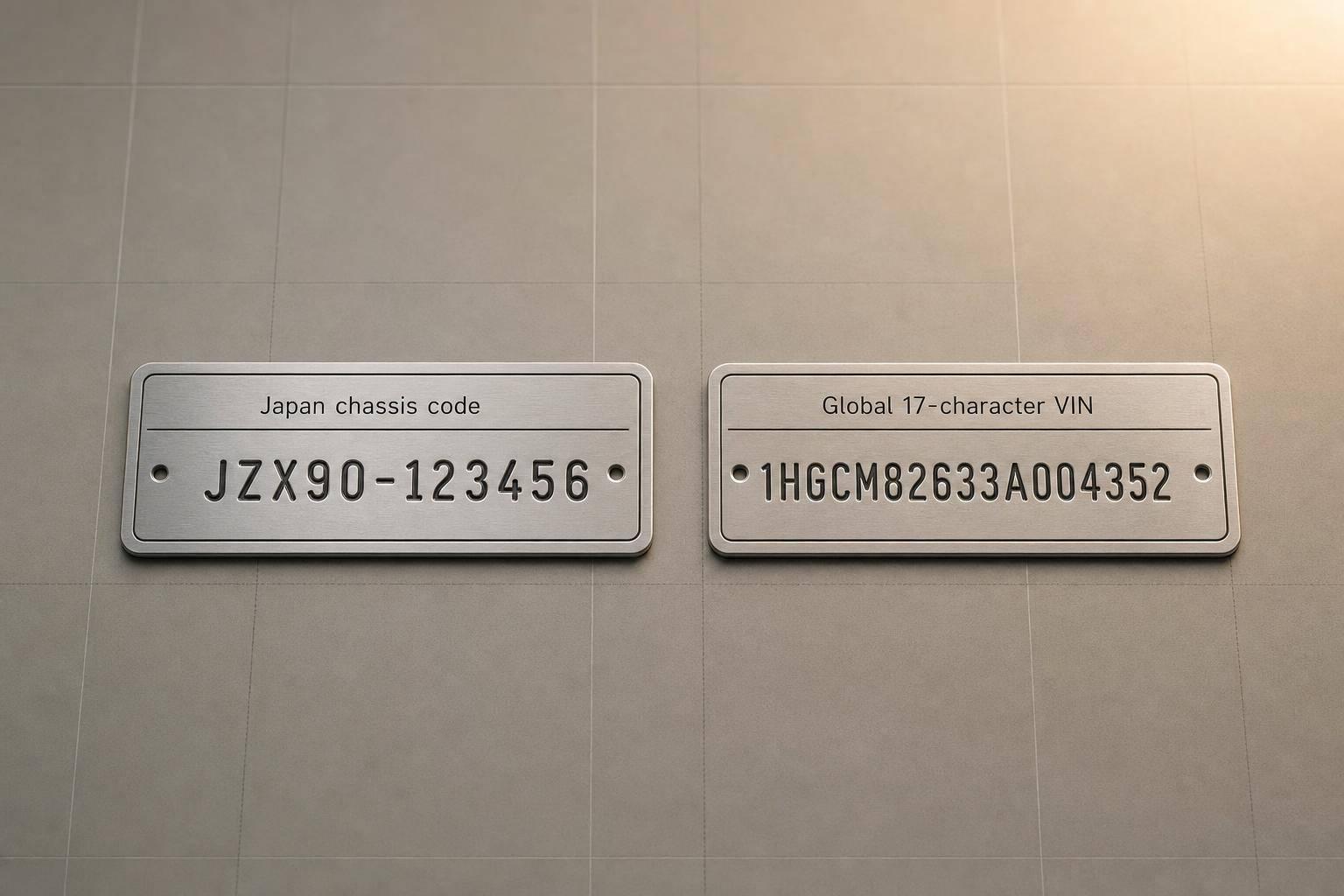
If a Japanese car does not have a 17-character VIN, most U.S. systems will not read it the normal way. That is the main issue.
I’d sum it up like this:
- Japan domestic vehicles usually use a 9- to 12-character chassis/frame number
- U.S. and many global systems expect a 17-character VIN
- Japan-built export vehicles often have a full 17-character VIN, so they fit U.S. DMV, insurance, recall, and history tools much better
- A Japanese chassis number usually does not include a check digit, fixed model year position, or fixed country/manufacturer positions
- For many JDM imports, I need the chassis number plus the model code to identify trim and equipment
That gap causes direct problems in the United States. A shorter Japanese identifier can fail in title systems, recall searches, insurance tools, and value lookups. It can also slow import paperwork, especially for 25-year-rule vehicles.
Bottom line: if I see 17 characters, I use normal VIN tools. If I see fewer than 17, I treat it as a Japan chassis number and use Japan-specific lookup sources instead.
Japan VIN vs. Chassis Number: Key Differences at a Glance
Quick Comparison
Item Japan domestic chassis number ISO 3779 / U.S. VIN Japan-built export vehicle ID length 9–12 characters 17 characters 17 characters Main format Model code + serial Fixed-position VIN Fixed-position VIN Check digit Usually no Yes, in U.S. use Yes, for U.S.-market VINs Model year in fixed position No Yes Yes Works in U.S. VIN tools Often no Yes Yes Best decoding method Maker/Japan database lookup Standard VIN decoder Standard VIN decoder U.S. workflow fit Low High High
One number system was built for Japan’s local registration process. The other was built for cross-market VIN decoding. That’s why the same car can be easy to identify in Japan but hard to process in the U.S.
sbb-itb-9525efd
1. Japan Domestic Chassis/Frame Number Decoding
Identifier Structure
Japan’s domestic vehicle identifier is called the Shadai Bangō (車台番号). It usually runs 9 to 12 alphanumeric characters [1][11].
In most cases, a Japan domestic chassis number uses a model code plus a serial number, often split by a hyphen. For example, BNR32-305366 points to the model series and the production sequence [10]. The serial length changes by maker. In some cases, that length can hint at who built the vehicle, but it’s not dependable enough to use by itself for identification [1].
That setup works well inside Japan. But once you compare it with VIN systems built around fixed character positions, the limits show up fast.
Regulatory Framework
Japan regulates chassis numbers under JIS D 4901, which is a modified adoption of ISO 3779. These numbers serve as the main vehicle identifier in Shaken inspection and compliance records [2][4][9].
So the system was built first for domestic registration needs, not for global VIN decoding.
Data Completeness
A Japanese domestic chassis number does not lock in the manufacturer, country, or model year in fixed positions. It also does not include a check digit [1][5][6][8]. If you want trim, color, or equipment details, you usually need the separate model code as well [1][10].
In plain terms, the chassis number tells part of the story, not the whole thing.
Cross-Border Decoding
Once these shorter identifiers hit the border, they often run into trouble in U.S. systems that expect a 17-character VIN. That’s why matching usually depends on specialized chassis-to-production databases [1][5][6][12].
The gap becomes easier to see when you put this system next to ISO 3779 VIN decoding. The next section shows how ISO 3779 assigns meaning to each of the 17 VIN positions.
2. Global ISO 3779 17-Character VIN Decoding
Identifier Structure
The ISO 3779 standard uses a 17-character alphanumeric code split into three parts: the World Manufacturer Identifier (WMI), the Vehicle Descriptor Section (VDS), and the Vehicle Identifier Section (VIS) [5][8].
Section Positions Purpose WMI 1–3 Region, country, and manufacturer VDS 4–9 Model, body style, engine type VIS 10–17 Model year, assembly plant, serial number
This is very different from Japan's domestic chassis numbers. Here, each character position means something specific. The WMI points to the region and maker, the VDS describes the vehicle itself, and the VIS covers the year, plant, and serial number. The letters I, O, and Q are left out to avoid mix-ups with numbers like 1 and 0 [3][8].
Regulatory Framework
The format by itself doesn't make a VIN easy to decode. The rules behind it do.
In the United States, 49 CFR Part 565, carried out through NHTSA, requires OEMs to submit VIN decoding mappings and safety data through the 565 submittal. U.S. rules are tighter at position 9. In North America, position 9 must be a Modulo 11 check digit, and position 10 shows model year on a 30-year cycle [14][7].
Data Completeness
When a 17-character VIN is decoded the right way, one short string can reveal the manufacturer, country of origin, model year, assembly plant, and sequential production number.
"ISO 3779:2009 specifies the content and structure of a vehicle identification number (VIN) in order to establish, on a world-wide basis, a uniform identification numbering system for road vehicles." - ISO 3779:2009 Abstract [13]
Cross-Border Decoding
The 17-character format has supported cross-market decoding since 1981 [5]. NHTSA's vPIC is widely used because it is public and broad in scope [14].
That setup shifts again for vehicles built in Japan for export, where a full VIN takes the place of the domestic chassis number.
3. Japan-Built Export Vehicles With Standard VINs
A Japan-built vehicle made for the U.S. market uses the full 17-character VIN format [16][1]. By contrast, Japanese domestic vehicles usually use a shorter chassis or frame number. That difference matters because Japan also has its own domestic identification system, and it doesn't follow the same global VIN setup.
Japan's own standard, JIS D 4901, is a modified adoption of ISO 3779 and ISO 3780 [2][15]. So export vehicles can follow global VIN rules even though domestic cars often do not.
For Japan-built export vehicles, the VIN uses the global 17-character structure. But decoding it isn't always simple. Some parts still depend on maker-specific VIN data. The first character, J, identifies Japan [16][8]. Common WMIs include:
Positions 4–8 are still manufacturer-specific and usually require OEM data or a VIN decoder to interpret [16].
There's another wrinkle here. A Japan-built vehicle first sold in a different market may still need changes to meet Federal Motor Vehicle Safety Standards if it's later imported as a gray-market vehicle [17]. The VIN shows where the vehicle came from. It does not prove compliance. That split sets up the next section, which looks at domestic chassis numbers next to standard VINs.
How Japan Domestic Chassis Numbers Differ From 17-Character VINs
Japan's domestic chassis numbers and global VINs follow different logic. You see that difference most clearly when it's time to decode them.
Format and Length Differences
The biggest contrast is the structure itself, and how each code gets looked up. A U.S.-standard VIN is always 17 characters long [16]. A Japan domestic chassis number is usually 9 to 12 alphanumeric characters [1], often written with a dash in the middle.
Take a Toyota chassis number like SV30-0169266. It includes a model prefix and a serial number, but it does not place origin, model year, or a check value in fixed character positions [1]. That's a big shift from the U.S. system. And it's one reason these numbers can run into trouble in U.S. registration, insurance, and vehicle-history systems.
Why Fixed-Position Decoding Works Differently
VINs are built for fixed-position decoding. Japanese chassis numbers are not. In an ISO 3779 VIN, each character sits in a set position and carries a set meaning [16]. Japanese domestic numbers work another way: they are decoded through manufacturer database lookup, not a shared position-by-position rule [1][6].
To supply details that the chassis number does not include on its own, Japanese manufacturers use a separate Model Code. For example, SV30-BTPNK points to a given trim and equipment setup [1]. Once a Japanese vehicle moves into U.S. registration and history systems, that missing fixed-position data can turn into a compliance problem.
Feature ISO 3779 VIN (U.S.) Japan Domestic Chassis Number Total Length Fixed 17 characters [16] 9–12 characters [1] Check Digit Mandatory at Position 9 [16] Generally not present [1] Decoding Method Fixed-position rules [16] Manufacturer database lookup [1][6]
Regulatory and Registration Differences
Decoding differences turn into compliance issues the moment a vehicle hits a registration system.
Japan Domestic Registration Context
Japan’s domestic vehicle registration system is built around the Chassis (Frame) Number, not a global VIN. Japan matches that chassis number with a model code to identify trim and configuration.[1] Put those two together, and they do the same job a VIN does in the U.S.
Japan also uses Shaken (車検), a mandatory roadworthiness inspection program tied to the vehicle’s identity through that chassis-number-and-model-code pairing.
U.S. VIN-Based Compliance Requirements
In the U.S., federal agencies, insurers, and DMVs use a 17-character VIN as the main vehicle identifier. Position 9 includes a check digit, which helps systems catch data-entry mistakes. A Japanese domestic chassis number is usually 9 to 12 characters long and does not include a check digit, so it doesn’t fit the fixed-format fields many U.S. systems expect. That can trigger manual review or an outright rejection.
That format mismatch is the main reason import and registration can get messy.
What Changes When a Japan-Built Vehicle Is Exported
Japan-built export vehicles use the standard 17-character VIN format, so they line up with what U.S. Customs, DMVs, and insurance systems expect.
The trouble tends to show up with JDM vehicles brought in under the 25-year federal age exemption. Those imports still have to go through federal review and state registration. If the chassis number doesn’t fit a state system, some states assign a state VIN during inspection.[18][19]
Those registration rules set up the practical tradeoffs covered next.
Practical Tradeoffs for U.S. Decoding, History, and Compliance
That identifier gap shows up in almost every U.S. process that relies on vehicle data. Japan domestic chassis numbers don't fit the same fixed-position decoding logic that U.S. systems expect. So things slow down fast: decoding takes longer, record matching gets weaker, and compliance work turns more manual.
Importers and Dealers
A Japan-built export vehicle with a standard 17-character VIN usually moves through U.S. customs, auctions, and title systems with less friction. A JDM import with a 9 to 12 character chassis number often doesn't. Dealers buying stock from Japanese auctions usually need the Model Code too, such as SV30-BTPNK, along with the chassis number, to pull full trim and spec data. The chassis number by itself doesn't carry that detail.[1]
That creates a pretty direct problem. Standard U.S. decoders often fail on JDM chassis numbers, so dealers have to use Japan-specific lookup sources before they can list, appraise, or price a vehicle. If that lookup isn't done early, the same data gap spills into inventory setup and valuation.
Insurers and Valuation Workflows
Most U.S. valuation platforms assume the VIN can tell them the trim level, engine, and feature set. With Japanese domestic vehicles, that logic falls apart. Trim data isn't encoded in the chassis number, so valuation tools often lean on past listings to guess the configuration. That's a weak fallback, especially for low-volume JDM imports that have little or no U.S. sales history.[7]
In practice, that means appraisal and claims teams end up doing more manual review. The issue isn't only that the identifier is shorter. It's that vehicle-level trim and validation data often aren't there in the first place.
Recall and History Record Matching
U.S. recall and history systems are built around 17-character VINs. So when a JDM import enters the picture, teams usually need Japan-side records to piece together the vehicle's history.[9]
Developer and API Integration Considerations
For software teams, the split is simple: VINs can be validated structurally, while Japanese chassis numbers usually can't. That means developers need separate validation flows for each identifier type. Year decoding also gets shaky without full VIN context.
APIs that support cross-border vehicle data, like CarsXE, can help close part of that gap. But the prep work still matters. Before running any lookup, developers should:
- convert the identifier to uppercase
- strip hyphens and spaces
- store the raw input separately for audit purposes[20]
Feature 17-Character VIN (ISO/U.S.) Japan Domestic Chassis Number Length Exactly 17 characters [7] 9 to 12 characters [1] Check Digit Mandatory at Position 9 [7] Not included [1] Make Identification Encoded in WMI (Positions 1–3) Inferred from model code [1] Model Year Encoded in Position 10 [7] Requires external lookup [1] U.S. DMV Compatibility High; native to title workflows Low; often requires manual handling [9] Recall/History Support Full for U.S.-indexed systems [14] Requires Japan-specific sources [1] Public Data Access High via NHTSA submittals [14] Largely proprietary [14] Validation Risk Low; algorithmic check [14] Higher; no universal checksum [20]
Pros and Cons
The tradeoff is pretty simple: Japan domestic chassis numbers fit local registration in Japan, while export VINs fit U.S. decoding and compliance far better.
Put another way, each identifier is built for a different job. Japan domestic chassis numbers work best inside Japan. ISO 3779 VINs work best across markets. And Japan-built export VINs tend to slide into U.S. systems with the least friction.
Subject Pros Cons Japan Domestic Chassis Numbers Fits Japan's registration system; useful for model and serial identification [1] Forces manual lookup in U.S. workflows; no check digit; difficult to process in U.S. registration, insurance, and history databases [1][16] ISO 3779 VINs (Global Standard) Works across markets; high information density across WMI, VDS, and VIS sections [3] Regional decoding rules still vary, especially check-digit use and year-position interpretation [3][8] Japan-Built Export VINs (U.S. Spec) Best fit for U.S. compliance; fully compliant with 49 CFR Part 565; fit U.S. recall, insurance, and DMV workflows [3][16] Full trim decoding still requires OEM data [21]
That’s why U.S. workflows usually treat Japan domestic chassis numbers as lookup-based identifiers, not direct VIN equivalents.
Common Problems U.S. Users Run Into
Those differences don’t stay on paper. They show up fast in day-to-day U.S. workflows.
The first snag is simple: a Japanese domestic chassis number usually breaks standard U.S. VIN tools because it’s shorter than 17 characters and doesn’t follow the ISO VIN format [16].
Recall and history searches run into the same wall. Most U.S. systems are VIN-first, and many don’t have JDM chassis mappings, so the results are partial - or there’s no result at all [9]. Even when the same model was sold in both Japan and the U.S., recall data can still differ by plant. So a recall tied to the U.S. version may not show up for the Japanese domestic version [16][21].
That same mismatch spills into import paperwork. If the Japanese export certificate doesn’t line up with U.S. forms like HS-7 and EPA Form 3520-1, clearance at the port can get delayed [18]. And those delays aren’t cheap. Bonded storage fees can run $25 to $75 per day [18]. Some states also add a physical inspection or emissions review. In California, that can mean a BAR referee [18][19].
Auction records can trip people up too. Japanese auction sheets may show the first registration date instead of the build date. That detail matters a lot in the U.S. because the 25-year rule is based on the build date, not the registration date [18][22].
At the root of all this is one basic mismatch: a domestic Japanese identifier being pushed through a VIN-based U.S. system.
Conclusion
Japan’s domestic system uses chassis or frame numbers. Most global markets use 17-character ISO 3779 VINs. Export vehicles usually follow that global format, but domestic JDM vehicles often don’t.
That difference matters most in U.S. registration and lookup workflows. For U.S. readers, the rule is simple: check the identifier first before you run any title, history, value, or recall search. If it’s a 17-character ID, use standard VIN tools. If it’s a shorter Japan chassis number, use Japan-specific decoding instead.
The same goes for teams dealing with imports at scale. Importers, dealers, insurers, and developers should identify the number first, then send anything under 17 characters through Japan-specific decoding. When possible, capture the model code along with the chassis number.
Platforms like CarsXE can support that split decoding workflow across more than 50 countries.
Identify the number first, then decode it the right way.
FAQs
How can I tell if my Japanese car has a VIN or a chassis number?
Check the code’s length and format. A standard VIN is always 17 characters long. A Japanese chassis number or frame number is usually shorter, often 9 to 12 alphanumeric characters.
You can usually find it stamped on the chassis frame, inside the engine bay, or on your registration or insurance documents.
Why do U.S. DMV and insurance systems reject some JDM vehicle numbers?
U.S. DMV and insurance systems often reject Japanese vehicle identifiers because they don’t match the required 17-character VIN format.
Japanese domestic market vehicles usually use a shorter chassis number, often 9 to 12 characters, instead of a standard VIN with a check digit. That’s where the problem starts.
Most U.S. systems are built to validate the 17-character VIN structure. So when a Japanese domestic market vehicle shows up with a shorter identifier, the system may flag it or reject it outright.
What extra information do I need to decode a Japanese chassis number correctly?
You usually need the Model Code. A Japanese chassis number often tells you only a small part of the story, like the model and serial number.
The Model Code gives you the missing context. It helps identify things like features, engine type, and equipment. And because manufacturers use their own coding systems, you may also need supporting documents, auction sheets, or manufacturer-specific databases.
Related Blog Posts
- How VIN Decoding Retrieves Vehicle Specs
- US vs. EU VIN Decoding Standards
- How VIN Decoding Helps with Import Compliance
- Harmonizing VIN Decoding Algorithms