OBD Code Diagnostics for Plug-In Hybrids

OBD Code Diagnostics for Plug-In Hybrids
If a plug-in hybrid is not VIN-matched, fully scanned, and monitor-ready, it can fail a certification check even after the repair is done.
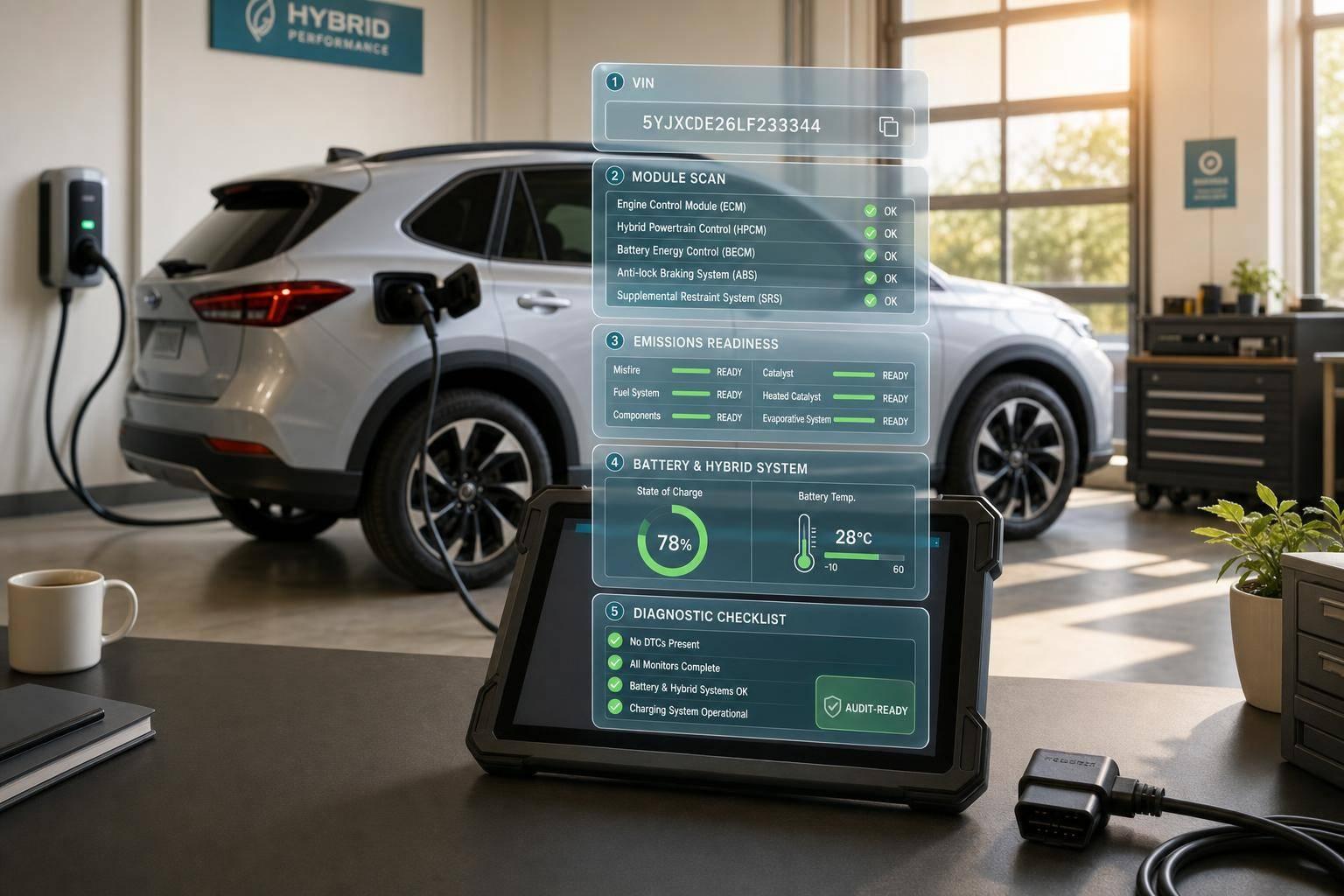
I’d sum up the process like this: verify the VIN, scan every related module, fix emissions-first faults, confirm monitor status, run the right drive cycle, and save proof before and after the repair. For PHEVs, that means checking both the gas side and the hybrid side, because faults in the battery, inverter, or control modules can stop the vehicle from entering the modes needed for testing.
Here’s the short version:
- OBD-II covers more than engine faults on a PHEV
- MIL status and readiness monitors are the main pass/fail signals
- Federal rules may allow 2 not-ready monitors, while California may allow only 1 for many 2000+ vehicles
- EVAP leak detection goes down to 0.020 inches under Tier 3
- Permanent codes do not clear right away and may need about 15 warm-up cycles and 200 miles
- Battery SOC should be at least 40%
- Battery temperature should be at least 59°F
- OEM data matters, because generic tools can miss battery, inverter, charging, and thermal faults
- SAE J1979-2 / OBDonUDS is becoming part of the certification path, with EPA acceptance from MY 2024 and CARB use expanding for MY 2027
A quick way to think about it: generic OBD tells you part of the story; PHEV certification needs the full story.
Check area What I’d confirm Vehicle setup VIN, model year, fuel type, rule set Fault scan Stored, pending, and permanent DTCs Modules ECU, BMS, inverter, hybrid control, thermal system Pass/fail items MIL status and readiness completion Drive conditions SOC, temperature, mode entry Audit file Pre-scan, post-scan, freeze-frame, repair notes, tool info
If I were building a repeatable process, I’d treat those six checks as the baseline for every certification-related PHEV diagnostic record.
Core OBD Requirements for Plug-In Hybrids
Readiness monitors, emissions systems, and hybrid fault coverage
Once readiness and MIL status are confirmed, the next step is checking the emissions and hybrid monitors the vehicle is supposed to support.
For certification compliance, PHEVs need to monitor standard emissions items like misfire, fuel system integrity, oxygen and air-fuel ratio sensors, catalyst performance, and EVAP leaks. Under federal Tier 3 standards, EVAP leak detection is required at or above an effective diameter of 0.020 inches. After any memory clear, the vehicle also has to log monitor completion again. [4]
That’s only part of the picture. PHEVs also need OBD coverage for hybrid-related parts that can affect emissions. That includes the rechargeable energy storage system (RESS), the inverter, and hybrid control modules such as the PHEV-ECU. [3][5] If one of those parts has a fault, the vehicle may not enter the operating modes needed for emissions testing. A good example is a precharge contactor fault like P0AE7-00. [5]
OEM-specific codes and data
Generic OBD-II trouble codes, defined by SAE J2012, handle common issues like engine misfires, fuel system faults, and catalyst problems. Any standard scan tool can read those.
But for PHEV certification records, that basic view isn’t enough.
OEM-specific codes fill in the gaps. They can show battery cell-level voltages, inverter temperatures, thermal management status, and charging circuit faults that won’t show up in generic data. SAE J1979-2 opens the door to more than 65,000 parameters, which is a big jump from the old limit. EPA and CARB are also moving this into the certification process. EPA accepted it as a valid compliance path starting with model year 2024, and CARB will require it for all new certifications beginning with model year 2027. [6]
Feature Generic OBD-II OEM-Specific Codes and Data Standardization Universal across brands Defined by the OEM Hybrid Detail Basic powertrain and emissions faults Battery cells, inverter temps, thermal management Parameter Capacity 256 PIDs 65,536 DIDs Access Any standard OBD-II scan tool Often requires enhanced access or OEM-specific software
Why vehicle identification matters before diagnostics
VIN verification comes first for a reason. If you skip it, you can end up scanning the wrong module set and miss high-voltage faults.
It can also lead you to apply the wrong emissions rules. EPA Tier 3 and California LEV II do not use the same malfunction thresholds, and the allowed number of "not ready" monitors changes by jurisdiction. CARB allows only one not-ready monitor for model year 2000 and newer vehicles, while the federal EPA standard allows two. [6]
CarsXE can decode the VIN and pull vehicle specs before the first scan. That helps match the right monitor set and the right diagnostic protocol. Once the VIN is confirmed, you can move straight to the correct modules and emissions codes.
sbb-itb-9525efd
Hybrid/EV Diagnosis and Repair with Jason Gabrenas | Snap-on Diagnostics UK
Step-by-Step OBD Diagnostic Workflow for Certification Compliance
PHEV OBD Diagnostic Workflow for Certification Compliance
1. Connect safely and scan all relevant modules
Once you've confirmed the vehicle profile, begin with a pre-repair baseline scan.
Connect through the SAE J1962 OBD-II port with a quality adapter, such as an ELM327-based or STN-based unit, that supports the vehicle's communication protocols. Cheap clone adapters can trip you up here. They often fail on multi-frame responses or mishandle CAN protocols.
Scan every relevant module: the ECU, BMS, hybrid control module, inverter, and thermal-management system.[2] Record stored and pending DTCs, freeze-frame data, and readiness status before you change anything.
That baseline scan gives you a clean starting point. It helps you separate emissions faults from hybrid faults in the next step.
2. Read DTCs and prioritize emissions-related faults
Group the codes by system, then address emissions-related faults first. That order matters because hybrid or BMS faults can block emissions test modes.
3. Check monitors, review live data, and confirm repairs
After you fix the blocking faults, verify readiness before running the drive cycle.
All applicable monitors should read "complete" before certification-level emissions testing. For California compliance, the only monitor that may remain incomplete on 2000+ gasoline vehicles is the EVAP monitor.[1]
Before the drive cycle, keep the state of charge at 40% or higher and battery temperature at 59°F (15°C) or higher. If those numbers are too low, the hybrid system may not enter all required modes.[7]
During the drive cycle, watch live data for:
- HV battery voltage and current
- SOC and SOH
- Pack temperature
- Inverter and motor temperature
- Isolation resistance
- Propulsion status[2]
After the drive cycle, confirm that none of the original DTCs return and that the target monitors still show "complete."
Save the post-repair scan as the certification record.
How to Document OBD Results for Audits and Internal Records
After the post-repair scan, save the results in a format that stands up to audit review. The goal is simple: an auditor should be able to follow the full trail from vehicle ID to fault, repair, and retest without guessing.
What to include in every certification-related diagnostic record
Start with the basics: VIN, make, model, engine size, fuel type, and certification type. Then log MIL status for key-on/engine-off and key-on/engine-running, along with all confirmed, pending, and permanent DTCs.
Permanent DTCs deserve extra attention. They clear only after the repair has been verified through driving, usually after 15 warm-up cycles and 200 miles. That’s why it helps to record the distance traveled since codes were cleared. It gives you a clear way to show whether those marks have been reached.
You’ll also want to include freeze-frame data, such as engine load, temperature, and fuel trim at the moment the fault was set. Add readiness monitor status for every supported monitor, the repair action taken, and the scan tool model, software, and firmware. That last part matters more than people think. If someone reviews the file months later, traceability can save a lot of back-and-forth.
Pre-repair vs. post-repair comparison table
A side-by-side layout makes the repair trail easy to read at a glance.
DTC or Monitor Pre-Repair Status Post-Repair Status Emissions Relevance Notes DTC P0301 Stored / MIL ON Cleared / MIL OFF High (Misfire) Replaced spark plug and coil Evap Monitor Not Ready Complete High Readiness restored after repair PDTC P0456 Present Cleared High Cleared after 200 miles / 15 warm-up cycles Battery SOC 45% 95% Low (Hybrid System) Verified charging circuit Mode $06 TID $01 Fail (Value: 0.5) Pass (Value: 0.1) Medium Catalyst efficiency check
The Mode $06 row is worth a closer look. Those component test values and pass/fail thresholds can show borderline issues before they turn on the MIL. In plain English, they can help you confirm the repair before the vehicle goes back into service.
Using CarsXE to standardize vehicle and OBD data workflows
When you’re handling a lot of records, standard intake helps avoid mismatched vehicle and OBD data. Use CarsXE to automate VIN-based intake and keep vehicle fields lined up with OBD records. Manual entry may seem harmless, but at scale it creates avoidable record mistakes.
For fleet and software workflows, make, model, year, engine, and fuel type can be filled in as soon as the VIN is submitted. That keeps diagnostic records consistent before testing even starts.
If your team is getting ready for the move to SAE J1979-2 (OBDonUDS) in model year 2027, map legacy PIDs to UDS DIDs so records stay consistent across model years [6][8].
Best Practices and Conclusion
Common mistakes that delay or block compliance
Most certification delays don’t come from the repair itself. They usually come from setup mistakes that are easy to avoid.
One of the biggest ones is clearing DTCs before a certification scan. That wipes readiness data and sends you back to retesting. Another common problem is relying on a generic scan tool. Generic scans can miss the exact conditions that decide whether hybrid monitors will run. Use enhanced module data instead. It gives you the detail you need. Also, run actuator tests before the drive cycle so you can spot functional failures early, before you waste time on a retest.
Key points to carry into your diagnostic process
Once you’ve removed the blockers, the job gets a lot simpler. Boil it down to a small set of repeatable checks and treat that as your final certification checklist.
Start with the VIN. Accurate vehicle identification sets the right diagnostic configuration and the right pass/fail standards before any scan begins [1]. Then scan all modules, not just the engine control module. Put emissions-related and hybrid-specific faults at the top of the list, including the Energy Storage System and thermal management systems [2][7].
After that, make sure readiness monitors show "Ready" or "Complete" status. Confirm the repair with live data, and use the right drive cycle pattern for each fault type [1][7]. Keep your records audit-ready so the fault, repair, and retest are easy to trace.
FAQs
Why can a plug-in hybrid fail after the repair is done?
A plug-in hybrid can still fail after a repair if a deeper issue is still there. Common causes include hybrid system faults, battery management problems, motor/generator faults, inverter issues, or a needed software update.
When that happens, the vehicle may log diagnostic trouble code P1E00 and switch on the check engine light.
Do I need an OEM-level scan tool for PHEV diagnostics?
Not always. Generic OBD-II scan tools can read basic diagnostic trouble codes and check monitor systems.
But for deeper diagnostics - especially when you're dealing with high-voltage components or maker-specific data - you may need OEM-specific tools or protocols like UDS.
How long do permanent codes take to clear?
Permanent codes usually clear on their own only after the root problem is fixed and the vehicle completes at least 15 warm-up cycles and 200 miles of driving.
Related Blog Posts
- How OBD Data Powers Predictive Analytics
- How to Integrate OBD Data into Your App
- International Standards for OBD Session Management
- How VIN Decoding Helps with Import Compliance