How Authentication Enhances RBAC in OBD Systems

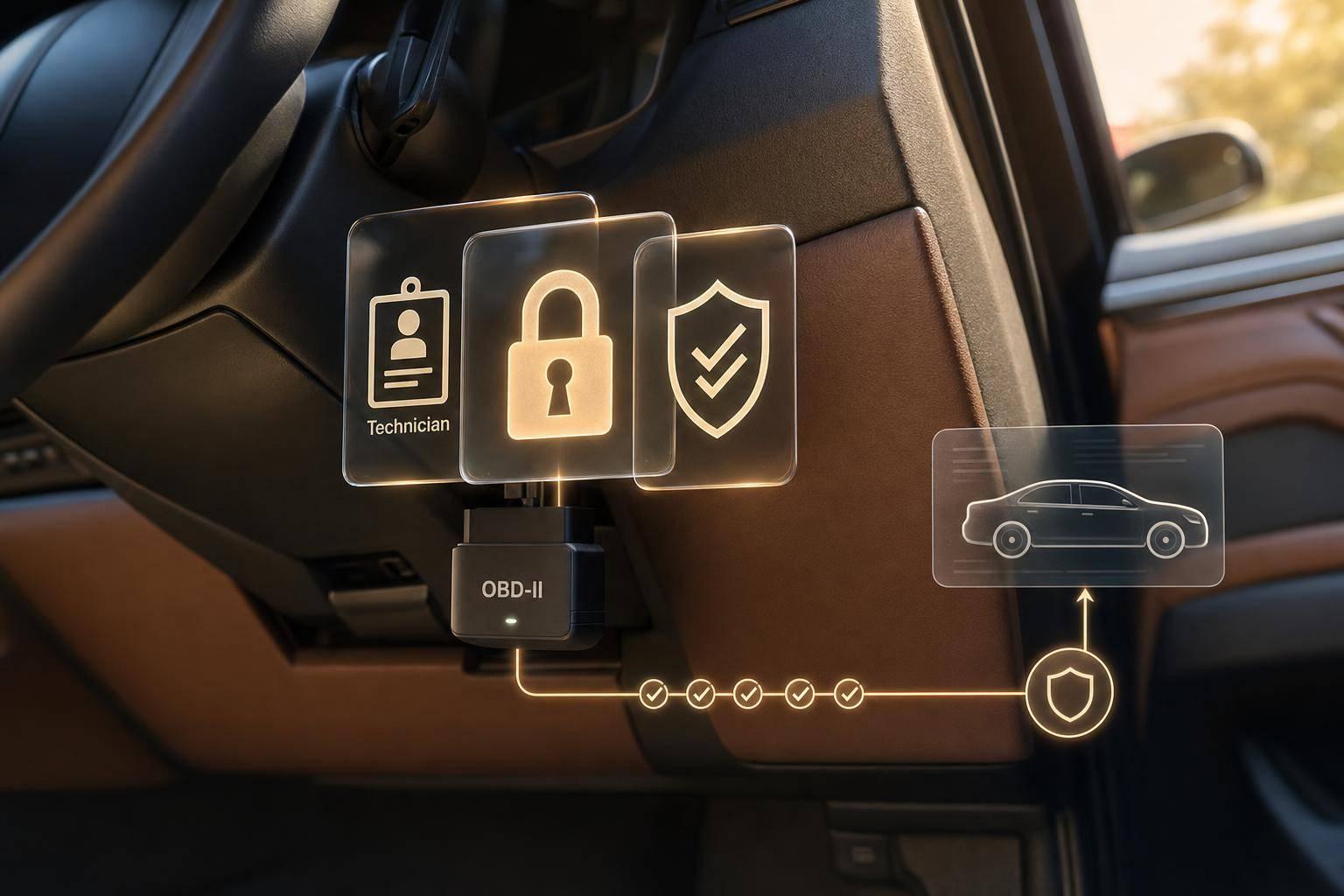
How Authentication Enhances RBAC in OBD Systems
Key Takeaways:
- RBAC (Role-Based Access Control) determines what users or tools can do based on their roles, such as OEMs, fleet managers, or technicians.
- Authentication ensures only verified users or tools gain access, forming the backbone of RBAC.
- Legacy methods like the "seed-and-key" model (UDS Service 0x27) are outdated and insecure.
- Modern approaches, like UDS Service 0x29, use digital certificates and cryptography for stronger protection.
- Risks include physical and remote attacks, data theft, and compromised vehicle systems, as seen in the 2015 Jeep Cherokee hack.
Solutions:
- Credential-Based Authentication: Digital certificates validate roles and identities.
- Token-Based Authentication: OAuth tokens specify permissions and restrict access.
- Multi-Factor Authentication: Adds extra security layers for high-risk tasks.
- Secure Gateway Modules (SGWs): Block unverified commands and enforce authenticated access.
Benefits:
- Prevents unauthorized access to critical vehicle systems.
- Reduces privilege misuse by linking permissions to verified identities.
- Enhances accountability through detailed audit logs.
Modernizing OBD security with advanced authentication and RBAC is essential for protecting vehicles and sensitive data from evolving threats.
Authentication Models That Support RBAC in OBD Systems
UDS 0x27 vs UDS 0x29: OBD Authentication Security Comparison
When it comes to Role-Based Access Control (RBAC) in On-Board Diagnostics (OBD) systems, several authentication models come into play. These range from traditional credential methods to more advanced token-based and multi-factor techniques, all designed to ensure accurate role verification.
Credential-Based Authentication
One of the older methods, UDS Service 0x27, also known as the "seed-and-key" model, relies on a diagnostic tool requesting a seed from the ECU. The tool then calculates a key based on a shared secret and sends it back. If the key matches, access is granted. However, this method lacks any mechanism to verify the identity of the connecting party or their role.
"The fundamental limitation of 0x27 is that it proves knowledge of a secret, not identity." - Piembsystech [1]
A more modern approach is UDS Service 0x29, introduced in ISO 14229-1:2020. This method uses Public Key Infrastructure (PKI) and X.509 digital certificates. Its standout feature, APCE (Asymmetric Proof of Possession and Certificate Exchange), validates the diagnostic tool's certificate chain back to a trusted Root CA. From there, it extracts role metadata - such as OEM, dealer, or supplier - to enforce specific permissions. It also supports certificate revocation through CRL or OCSP, which means compromised credentials can be invalidated without having to reflash every ECU [1].
While these credential-based methods provide a solid foundation, the growing complexity of vehicle networks has led to the adoption of more advanced authentication models.
Token and OAuth-Based Authentication
In cloud-connected OBD systems, OAuth 2.0 with JSON Web Tokens (JWT) offers a scalable solution. Tokens encode roles and permissions directly, specifying not only the user's identity but also their exact access rights - such as which APIs they can call or which vehicle identifiers they can interact with [5].
This method also minimizes the risk of privilege escalation. Even if a token is intercepted, its permissions are narrowly defined and time-limited. For example, systems like Volkswagen/Audi's SFD (Schutz Fahrzeug Diagnose) use time-limited tokens to grant access to specific modules during authorized operations [1].
Feature UDS 0x27 (Security Access) UDS 0x29 (Authentication) Security Basis Shared secret/algorithm PKI and digital certificates Identity Verification Proves knowledge of a secret Verifies cryptographic identity Granularity Binary (locked/unlocked) Role-based (OEM, dealer, supplier) Revocation None (requires reflashing) Supported via CRL or OCSP Standard Legacy UDS ISO 14229-1:2020
For scenarios requiring even greater trust, additional layers of authentication come into play.
Multi-Factor and Risk-Based Authentication
In offline or high-security situations, multi-factor authentication (MFA) provides an extra layer of security. For instance, research from Politehnica University of Timișoara explores combining RFID tokens with mobile "soft tokens" for offline authentication [7].
Some advanced models utilize group signatures, which allow a vehicle to confirm that a user belongs to an authorized role - such as "Technician" - without revealing their specific identity.
"By using group signatures, the car will be aware which role is accessing the car, i.e., owner, driver, passenger or technician, but will have no information on the entity that instantiated the specific role." - Bogdan Groza et al., Politehnica University of Timișoara [7]
When combined with Attribute-Based Access Control (ABAC), RBAC becomes even more dynamic. This approach adapts policies based on context, such as distinguishing between a vehicle owner performing maintenance and a valet who only needs limited access [7].
These authentication models - spanning credential-based, token-based, and multi-factor methods - work together to improve security, prevent privilege escalation, and enable the safe integration of vehicle data APIs.
sbb-itb-9525efd
How Authentication Strengthens RBAC in OBD Systems
Linking Identities to Roles and Permissions
RBAC works effectively only when the system reliably verifies the identity of the requester. Without proper identity verification, roles are just labels - easy to claim but difficult to enforce.
Modern systems address this by tying permissions to verified identities. For instance, identity-based cryptography systems like PRESTvO derive public keys from a user’s identity or a vehicle’s VIN. This ensures permissions are mathematically linked to a confirmed identity rather than one that’s self-reported [7]. Similarly, SGWs now require internet-authenticated credentials to enforce access, making sure only validated identities can control sensitive functions [4].
"The SGW sits between these two networks and decides which commands pass through based on an approved, authenticated list." - Consumer Rights Wiki [4]
This setup ensures that someone claiming the "Technician" role cannot assume it unless their credentials are validated by the system. By securely linking identities, authentication becomes a cornerstone in preventing unauthorized privilege use.
Preventing Role Abuse and Privilege Escalation
Even when roles are assigned correctly, compromised credentials or tools can lead to privilege misuse. Strong authentication measures help mitigate these risks.
Session-specific keys play a critical role here. Under UDS Service 29, session keys expire at the end of a diagnostic session - or even earlier if mileage offset limits or explicit deauthentication requests are triggered [2]. The J1939-ADBE protocol improves security further by eliminating the centralized Security-designated ECU (SeCU). Instead, it distributes key management, reducing the risk of a single point of failure and cutting vehicle-wide key rotation delays by 41.5% to 81.6% compared to older centralized systems [6].
For high-risk tasks like ADAS calibration or module programming, time-limited tokens (used in Volkswagen/Audi’s SFD system) limit access duration, reducing the potential for damage [4]. These measures - session keys and time-restricted tokens - directly bolster RBAC by preventing unauthorized role changes and ensuring secure, time-bound access.
Improving Auditability and Access Transparency
Authentication doesn’t just control access - it also enhances accountability by creating a clear audit trail. This is crucial for compliance, safety investigations, and resolving legal disputes.
Group signatures strike a balance between privacy and accountability. They allow a vehicle to confirm that a user belongs to a specific role without revealing their identity. However, in the event of a dispute, it’s still possible to trace the individual. As one study explains:
"By using group signatures, the car will be aware which role is accessing the car... but will have no information on the entity that instantiated the specific role." - Bogdan Groza et al., Politehnica University of Timișoara [7]
Advanced frameworks like XACML4M take this further by logging every access request with details such as signal type, time, location, and frequency. This creates a tamper-resistant record [8]. These audit capabilities not only verify access but also support RBAC by providing a transparent history of role-based permissions. For instance, insurers may require proof that ADAS cameras were recalibrated after a windshield replacement. Authenticated OBD access provides the verifiable documentation needed to meet such requirements [4].
Applying These Findings to Vehicle Data APIs and Platforms Like CarsXE
Security Patterns for OBD Data Access
Research highlights the importance of layered security when accessing OBD data. This approach starts with verifying identity through authentication and then enforcing permissions with role-based access control (RBAC). Skipping either step can leave vulnerabilities that attackers might exploit.
A great example is the Secure Gateway (SGW) architecture, which treats the OBD-II port as a "public" entry point. However, access to more sensitive internal vehicle functions requires authenticated credentials. Companies like Stellantis and Bosch have implemented this model, requiring technicians to authenticate via authorized services before performing advanced tasks like bidirectional repairs. The level of authentication varies based on the risk of the data request: for instance, reading OBD fault codes is relatively low-risk, while clearing diagnostic trouble codes (DTCs) or accessing a vehicle’s full history demands stricter authentication.
These layered strategies offer a strong foundation for securing vehicle data APIs, including platforms like CarsXE.
Adding Authentication and RBAC to CarsXE APIs
By following these principles, CarsXE can enhance the security of its APIs through more robust authentication and role-based access controls.
CarsXE already grants access to sensitive vehicle data, such as OBD diagnostics, VIN decoding, and vehicle history. To strengthen security, token-based access tied to role-aware permissions should be adopted. OAuth tokens containing role metadata would be evaluated with each request, ensuring that every integration only gets access to the data its role permits. This is in line with the principle of least privilege:
"A user isn't special because of who they are; they're trusted because of the role they hold right now." - LoginRadius [9]
For higher-risk endpoints, risk-based authentication can add an extra layer of protection. For example, multi-factor authentication (MFA) can safeguard actions like bulk history pulls or lien data access. This becomes especially important when considering insider threats, which can be costly. Data breaches caused by malicious insiders average $4.92 million, compared to the overall average of $4.44 million [10]. Clearly defined roles and step-up authentication can help mitigate this risk.
Challenges and Next Steps
Implementing advanced authentication and RBAC at scale comes with its own set of challenges:
- Interoperability: Vehicle data originates from numerous OEMs, each with its own diagnostic protocols and security measures. A universal solution, like the Secure Vehicle Interface (SVI) initiative, could simplify this by replacing manufacturer-specific authentication systems with a standardized approach. This would reduce complexity and eliminate the need for multiple per-OEM subscriptions [4].
- Latency and Performance: Cryptographic operations can slow down processes. Research on J1939-ADBE suggests that selective protection - applying intense cryptography only to high-risk services like powertrain or braking controls - can maintain real-time performance while still ensuring security [6]. For CarsXE, this means tailoring authentication intensity to the sensitivity of each endpoint.
- Legacy Coverage: Many vehicles on U.S. roads today were not designed with authenticated OBD access.
"The architectures of vehicles were never designed with external connectivity in mind, and accordingly, security has never been pivotal in the design." - Mahmoud Ammar et al. [3]
To address this, solutions must work across both older and newer vehicle architectures without requiring hardware upgrades. For CarsXE, ensuring API-layer security that accommodates legacy vehicles is essential to maintaining broad compatibility and effectiveness.
Conclusion
Research shows that without robust authentication, Role-Based Access Control (RBAC) in On-Board Diagnostics (OBD) systems falls short, enabling unauthorized users to assume roles they shouldn't.
As Yufeng Li and colleagues from the Shanghai Key Laboratory of Intelligent Connected Vehicle Cybersecurity explain:
"SAE J1939 lacks native cryptographic authentication, leaving in-vehicle communication exposed if adversaries obtain access to the bus." [6]
The industry is moving away from centralized models, which are vulnerable to single-node failures, toward decentralized authentication systems that distribute trust. Decentralized approaches like J1939-ADBE have been shown to reduce message delays by 41.5% to 81.6%, improving both security and performance.
These advancements directly benefit vehicle data APIs. For example, platforms like CarsXE - which handle sensitive vehicle data - should adopt measures such as linking tokens explicitly to roles, implementing strict authentication for high-risk endpoints, and incorporating access controls that adapt to context. Researcher Ashish Ashutosh emphasizes this point:
"Connected vehicles operate in a highly dynamic environment, it is important to consider context information such as location, time, and frequency when designing a fine-grained access control mechanism." [8]
The reality is that many vehicles on U.S. roads today were not built to withstand modern cybersecurity threats. For these vehicles, software-based, AUTOSAR-compliant solutions remain the only practical way to enhance security and make a tangible difference [3].
FAQs
Why isn’t RBAC enough without authentication in OBD systems?
Relying solely on Role-Based Access Control (RBAC) for On-Board Diagnostics (OBD) systems leaves a critical gap in security. Without robust authentication measures, unauthorized users or devices could potentially access the system and even manipulate vehicle functions. This creates serious risks, as it directly impacts both the safety and security of the vehicle.
The OBD-II port, in particular, is a common target for cyberattacks due to its accessibility. Incorporating authentication ensures that only verified and authorized entities can interact with the system. This added layer of security plays a crucial role in minimizing the risks of unauthorized access and tampering.
What makes UDS 0x29 more secure than the seed-and-key method (UDS 0x27)?
UDS 0x29 (Authentication) offers a stronger level of security compared to the seed-and-key method (0x27). The key difference lies in how each approach establishes trust and safeguards communication.
UDS 0x29 employs PKI certificates and cryptographic handshake protocols. This ensures trust is established through verified identities and helps prevent threats like replay attacks. By using these advanced methods, it creates a robust and secure authentication process.
On the other hand, the seed-and-key mechanism (0x27) relies on a simpler challenge-response system based on shared secrets. While functional, this method is more susceptible to vulnerabilities such as key leakage and brute-force attacks, making it less secure than the cryptographic measures in UDS 0x29.
How do SGWs and OAuth tokens limit what a diagnostic tool can do?
SGWs and OAuth tokens limit the use of diagnostic tools by implementing short-lived, proof-of-possession tokens that are linked to specific device identities. For instance, tokens like mTLS-bound JWTs ensure they are valid exclusively for the device they are tied to. This approach reduces the chance of misuse and lowers the risks associated with token exposure.
Related Blog Posts
- How PKI Secures Vehicle Data APIs
- Common Access Control Issues in Vehicle APIs
- How Mutual Authentication Secures Vehicle Data APIs
- Phishing in OBD Systems: Case Studies