Checklist for Choosing a Data Licensing Provider

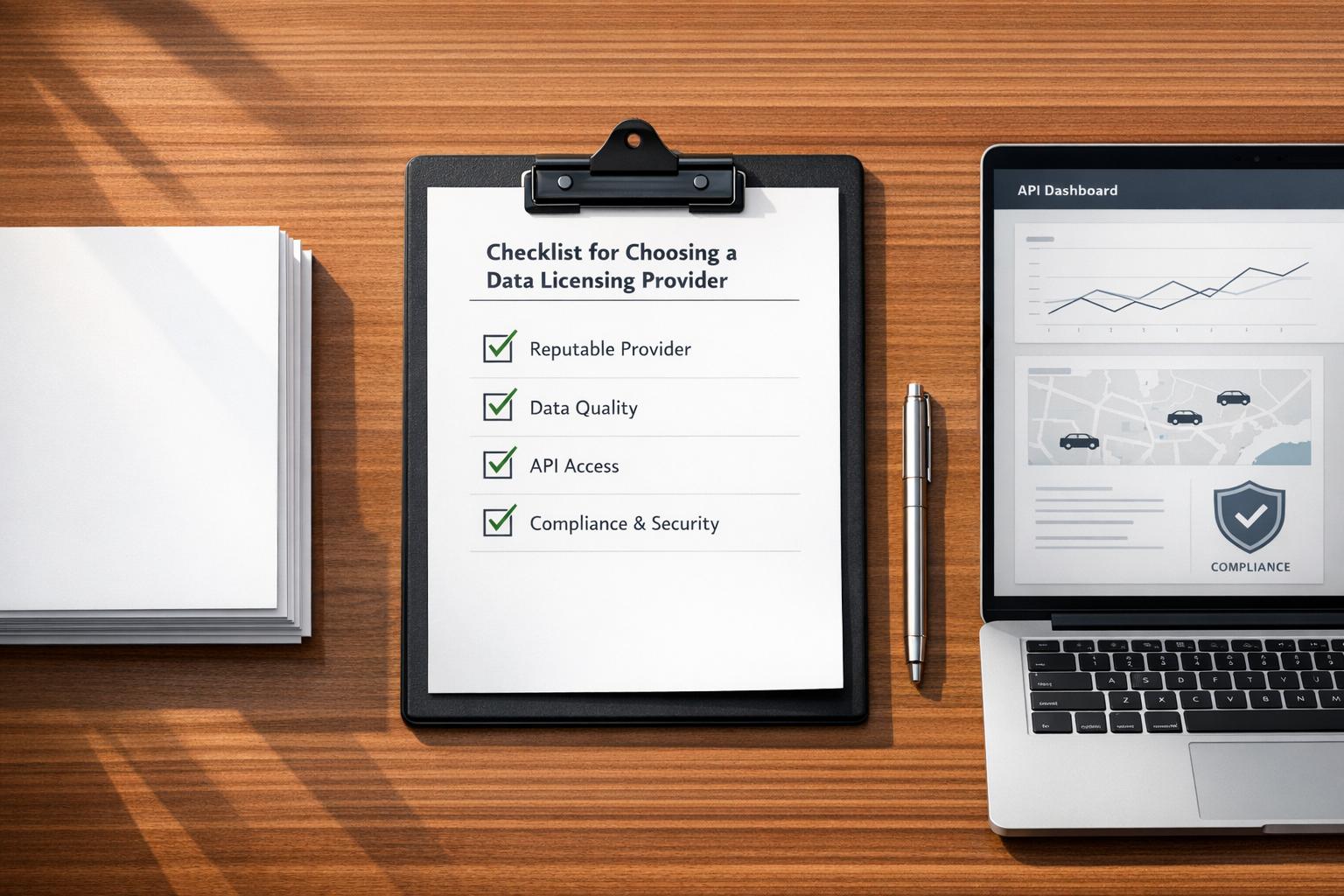
Checklist for Choosing a Data Licensing Provider
Accurate vehicle data is essential for businesses in the automotive industry, from dealerships to insurers. Selecting the right vehicle data platform ensures you avoid costly errors, maintain trust, and improve operations. Here's what to focus on:
- Define Your Data Needs: Identify the specific vehicle data types required (e.g., VIN specs, market value, recalls) and ensure the provider supports scalability and easy integration. Electric vehicle (EV) data is increasingly important.
- Ensure Data Accuracy and Coverage: Verify the provider's data validation methods, geographic coverage, and system reliability. Look for certifications like SOC 2 Type II and uptime SLAs of at least 99.9%.
- Check Compliance and Ethics: Confirm adherence to industry standards like ISO 27001 and ensure transparent sourcing and consent practices to avoid legal risks.
- Evaluate API Features: Prioritize RESTful APIs with clear documentation, low latency (under 200ms), and developer-friendly tools like SDKs and dashboards.
- Compare Pricing Models: Opt for transparent pricing that aligns with your usage, such as per-call or hybrid models, and test services with free trials before committing.
Key takeaway: The right provider delivers accurate, reliable, and scalable data while ensuring compliance and fair pricing. This choice impacts your business efficiency and customer experience.
How to Choose a Data Licensing Provider: 5-Step Checklist
1. Define Your Data Needs and Business Goals
To make smart decisions and avoid unnecessary costs, it’s crucial to clearly define what data you need and how it aligns with your business goals. Understanding your specific requirements and how they might scale over time ensures you’re prepared for every step of the process.
Identify the Vehicle Data Types You Need
Every automotive business has unique data priorities. For instance, what a dealership values will differ greatly from what an insurance company or repair shop needs. The table below outlines common vehicle data types and their typical applications:
Data Type Key Attributes Primary Use Case VIN Specs Engine, trim, drivetrain, MSRP, dimensions Inventory management, listings Market Value Trade-in, retail, and private party estimates Appraisals, lending, trade-ins Vehicle History Accidents, title brands, thefts, liens Risk assessment, buyer transparency Plate Decoder VIN, make, model from plate number Parking, tolling, quick onboarding Recalls Open safety recalls, repair status Warranty services, auto repair OBD Decoder Diagnostic trouble code meanings Service centers, remote diagnostics
Precision at the VIN level is non-negotiable. Even small details - like factory-installed options - can significantly impact a vehicle’s value. Providers that only offer generalized data or averages could lead to inaccurate appraisals and poor decision-making.
"The Recall API is a game changer for our warranty platform. Real-time recall data integrated directly into our workflow - our customers love the transparency." - Samee Khan, Founder & CEO, PAM
As electric vehicles (EVs) gain traction across the U.S., data specific to EVs - such as battery health, charging compatibility, and depreciation trends - has become increasingly important.
Once you’ve identified your data needs, turn your attention to scalability and integration to ensure your chosen provider can grow with your business.
Check Scalability and Integration Requirements
Scalability is key. Your provider should handle everything from a few hundred API calls to millions without performance issues.
Integration should also be straightforward. A single API key that grants access to multiple endpoints can simplify development and reduce complexity. Look for providers that support widely used formats like JSON, CSV, and XML, as these are easier to integrate into most systems. The less custom work required, the faster you can deploy.
"The API is super easy to integrate and the data quality is consistently excellent. We've reduced our vehicle onboarding time by 70% since switching to CarsXE." - Senior Director of Software, Major Parking App
Also, pay attention to contract terms. Providers that lock you into rigid agreements can limit your flexibility as your business evolves. Opt for transparent pricing models, such as pay-per-call options or free tiers, so you can test the service before committing to a larger scale.
sbb-itb-9525efd
2. Check Data Accuracy, Coverage, and Reliability
Once you've outlined your data needs, it's time to ensure your provider meets the standards for precision, coverage, and reliability. These factors are critical because they directly impact how effectively your product or service functions on a daily basis.
Verify Data Accuracy and Validation Methods
Ask providers how they maintain the quality of their data. The best providers often back their updates with independent audits. For instance, a SOC 2 Type II certification indicates that a third party has reviewed the provider's data handling and security practices. This certification can be a strong indicator of trustworthiness.
Depth is also key. Providers who offer detailed manufacturer data - like engine displacement, plant location, or restraint system specifications - are generally more reliable than those who provide only general averages. This level of detail is especially important for tasks like appraisals, underwriting, and warranty decisions.
"CarsXE offers MotorTango's customers accurate and reliable vehicle data across many makes and models. Their VIN decoder and specs API are second to none." - Andy Liakos, CTO, MotorTango
Confirm Geographic Coverage
"Global coverage" might sound great, but the specifics matter. Some providers might support international VIN decoding but lack robust license plate lookup capabilities outside the U.S. Always verify whether the specific endpoints you need are operational in the regions where you do business.
For example, CarsXE provides data from over 50 countries and maintains a database of more than 275 million vehicle records. This can serve as a strong benchmark to assess whether a provider can handle your geographic needs. During a trial, test the local data accuracy in the specific markets you serve, not just the high-level regions mentioned in marketing materials.
Beyond simply covering regions, consistent uptime is essential for smooth operations.
Review System Uptime and Data Availability
Uptime shows whether a system is operational, but reliability ensures users can actually accomplish tasks. Evaluating both is crucial to understanding a provider's performance.
"Uptime tells you whether your system is running. Reliability tells you whether users can actually get things done." - Daniel R. Foster, Founder, OptyxStack
A 99.9% uptime SLA - commonly referred to as "three nines" - allows for about 43.8 minutes of downtime per month. This is an acceptable standard for most automotive applications. CarsXE adheres to this benchmark and pairs it with an average API response time of roughly 120ms, making it fast enough for real-time processes like instant VIN decoding or live license plate lookups.
Uptime Level Downtime per Month Downtime per Year 99% 7.3 hours 3.65 days 99.9% ("Three Nines") 43.8 minutes 8.76 hours 99.99% ("Four Nines") 4.38 minutes 52.56 minutes
When reviewing an SLA, be sure to clarify what the provider includes as "downtime." Some may exclude planned maintenance or periods of slow response from their calculations. This distinction can make a big difference when assessing reliability.
3. Check Compliance and Data Ethics
Ensuring compliance and ethical data practices isn't just about ticking boxes - it’s about protecting your business from hefty penalties and maintaining trust. Non-compliance can lead to serious consequences, like FTC fines of up to $46,517 per violation or TCPA settlements that have totaled more than $500 million over five years. To steer clear of such risks, make sure your data provider adheres to strict industry standards and ethical guidelines.
Confirm Compliance with Industry Standards
Certifications such as SOC 2 Type II and ISO 27001 demonstrate that a provider’s security practices have been rigorously audited. For instance, in March 2026, CarsXE released its SOC 2 Type II Report, verified by GreenHat Assurance, confirming the effectiveness of its controls for security, availability, and confidentiality.
"SOC 2 Type II certification means an independent auditor has verified that CarsXE maintains effective security controls over an extended period. This provides assurance that your data is handled with the highest standards." - CarsXE Trust Center
Additionally, confirm that the provider has a Written Information Security Plan (WISP) and a dedicated security officer, as required by the FTC. A Data Processing Agreement (DPA) is also essential - it should outline permitted data uses, sub-processor management, and breach notification protocols. For data security, look for AES-256 encryption for stored data and TLS 1.3 for data in transit.
Review Data Sourcing and Consent Practices
A trustworthy provider should be able to trace every dataset back to verified sources, like government records, insurer feeds, or validated trade data. If the provider relies on unverified web scraping or cannot name its sources, that’s a major warning sign.
"If you can't trace where your data comes from, how can you defend the decisions it supports?" - Chris Wright, Vice President, Solera Northern Europe
For lead generation, compliance with the FCC’s one-to-one consent rule is now mandatory. This means consumers must explicitly agree to be contacted by your specific organization. Always ask for documentation that includes the exact consent language shown to consumers and the timestamp of their agreement. Clear records of data sourcing and consent practices are non-negotiable for building a reliable data partnership.
4. Review API Features and Developer Tools
After verifying a provider’s compliance and ethical handling of data, the next crucial step is to evaluate the quality of their developer tools. Even the best data product can become a hassle if the developer tools are clunky or poorly designed. This step ensures the provider’s technical offerings align with your team’s workflow and capabilities.
Look for Developer-Friendly Features
Seamless integration is essential, and robust developer tools can make the entire process far smoother.
At a minimum, any modern data licensing provider should offer a RESTful API. According to Gartner, RESTful APIs are favored because they deliver 30–50% lower latency compared to older protocols like SOAP.
The quality of documentation is equally important. Clear, detailed, and interactive documentation can make all the difference, enabling developers to execute API calls within minutes. Look for features like:
- Step-by-step setup guides
- Real-world examples with JSON payloads
- Detailed explanations of error codes
- Information on rate limits
Providers that offer a full suite of endpoints through a single API key, SDKs for major programming languages, and a developer dashboard with tools like real-time usage monitoring, API key management, bulk exports, and sandbox environments are ideal. These tools can significantly reduce integration time. In fact, a 2025 RapidAPI developer survey found that providers with such features can cut API integration time from four weeks to just one.
"The API is super easy to integrate and the data quality is consistently excellent. We've reduced our vehicle onboarding time by 70% since switching to CarsXE." - Senior Director of Software, Major Parking App
These features not only simplify integration but also ensure the API can handle demanding workflows without hiccups.
Check API Speed and Latency
API speed plays a critical role in user experience and, ultimately, in conversion rates. Research shows that even a 100ms delay can reduce conversion rates by 10%. For real-time use cases - like instant VIN lookups during a drive-thru appraisal or live recall checks in telematics systems - there’s no room for delays. A good benchmark to aim for is an average response time under 200ms for standard queries.
Before committing to a provider, conduct your own latency tests using tools like Postman or Apache JMeter. Test at least 100 concurrent requests on key endpoints, such as VIN decoding, market value retrieval, or license plate lookups, and carefully document the results. CarsXE, for example, averages a response time of 120ms with a 99.9% uptime SLA, ensuring reliability for mission-critical operations.
Make sure the provider guarantees at least 99.9% uptime in their SLA. This level of reliability reduces operational risks and ensures your workflows stay efficient and uninterrupted.
5. Compare Pricing Models and Overall Value
When choosing a data licensing provider, balancing technical reliability with cost efficiency is key. It's important to select a pricing structure that aligns with your business needs. Be cautious of APIs with hidden fees or pricing models that could strain your budget.
Look for Pricing Transparency
The way a service charges can be just as important as the price itself. Different pricing models suit different needs:
- Per-call pricing: Costs are tied directly to usage, making it ideal for fluctuating or unpredictable demand.
- Flat-fee models: Offer predictable budgeting but may result in paying for unused capacity.
- Hybrid models: Combine a base subscription with tiered per-call fees, offering a middle ground.
Whatever the model, transparency is critical. Be sure to identify any hidden costs such as setup fees, premium support charges, or penalties for exceeding usage limits. For instance, CarsXE provides a clear structure: a $99/month base fee, tiered per-call pricing, and a 7-day free trial to test the service before committing.
Once you've established clear pricing, the next step is to evaluate whether the costs match the quality and breadth of the data provided.
Assess Cost Against What You Get
Price alone doesn't paint the full picture. A lower-cost provider delivering incomplete or inaccurate data can lead to expensive errors, rework, and damage to customer trust. It's crucial to weigh the overall value against the cost.
Here’s a breakdown of CarsXE’s per-call pricing for key endpoints:
API Product 0–1,000 Calls 1,001–10,000 Calls 10,000+ Calls Specifications / Images $0.20/call $0.15/call $0.10/call International VIN Decoder $0.35/call $0.30/call $0.20/call Market Value $2.00/call $1.50/call $1.00/call Vehicle History Report $5.99/call $4.99/call $3.99/call Vehicle Recalls $0.30/call $0.25/call $0.20/call
As your usage grows, the per-call rate decreases, rewarding higher volumes. For large-scale needs, negotiating multi-year contracts can lead to discounts ranging from 15% to 30%.
A smart approach is to start small. Take advantage of the free trial to ensure the data quality meets your standards and that the integration process works smoothly before committing to larger volumes. This ensures you're making an informed decision that aligns with both your budget and operational needs.
Conclusion: How to Make the Right Choice
Selecting a data licensing provider is more than just a technical decision - it's a strategic one. The provider you choose will directly impact your efficiency, the customer experience you deliver, and your overall business performance. As WebDataGuru aptly states:
"You're not buying a scraping tool - you're choosing a partner who understands automotive data complexity."
This highlights the importance of finding a partner who can navigate the challenges of automotive data with expertise.
To make the best choice, start with a clear plan. Define your data requirements, assess the provider's accuracy and coverage, ensure compliance, review the developer tools available, and weigh pricing against the value offered. By following these steps, you can eliminate providers that don’t meet your standards.
Look for providers with a strong background in automotive data. Their expertise ensures you’ll get accurate, comprehensive information tailored to your needs.
The right provider should also grow with your business. Whether you’re handling a few hundred API calls a month or scaling to tens of thousands, they should maintain accuracy and uptime seamlessly. CarsXE is a great example of this kind of scalability, offering tiered pricing, extensive geographic reach, and a wide range of vehicle data endpoints.
Before committing, take advantage of a free trial. This lets you test data quality, integration ease, and how responsive their support team is. A thoughtful, informed decision now can save you time, money, and unnecessary stress down the road.
FAQs
What should I test during a data provider free trial?
When trying out a data provider's free trial, it's essential to assess the API's performance in delivering precise, real-time vehicle data. Focus on testing critical features like VIN decoding, license plate lookup, and vehicle specifications to ensure they work accurately and respond quickly. Check how well the API integrates with your existing systems, whether it supports data from various countries, and if it consistently delivers reliable response times. This process ensures the provider aligns with your business requirements for data accuracy, performance, and seamless integration.
Which security and compliance documents should I ask for?
When evaluating a provider, it's essential to request key documents to ensure they meet legal standards and protect sensitive automotive data. Here's what to ask for:
- Data Privacy and Security Policies: These outline how the provider safeguards data, including protection measures and protocols.
- Compliance Certifications: Documents like GDPR or CCPA certifications confirm adherence to data protection regulations.
- Legal and Licensing Agreements: These agreements clarify how data is used, stored, and kept confidential.
- Audit Procedures: Details about security checks, breach handling, and ongoing monitoring should be included.
These documents provide transparency and confidence in the provider's ability to handle sensitive information responsibly.
How do I estimate my API call volume to pick the right pricing plan?
To figure out your API call volume, start by examining how often your application will likely use the API. Look at features like vehicle data or history reports to estimate the average number of requests per day or month. Once you have that number, check out CarsXE's pricing tiers. These tiers lower the cost per call as your usage increases. Multiply your estimated call volume by the per-call rate to get a sense of your expenses and choose a plan that aligns with both your needs and budget.
Related Blog Posts
- VIN Decoder API: 7 Key Features to Look For
- Top APIs for EU VIN Decoding
- How Real-Time VIN Decoding APIs Work
- Top APIs for Automated VIN Data Validation