Electric Vehicle Tax Incentives in Thailand: 2026 Update

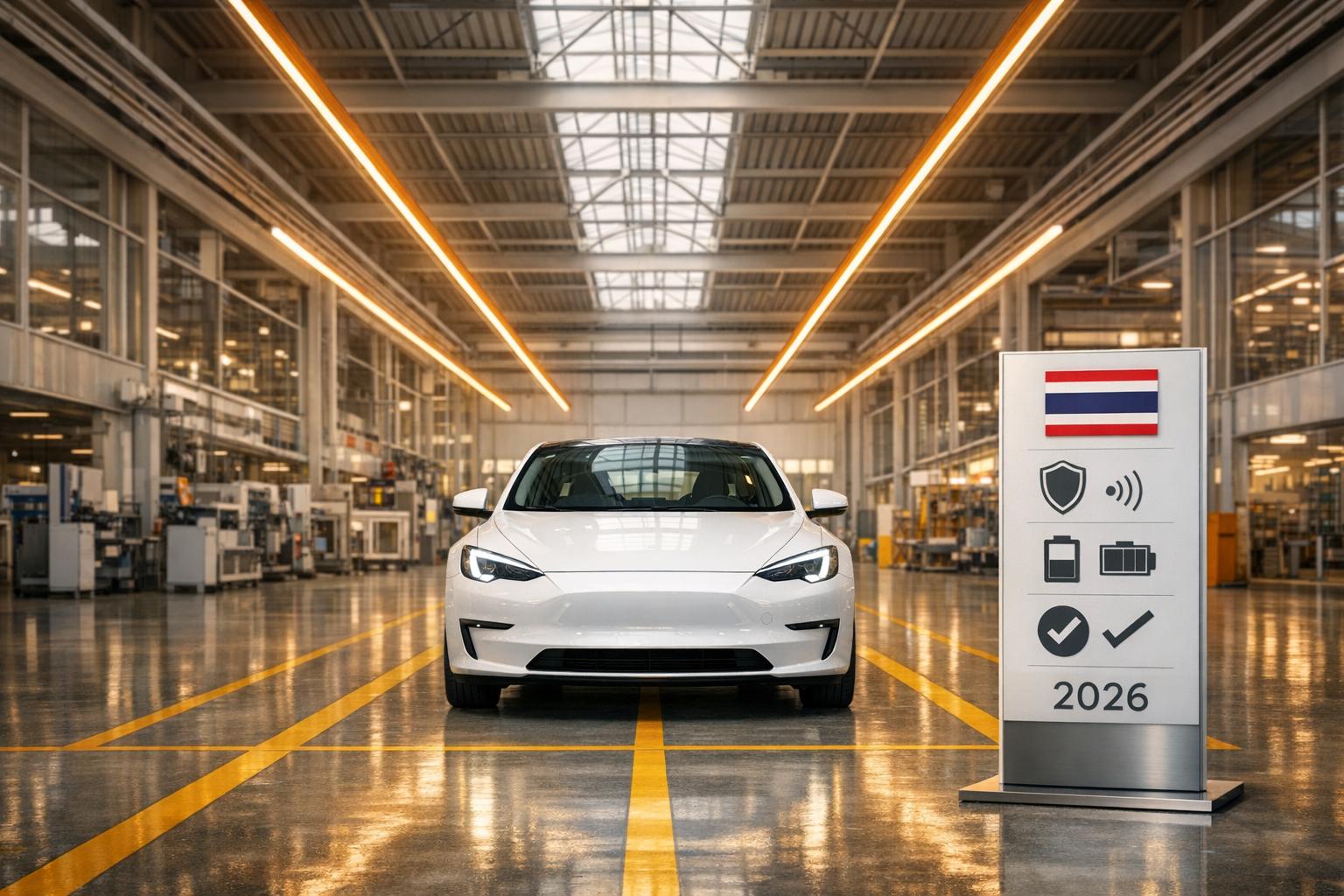
Electric Vehicle Tax Incentives in Thailand: 2026 Update
Thailand’s 2026 EV tax incentives aim to boost electric vehicle adoption while supporting local manufacturing. Key changes include:
- Lower taxes for BEVs: Excise tax reduced to 2% for qualifying BEVs; non-compliant imports taxed at 10%.
- Scaled-back subsidies: Up to 50,000 THB ($1,370) for BEVs with batteries ≥50 kWh; smaller subsidies for lower-capacity models.
- Road tax discounts: 80% off annual road tax for EVs registered within three years.
- Local production focus: Manufacturers must meet a 2:1 local production-to-import ratio by 2026 to access import duty exemptions and subsidies.
- PHEV and hybrid rules: Tax rates depend on electric range or CO₂ emissions, with stricter requirements for ADAS safety systems and local content.
These policies reflect Thailand’s commitment to becoming a key player in the global EV market while encouraging safer, more efficient, and locally-produced vehicles. Buyers benefit from reduced costs, but manufacturers face tighter production and compliance standards.
Thailand 2026 EV Tax Incentives: BEV, PHEV, HEV & MHEV at a Glance
Tax Incentives for Battery Electric Vehicles (BEVs) in 2026
Excise Tax Reductions for BEVs
Thailand’s 2026 EV policy roadmap introduces tax measures aimed at reducing costs for eligible BEVs. Vehicles that meet specific technical criteria - such as incorporating at least 3 out of 6 ADAS features, using Thai-made batteries, and including local parts - qualify for a reduced excise tax rate of 2%. Those that don't meet these standards face a 10% excise tax [6][10]. Meanwhile, electric motorcycles priced under 150,000 THB (around $4,110) will continue to benefit from a 1% excise tax rate through 2027 [10].
These tax policies are designed to complement purchase subsidies, making BEVs more accessible.
Purchase Subsidies for BEVs
Subsidies in 2026 offer additional financial incentives for buyers, with the amounts varying based on the vehicle type, price, and battery capacity [3][10].
Vehicle Category Price Cap Battery Capacity 2026 Subsidy (THB) Approx. USD Passenger Car ≤ 2M THB ≥ 50 kWh 50,000 ~$1,370 Passenger Car ≤ 2M THB 10 – < 50 kWh 25,000 ~$685 Pickup Truck ≤ 2M THB ≥ 50 kWh 100,000* ~$2,740 Motorcycle ≤ 150k THB ≥ 3 kWh 10,000* ~$275
*Only applicable to models manufactured domestically.
To qualify, vehicles must be priced below 2M THB and meet the required battery capacity. Additionally, manufacturers are obligated to maintain an import-to-production ratio of 1:2 by the end of 2026, meaning two BEVs must be produced locally for every one imported. If domestic production falls short - producing less than 15% of a company’s declared plan - subsidy payments could be withheld [1][4].
These production requirements also play a role in securing import duty exemptions.
Import Duty Exemptions
In 2026, manufacturers must adhere to a 2:1 local production-to-import ratio to benefit from import duty exemptions on completely built-up (CBU) units. If production is delayed until 2027, the ratio increases to 1:3 [10][4][8]. Import duty reductions also extend to EV parts and components, helping to lower costs as local manufacturing scales up. Furthermore, exported EVs count as 1.5 units toward a manufacturer’s domestic production quota, encouraging Thailand’s development as an EV export hub [9][11].
sbb-itb-9525efd
Plug-In Hybrid EV (PHEV) Tax Rules and Incentives for 2026
Range-Based Excise Tax Structure
Starting January 1, 2026, Thailand introduced a revised excise tax structure for PHEVs, focusing entirely on their electric-only range.
"The key objective is to create a clearer distinction in tax treatment between PHEVs and standard hybrid electric vehicles (HEVs)." - Dr. Paopoom Rojanasakul, Deputy Finance Minister [12]
Under the new system, PHEVs capable of traveling 80 km or more on electric power qualify for a 5% excise tax rate. Those with a range below 80 km face a 10% tax rate [12]. For non-compliant PHEVs, the rates increase to 15% between 2026 and 2029, and 20% starting in 2030 [6]. Additionally, PHEVs with engines exceeding 3,000 cc are taxed at a flat rate of 30%, eliminating the previous requirement for a 45-liter fuel tank cap, which had forced manufacturers to create customized tanks for the Thai market [6].
To benefit from the reduced tax rates, PHEVs must also integrate at least two of six specified Advanced Driver Assistance Systems (ADAS). These systems include features like Advanced Emergency Braking (AEB), Lane Keep Assist (LKAS), Blind Spot Detection (BSD), and Adaptive Cruise Control (ACC) [6].
PHEV Category Electric Range 2026 Excise Tax Rate High-Range PHEV ≥ 80 km per charge 5% Standard PHEV < 80 km per charge 10% Non-Compliant PHEV N/A 15% (2026–2029) / 20% (2030+) Large Engine PHEV > 3,000 cc 30%
Battery and Local Manufacturing Requirements
The revised excise tax framework also imposes strict battery and local production requirements for PHEVs. To access the most favorable tax rates, a PHEV must achieve a 100 km electric range, use batteries with a minimum energy density of 150 Wh/kg, and ensure 1,000 charge cycles [9]. Additionally, imported battery components cannot exceed 10% of the vehicle's total price, encouraging local battery assembly [7].
Manufacturers are also required to invest at least $84 million (approximately 3 billion THB) in hybrid vehicle production between 2024 and 2027. They must meet local content thresholds ranging from 17% to 45% [9]. These measures align with Thailand's "30@30" initiative, which aims to significantly boost domestic electric vehicle production by 2030 [13]. The strategy appears to be yielding results, with PHEV production in Thailand increasing by 130% year-on-year as of May 2025 [13].
Hybrid and Mild-Hybrid Incentives in 2026
Excise Tax Rates for HEVs and MHEVs
For 2026, Thailand's tax system for hybrid electric vehicles (HEVs) and mild-hybrid electric vehicles (MHEVs) will focus on CO₂ emissions rather than engine displacement. This marks a significant shift in the country's approach to vehicle taxation [6].
HEVs will be taxed on a sliding scale, starting at 6% for vehicles emitting less than 100 g/km of CO₂ and rising to 26% for those exceeding 200 g/km. Intermediate rates include 9% for emissions between 101–120 g/km, 14% for 121–150 g/km, and 19% for 151–200 g/km. However, HEVs with engines larger than 3,000 cc will face a flat 40% tax, regardless of their emissions [6].
MHEVs, which enhance engine performance but lack standalone electric propulsion, have a simpler structure. If emissions are below 100 g/km, the excise tax is 10%, while those emitting between 101–120 g/km are taxed at 12%. Non-compliant MHEVs, however, face higher rates ranging from 13% to 22%, aligning them more closely with traditional internal combustion engine (ICE) vehicles [6].
Vehicle Type CO₂ Emissions (g/km) 2026–2027 Excise Tax Rate HEV ≤ 100 6% HEV 101–120 9% HEV 121–150 14% HEV 151–200 19% HEV > 200 26% MHEV (Compliant) < 100 10% MHEV (Compliant) 101–120 12% MHEV (Non-Compliant) < 100 13% MHEV (Non-Compliant) 101–120 22%
Eligibility Conditions
Reduced tax rates come with additional requirements beyond emissions compliance. Thailand's Excise Department has introduced safety and manufacturing criteria to qualify for these incentives.
"The 2026 excise tax structure for automobiles will be revised for vehicles not equipped with driving safety systems, aiming to encourage manufacturers to install safer driver-assistance systems." - Pornchai Thiraveja, Director-General of the Excise Department [14]
To qualify for standard reduced rates, HEVs must include at least 2 out of 6 Advanced Driver-Assistance Systems (ADAS). For those seeking the fixed 6% rate under a Board of Investment (BOI) project, the bar is higher - 4 out of 6 ADAS systems are required, along with a 3 billion baht (~$84 million) investment [6].
MHEVs face even stricter conditions. They must have 4 out of 6 ADAS systems from the start, with an initial investment of 1 billion baht by 2026 and a total of 5 billion baht by 2028 [6][15].
The six recognized ADAS systems include:
- Advanced Emergency Braking (AEB)
- Forward Collision Warning (FCW)
- Lane Keep Assist (LKAS)
- Lane Departure Warning (LDW)
- Blind Spot Detection (BSD)
- Adaptive Cruise Control (ACC) [6]
On the manufacturing side, both HEV and MHEV producers are required to meet local content standards. This includes using domestically assembled battery packs and sourcing at least 4 out of 5 key engine components - cylinder head, cylinder block, crankshaft, camshaft, and connecting rod - from local suppliers [6].
"ADAS is considered an important first step in the transition to autonomous vehicles." - Pornchai Thiraveja, Director-General of the Excise Department [14]
These measures highlight Thailand's push for safer, more locally manufactured vehicles while supporting the growth of advanced automotive technologies.
Integrating Thailand's 2026 EV Tax Rules into Vehicle Data Systems
Key Data Fields for Tax Calculations
Thailand's 2026 EV tax updates require a robust integration into vehicle data systems to ensure compliance and streamline tax computation. Unlike traditional systems that rely on basic parameters like engine size, this framework demands a more sophisticated approach. Developers need to create a logic engine capable of analyzing multiple vehicle attributes simultaneously to accurately determine tax tiers. Here's a breakdown of the essential data fields:
Vehicle Attribute Key Parameter Why It Matters Technology Type BEV, PHEV, HEV, MHEV, or ICE Each technology type follows a unique tax trajectory. CO₂ Emissions Exact g/km output A critical factor influencing excise rates for HEV, MHEV, and ICE vehicles. Battery Capacity kWh (thresholds at 10 kWh and 50 kWh) Defines subsidy eligibility for BEVs. Electric Range km (key threshold: 80 km) Determines excise rates for PHEVs, ranging between 5% and 10%. ADAS Count Number of active systems (out of 6) Impacts reduced tax rates for HEVs, MHEVs, and BEVs. Retail Price THB value (bands at 2M and 7M THB) Governs subsidy eligibility under the EV3.5 policy. Battery Origin Thai-made vs. imported Influences excise rate eligibility for BEVs.
Additionally, compliance flags play a vital role. These include whether a vehicle is part of a BOI project and if it meets local content requirements. These flags are essential to determine whether a BEV qualifies for the preferential 2% excise rate or defaults to the standard 10% rate [6][7].
For specifics on ADAS (Advanced Driver Assistance Systems) criteria, refer to earlier sections. These data points are indispensable for automating tax calculations under Thailand's updated framework.
Using CarsXE APIs for Automation
Given the complexity of Thailand's tax rules, relying on manual data collection is inefficient. This is where APIs like those from CarsXE can make a significant difference. CarsXE offers tools such as the VIN Decoder and Vehicle Specifications API, which can automatically retrieve the necessary technical data for compliance with Thailand's Excise Department.
- VIN Decoder: Identifies a vehicle's basic classification, including type, fuel system, and engine specs.
- Specifications API: Provides detailed data such as CO₂ emissions, battery capacity, and electric range - key factors for determining tax tiers.
- Equipment List API: Verifies the presence of ADAS systems, removing the need for manual checks.
By mapping CarsXE's CO₂ Emissions and Electric Range fields directly to Thailand's 2026 tax tables, developers can enable automated, real-time excise calculations [6].
For price-sensitive logic, the Market Value API monitors retail prices against the critical 2M THB and 7M THB thresholds. These thresholds are pivotal under the EV3.5 policy, as they influence subsidy amounts and import duty eligibility [10][16]. With data coverage spanning over 50 countries, CarsXE offers flexible plans starting at $49/month. Higher-tier plans provide daily or real-time updates, which are crucial for maintaining accuracy in environments where tax compliance is non-negotiable.
Precision in data handling isn't just a technical necessity - it’s the backbone of compliant EV pricing, registration, and fleet management systems in Thailand's evolving market.
Conclusion
Thailand's 2026 EV tax framework stands out as one of the most forward-thinking in Southeast Asia. The move from a straightforward engine-size tax to a more intricate system - factoring in CO₂ emissions, electric range, battery sourcing, and ADAS compliance - signals a determined push toward electrification.
For buyers, the benefits are clear. Eligible BEVs enjoy a reduced excise tax rate of just 2%, purchase subsidies of up to 50,000 THB for vehicles with batteries of 50 kWh or more [3], and an 80% cut in annual road tax [2]. On top of that, EVs are far cheaper to operate, costing just 0.58 baht per kilometer compared to 3.42 baht for petrol SUVs [5].
However, the framework isn't just about consumer perks - it places significant demands on manufacturers. Earning the lowest tax tiers means meeting stringent requirements, like using locally assembled batteries, integrating at least four out of six ADAS systems, and adhering to production-to-import ratios that tighten from 1:2 in 2026 to 1:3 by 2027 [3][7]. As Deputy Finance Minister Paopoom Rojanasakul emphasized:
"The worst outcome would be if Thais become major consumers of EVs, but we are not producers. This situation must not happen." [5]
FAQs
How do I know if a BEV qualifies for the 2% excise tax?
To benefit from the lower 2% excise tax rate, a battery electric vehicle (BEV) must follow specific rules set by the Excise Department. These include:
- Incorporating at least four out of six Advanced Driver-Assistance Systems (ADAS).
- Using key vehicle components manufactured in Thailand.
Failing to meet these standards results in a higher excise tax rate of 10%.
For developers, tools like CarsXE’s vehicle data API can help monitor and ensure compliance with these requirements.
Do BEV subsidies depend on battery size, price, or where the car is built?
In Thailand, subsidies for Battery Electric Vehicles (BEVs) under the EV 3.5 package are closely tied to where the vehicle is manufactured and its price point. These subsidies are available only for domestically assembled vehicles priced at 7 million Thai baht or less. While meeting battery compliance standards and incorporating Thai-made batteries can unlock specific tax incentives, the primary criteria for subsidies remain local production and adherence to the price cap.
What vehicle data is needed to calculate Thailand’s 2026 EV taxes automatically?
To figure out Thailand's 2026 EV taxes, you'll need specific details about the vehicle. These include the type of EV (like BEV, PHEV, HEV, or MHEV), battery capacity (in kWh), and the electric-only range (in kilometers). Other important factors are CO2 emissions (measured in g/km), compliance with safety standards (such as UN R94, R95, and R13h), the presence of ADAS features, the percentage of locally sourced parts, and the battery's energy density.
The CarsXE API simplifies this process by providing real-time access to all this essential data, making automated tax calculations much easier.
Related Blog Posts
- Cultural Trends in Cross-Border EV Adoption
- EV vs. Hybrid: Regional Adoption Trends
- Global Luxury Car Sales Trends by Trade Zones
- How Incentives Affect EV Prices Globally